Map of Germany showing where the Antonowicz arms are recorded
The Antonowicz arms were recorded in Hesse, c. 1743.
Hesse was central German country, divided among a large number of small landowners and prosperous towns. So many separate households held ground there that the region produced an unusual number of coats of arms.
This is where the arms were entered in the register. Families often moved to other parts of the country, so the same name can turn up in more than one region.
The body that granted and recorded arms in Germany in this period.
Charles VII, Holy Roman Emperor
Sovereign of the period
Charles VII, Holy Roman Emperor
1742–1745
Reigning in Germany when the Antonowicz arms are first recorded.
How Arms Worked in Germany
In the Holy Roman Empire, coats of arms were often granted to individuals by the Emperor or his representatives. These arms were then passed down through the generations to all legitimate descendants of the original holder. Younger branches of a family usually kept the same shield design without needing to change it, as the arms belonged to the entire lineage.
Granting authority
The Holy Roman Emperor held the sole power to grant new coats of arms throughout his vast imperial territories.
How they got arms
Families typically obtained their coats of arms through a formal imperial grant or by proving their noble status to the authorities.
Where arms were recorded
These grants were officially recorded in the Imperial Chancery registers, which began keeping formal records of such honors during the Middle Ages.
The family's standing
Recorded among the armigerous families of Hesse.
Origin & History of the Antonowicz Family in Germany
The history of the Antonowicz name in Germany begins with the movement of families across borders during the eighteenth century. By 1743, records confirm that members of the family were established in the region of Hesse. At this time, Hesse was a collection of territories known for its complex social structure and agricultural traditions. Families like the Antonowicz line often settled in these areas to work as skilled craftsmen or farmers during a period of significant regional growth. Because the name follows a Slavic naming pattern, it is likely that the family migrated from eastern territories into the German states to seek new opportunities or to escape political instability. Once in Hesse, they integrated into the local community by participating in parish life and contributing to the local economy. This transition highlights how families moved across Europe to build new lives, eventually becoming a permanent part of the German cultural landscape.
Meaning of the Antonowicz family crest colors & symbols
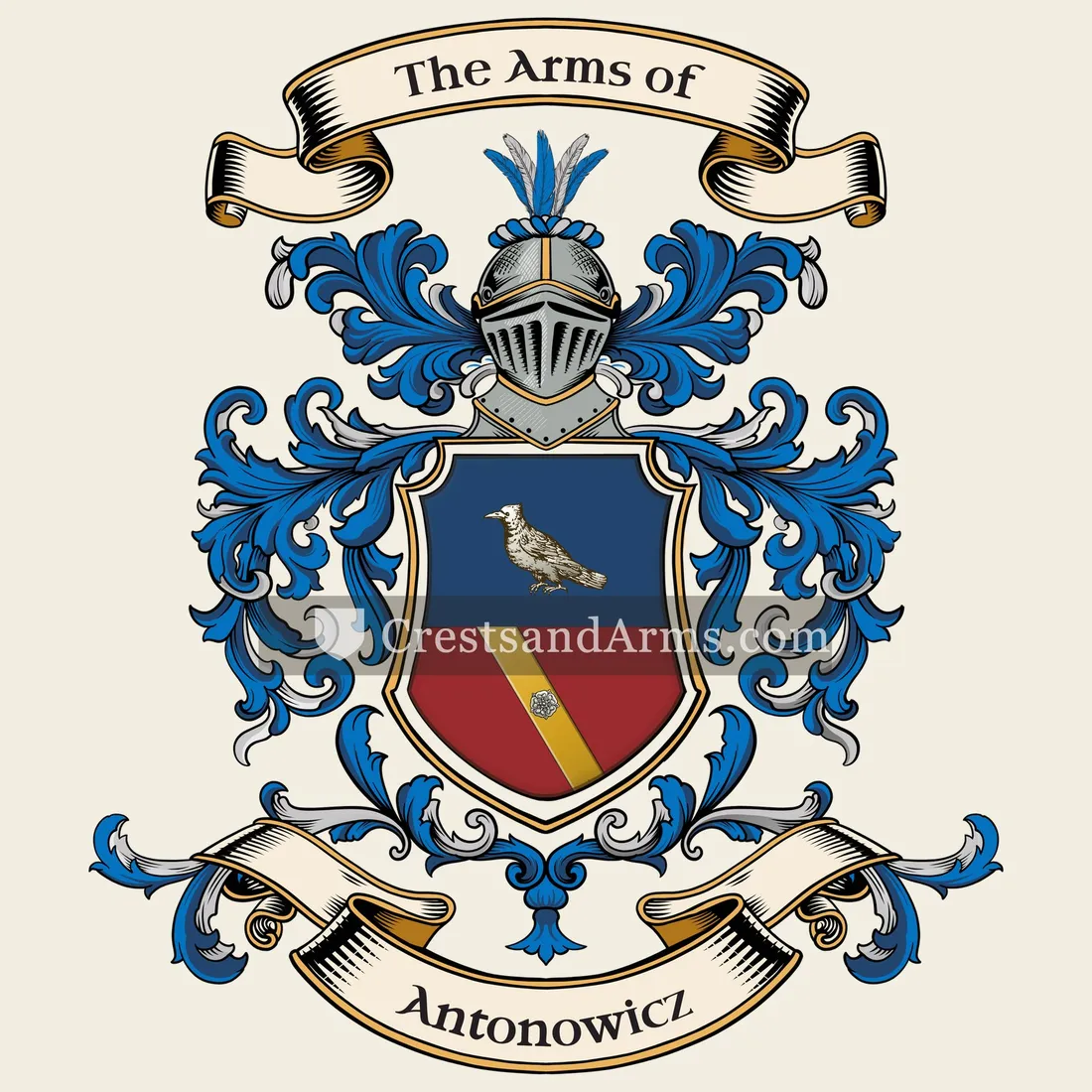
Symbols on this shield
bendDefence, and the scarf of a commander
dovePeace, love and the Holy Spirit
roseThe seventh son, and beauty with grace
Colours
Blue (Azure)Means: Loyalty and truth
Red (Gules)Means: Military strength
Gold (Or)Means: Generosity
Silver (Argent)Means: Peace and sincerity
Historical info
Source
J. B. Rietstap, Armorial Général, Gouda: G. B. van Goor Zonen, 1884–87
Blazon (the actual original written record)
“Coupé: au 1 d'azur à une colombe d'arg., le vol étendu; au 2 de gu. à la bande d'or, ch. d'une rose d'arg., bout. d'or, barbée de sin. Cq. cour. C.: la colombe, entre deux prob., celle à dextre d'arg. à deux barres d'azur, celle à sen. de gu. à deux bandes d'or. L.: à dextre d'or et de gu., à sen. d'arg. et d'azur.”
SwitzerlandBâle, c. 1745
Digital archive packCoat of arms PNG, gold border print PDF, vector SVG and the certificate of authenticity. Sent to your email in minutes.
Map of Switzerland showing where the Antonowicz arms are recorded
The Antonowicz arms were recorded in Bâle, c. 1745.
This is where the arms were entered in the register. Families often moved to other parts of the country, so the same name can turn up in more than one region.
The body that granted and recorded arms in Switzerland in this period.
How Arms Worked in Switzerland
In Switzerland, coats of arms were not restricted to the nobility and were often adopted by common citizens and families. These symbols were passed down through generations to show family identity. When branches of a family grew, they often changed small details of the design to distinguish their own line from the original group.
Granting authority
Cantonal and civic authorities managed the use of coats of arms within their specific regions and local jurisdictions.
How they got arms
Families typically assumed their own coats of arms based on local custom rather than receiving them from a central monarch.
Where arms were recorded
Arms were recorded in various cantonal and civic registers starting from the fourteenth century throughout the Swiss region.
The family's standing
Recorded among the armigerous families of Switzerland.
Origin & History of the Antonowicz Family in Switzerland
The family name Antonowicz carries a distinct history that traces back to Eastern Europe, but its presence in Switzerland offers a unique glimpse into the movement of families during the eighteenth century. By 1745, records confirm that members of the family were established in the city of Bâle. At that time, Bâle was a thriving center for trade and intellectual exchange, attracting merchants and skilled professionals from across the continent. The arrival of the Antonowicz family in this region suggests they were likely part of a network of travelers or tradespeople who moved along the Rhine River to seek new opportunities in the Swiss Confederation. Living in Bâle allowed the family to integrate into a society that valued craftsmanship and civic participation. While the name itself reflects a patronymic origin rooted in Slavic traditions, its early survival in the Swiss archives highlights how families adapted to new cultural environments while maintaining their distinct identity over generations.
Meaning of the Antonowicz family crest colors & symbols
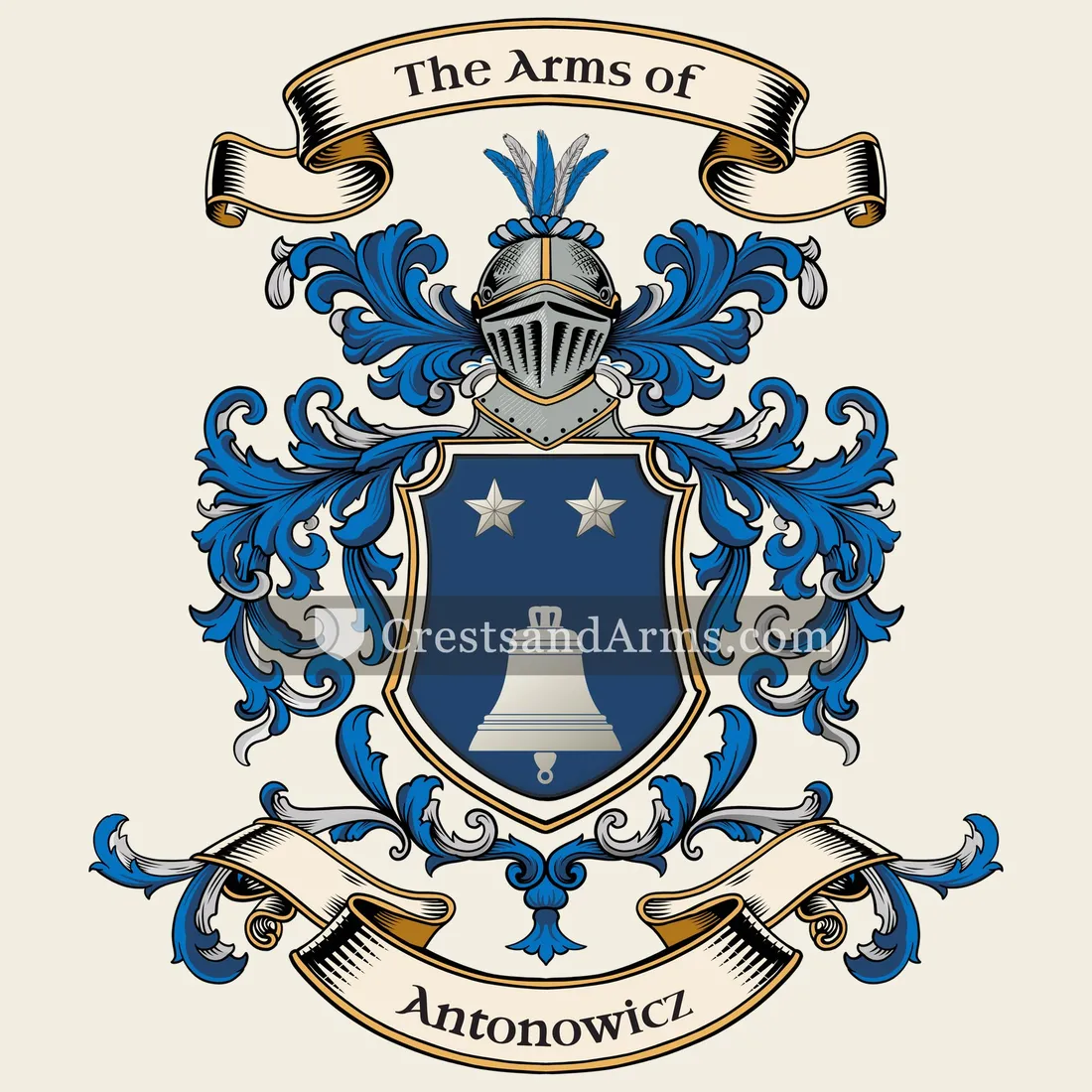
Symbols on this shield
bellA call to prayer, and a warning given
mulletThe third son, and a divine quality from above
Colours
Blue (Azure)Means: Loyalty and truth
Silver (Argent)Means: Peace and sincerity
Historical info
Source
J. B. Rietstap, Armorial Général, Gouda: G. B. van Goor Zonen, 1884–87
Blazon (the actual original written record)
“D'azur à la cloche d'arg., acc. en chef de deux étoiles du même. C.: un vol à l'antique, aux armes de l'écu.”
Austriac. 1772
Digital archive packCoat of arms PNG, gold border print PDF, vector SVG and the certificate of authenticity. Sent to your email in minutes.
Map of Austria showing where the Antonowicz arms are recorded
The Antonowicz arms were recorded in Austria, c. 1772.
Arms such as these were typically recorded in Tyrol.
Tyrol was mountain country in western Austria, where the valleys were held by families who had been there a very long time. Old tenure counted for more than money, and old families carried arms.
This is where the arms were entered in the register. Families often moved to other parts of the country, so the same name can turn up in more than one region.
Region
Tyrol
First recorded
1772
Granting Authority for the Antonowicz Arms
Imperial and Royal chancery
Sodacan · CC BY-SA 3.0
The body that granted and recorded arms in Austria in this period.
Joseph II, Holy Roman Emperor
Sovereign of the period
Joseph II, Holy Roman Emperor
1765–1790
Reigning in Germany when the Antonowicz arms are first recorded.
How Arms Worked in Austria
Austrian coats of arms were often linked directly to noble titles granted by the Emperor. These symbols belonged to the entire family line rather than just one individual. When a family grew, new branches kept the original design without needing to change it. This system allowed all members of a noble house to share the same identity across many generations.
Granting authority
The Imperial and Royal chancery managed all heraldic matters and controlled the official granting of arms throughout the Austrian lands.
How they got arms
Families typically received their arms through a formal imperial decree that often accompanied the elevation of a person to noble status.
Where arms were recorded
Official records of these grants were kept in the Imperial Register of Nobility which began its formal documentation process in 1453.
The family's standing
Recorded among the armigerous families of Austria.
Origin & History of the Antonowicz Family in Austria
The Antonowicz family name carries a history deeply rooted in the mountainous landscapes of the Tyrol region during the late eighteenth century. By 1772, records confirm that members of the family were already established residents in this part of the Austrian Empire. During this era, the Tyrol served as a vital crossroads for trade and cultural exchange between Central Europe and the Italian peninsula. Families living in these alpine valleys often worked as skilled laborers, merchants, or landholders who navigated the complex social structures of the Habsburg monarchy. The presence of the Antonowicz name in these official documents suggests that the family was integrated into the local administrative and economic life of the region long before the political shifts of the nineteenth century. Their early history reflects the broader movement of families who sought stability and opportunity within the diverse territories of the Austrian crown.
Antonowicz Meaning & Related Branches
Root word
Antonius
A Roman family name of uncertain, possibly Etruscan, origin.
This name
AntonowiczA patronymic surname meaning son of Anton, derived from the Latin Antonius.
also spelled
Antony
Antonee
Anthony
Documented Sources
J. B. Rietstap, Armorial Général, Gouda: G. B. van Goor Zonen, 1884–87
Hessisches Staatsarchiv Marburg, Kirchenbuch der evangelischen Kirchengemeinde, 1743
Knetsch, Carl, Die hessische Landesgeschichte, 1929
Müller, Friedrich, Die Einwanderung nach Hessen im 18. Jahrhundert, 1955
Digital archive packCoat of arms PNG, gold border print PDF, vector SVG and the certificate of authenticity. Sent to your email in minutes.


 mountThe ground held, and steadfastness upon it
 mountThe ground held, and steadfastness upon it
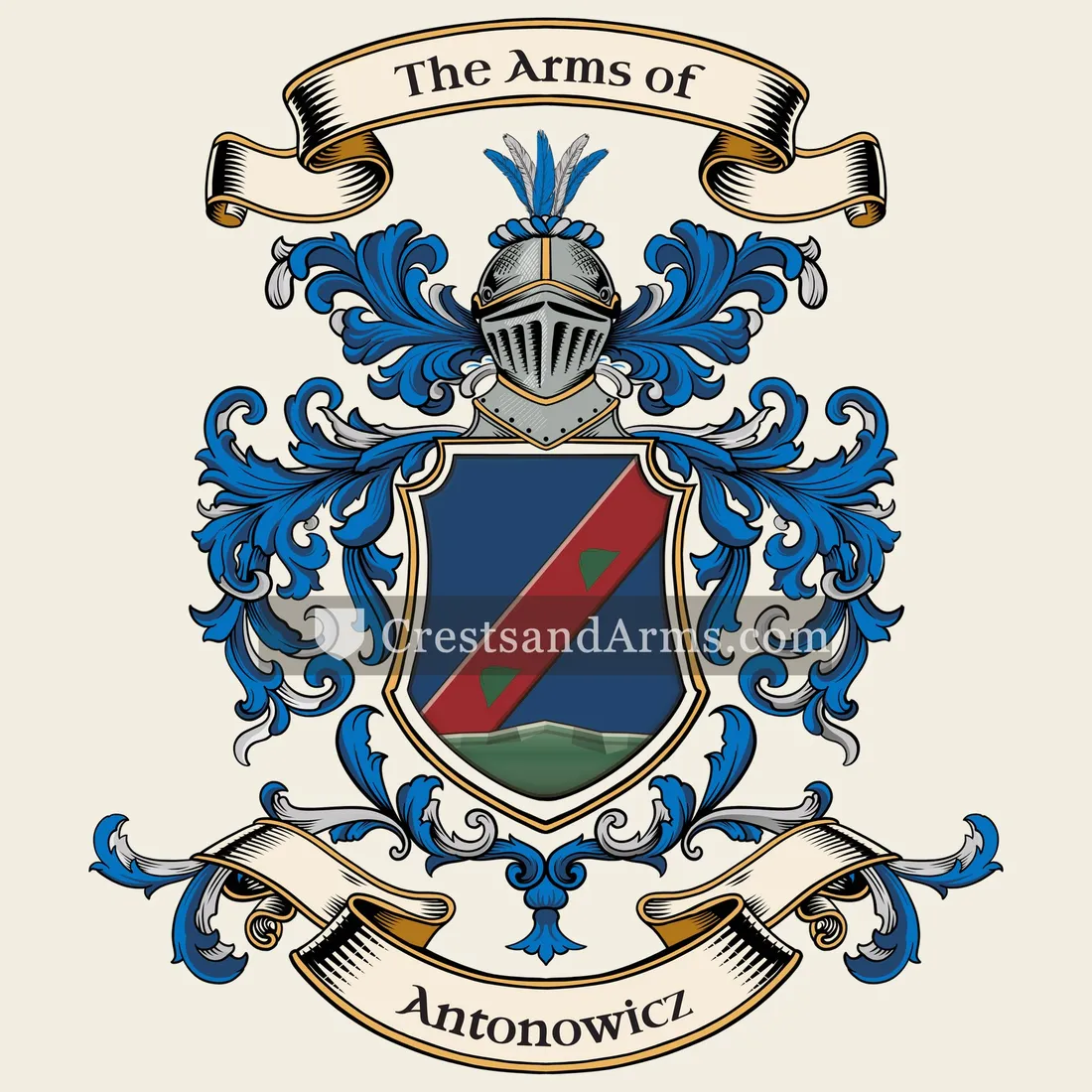


 bendDefence, and the scarf of a commander
 dovePeace, love and the Holy Spirit
 roseThe seventh son, and beauty with grace

 bellA call to prayer, and a warning given
 mulletThe third son, and a divine quality from above