Map of Germany showing where the Antonucci arms are recorded
The Antonucci arms were recorded in Hesse, c. 1743.
Hesse was central German country, divided among a large number of small landowners and prosperous towns. So many separate households held ground there that the region produced an unusual number of coats of arms.
This is where the arms were entered in the register. Families often moved to other parts of the country, so the same name can turn up in more than one region.
The body that granted and recorded arms in Germany in this period.
Charles VII, Holy Roman Emperor
Sovereign of the period
Charles VII, Holy Roman Emperor
1742–1745
Reigning in Germany when the Antonucci arms are first recorded.
How Arms Worked in Germany
In the Holy Roman Empire, coats of arms were often granted to individuals by the Emperor or his representatives. These arms were then passed down through the generations to all legitimate descendants of the original holder. Younger branches of a family usually kept the same shield design without needing to change it, as the arms belonged to the entire lineage.
Granting authority
The Holy Roman Emperor held the sole power to grant new coats of arms throughout his vast imperial territories.
How they got arms
Families typically obtained their coats of arms through a formal imperial grant or by proving their noble status to the authorities.
Where arms were recorded
These grants were officially recorded in the Imperial Chancery registers, which began keeping formal records of such honors during the Middle Ages.
The family's standing
Recorded among the armigerous families of Hesse.
Origin & History of the Antonucci Family in Germany
The surname Antonucci traces its roots to the Italian naming tradition, where it serves as a diminutive form of the name Antonio. While the name is distinctly Mediterranean in origin, historical records confirm that members of the family were established in the German region of Hesse by 1743. During the eighteenth century, the movement of people across European borders was often driven by trade, military service, or the search for new agricultural opportunities. Families who migrated from southern regions into the German states frequently integrated into local communities while maintaining their unique ancestral names. In Hesse, these early Antonucci settlers likely navigated a society defined by local parish administration and the complex social structures of the Holy Roman Empire. Their presence in this region highlights the historical reality of migration and cultural exchange that shaped the demographics of central Germany long before the modern era.
Coat of Arms & Family Crest Details
Symbols on this shield
bendDefence, and the scarf of a commander
dovePeace, love and the Holy Spirit
roseThe seventh son, and beauty with grace
Colours
Blue (Azure)Means: Loyalty and truth
Red (Gules)Means: Military strength
Gold (Or)Means: Generosity
Silver (Argent)Means: Peace and sincerity
Historical info
Source
J. B. Rietstap, Armorial Général, Gouda: G. B. van Goor Zonen, 1884–87
Blazon (the actual original written record)
“Coupé: au 1 d'azur à une colombe d'arg., le vol étendu; au 2 de gu. à la bande d'or, ch. d'une rose d'arg., bout. d'or, barbée de sin. Cq. cour. C.: la colombe, entre deux prob., celle à dextre d'arg. à deux barres d'azur, celle à sen. de gu. à deux bandes d'or. L.: à dextre d'or et de gu., à sen. d'arg. et d'azur.”
SwitzerlandBâle, c. 1745
Digital archive packCoat of arms PNG, gold border print PDF, vector SVG and the certificate of authenticity. Sent to your email in minutes.
Map of Switzerland showing where the Antonucci arms are recorded
The Antonucci arms were recorded in Bâle, c. 1745.
This is where the arms were entered in the register. Families often moved to other parts of the country, so the same name can turn up in more than one region.
The body that granted and recorded arms in Switzerland in this period.
How Arms Worked in Switzerland
In Switzerland, coats of arms were not restricted to the nobility and were often adopted by common citizens and families. These symbols were passed down through generations to show family identity. When branches of a family grew, they often changed small details of the design to distinguish their own line from the original group.
Granting authority
Cantonal and civic authorities managed the use of coats of arms within their specific regions and local jurisdictions.
How they got arms
Families typically assumed their own coats of arms based on local custom rather than receiving them from a central monarch.
Where arms were recorded
Arms were recorded in various cantonal and civic registers starting from the fourteenth century throughout the Swiss region.
The family's standing
Recorded among the armigerous families of Switzerland.
Origin & History of the Antonucci Family in Switzerland
The surname Antonucci traces its roots to the Italian peninsula, but the family established a notable presence in Switzerland by the middle of the eighteenth century. Records confirm that members of the family were living in the city of Bâle by 1745. During this era, Bâle served as a major crossroads for trade and intellectual exchange in Europe. Families like the Antonuccis often moved to such cities to participate in the growing merchant class or to practice specialized crafts. Because Bâle was a center for printing and banking, it is likely that these early settlers integrated into the local economy by providing professional services or goods to the diverse population of the region. Their presence in the city highlights the historical movement of families across borders in search of new opportunities during the Enlightenment period.
Coat of Arms & Family Crest Details
Symbols on this shield
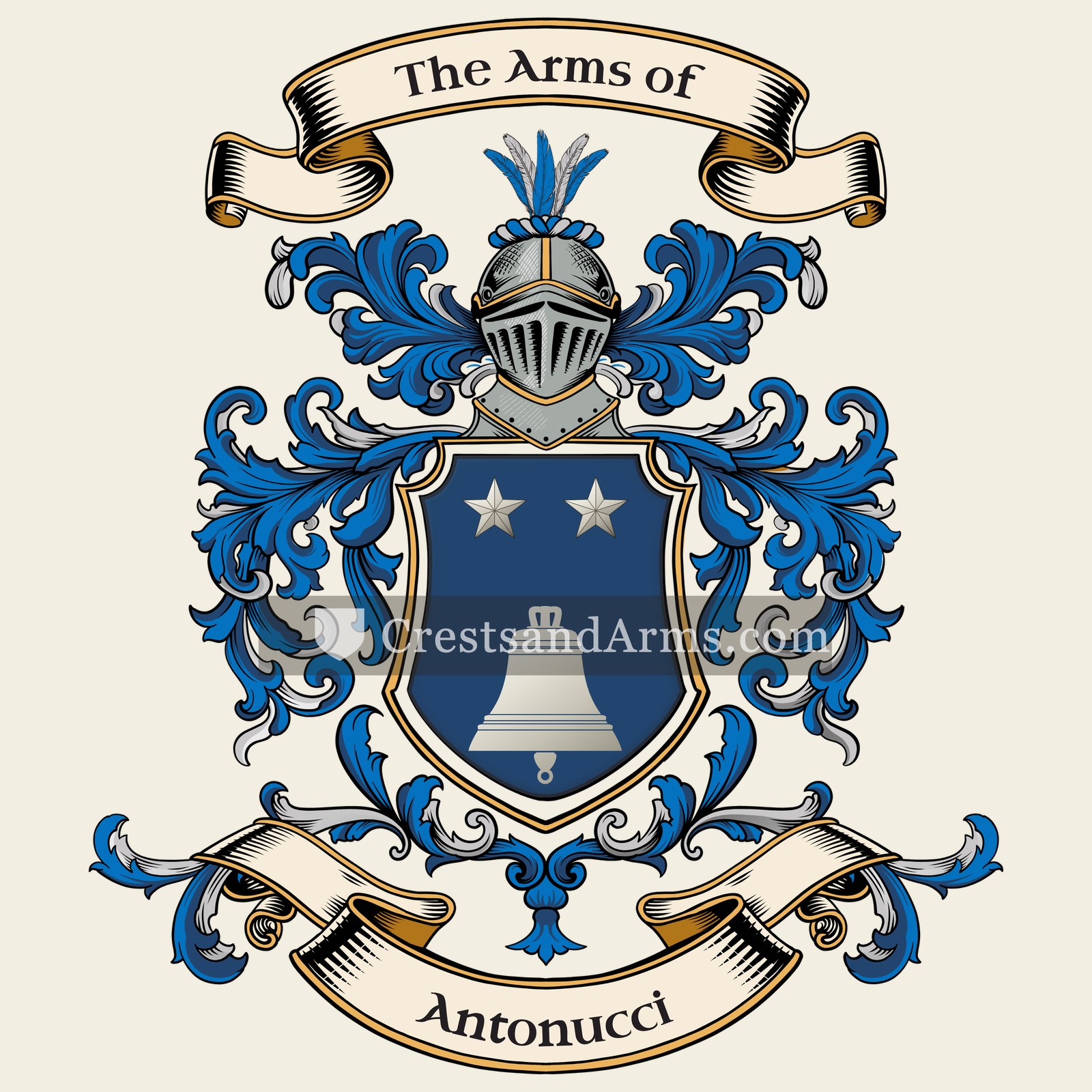
bellA call to prayer, and a warning given
mulletThe third son, and a divine quality from above
Colours
Blue (Azure)Means: Loyalty and truth
Silver (Argent)Means: Peace and sincerity
Historical info
Source
J. B. Rietstap, Armorial Général, Gouda: G. B. van Goor Zonen, 1884–87
Blazon (the actual original written record)
“D'azur à la cloche d'arg., acc. en chef de deux étoiles du même. C.: un vol à l'antique, aux armes de l'écu.”
Austriac. 1772
Digital archive packCoat of arms PNG, gold border print PDF, vector SVG and the certificate of authenticity. Sent to your email in minutes.
Map of Austria showing where the Antonucci arms are recorded
The Antonucci arms were recorded in Austria, c. 1772.
Arms such as these were typically recorded in Tyrol.
Tyrol was mountain country in western Austria, where the valleys were held by families who had been there a very long time. Old tenure counted for more than money, and old families carried arms.
This is where the arms were entered in the register. Families often moved to other parts of the country, so the same name can turn up in more than one region.
Region
Tyrol
First recorded
1772
Granting Authority for the Antonucci Arms
Imperial and Royal chancery
Sodacan · CC BY-SA 3.0
The body that granted and recorded arms in Austria in this period.
Joseph II, Holy Roman Emperor
Sovereign of the period
Joseph II, Holy Roman Emperor
1765–1790
Reigning in Germany when the Antonucci arms are first recorded.
How Arms Worked in Austria
Austrian coats of arms were often linked directly to noble titles granted by the Emperor. These symbols belonged to the entire family line rather than just one individual. When a family grew, new branches kept the original design without needing to change it. This system allowed all members of a noble house to share the same identity across many generations.
Granting authority
The Imperial and Royal chancery managed all heraldic matters and controlled the official granting of arms throughout the Austrian lands.
How they got arms
Families typically received their arms through a formal imperial decree that often accompanied the elevation of a person to noble status.
Where arms were recorded
Official records of these grants were kept in the Imperial Register of Nobility which began its formal documentation process in 1453.
The family's standing
Recorded among the armigerous families of Austria.
Origin & History of the Antonucci Family in Austria
The family name Antonucci traces its roots to the alpine region of Tyrol, where members of the family were documented as early as 1772. During the late 18th century, Tyrol was a vital crossroads within the Habsburg Empire, connecting the German-speaking north with the Italian-speaking regions of the south. The name itself reflects this cultural bridge, as it is derived from the Italian personal name Antonio with a diminutive suffix. Families with this name likely moved through the mountain passes for trade or seasonal labor, eventually settling in the rugged landscape of the Austrian Alps. By the time of the 1772 records, these individuals had become integrated into the local community, living among the farmers and craftsmen who defined the social structure of the region. Their presence in the historical record highlights how families often migrated across linguistic borders in search of new opportunities within the diverse territories of the Austrian Empire.
Related Branches & Arms
Root word
Antonius
A Roman family name of uncertain Etruscan origin.
This name
AntonucciA diminutive form indicating a descendant of someone named Anthony.
also spelled
Antony
Antonee
Anthony
Documented Sources
J. B. Rietstap, Armorial Général, Gouda: G. B. van Goor Zonen, 1884–87
Hessisches Staatsarchiv Marburg, Kirchenbücher der evangelischen Kirchengemeinden in Hessen, 1743
Bahlow, Hans, Deutsches Namenlexikon: Familien- und Vornamen nach Ursprung und Sinn erklärt, 1972
Digital archive packCoat of arms PNG, gold border print PDF, vector SVG and the certificate of authenticity. Sent to your email in minutes.


 mountThe ground held, and steadfastness upon it
 mountThe ground held, and steadfastness upon it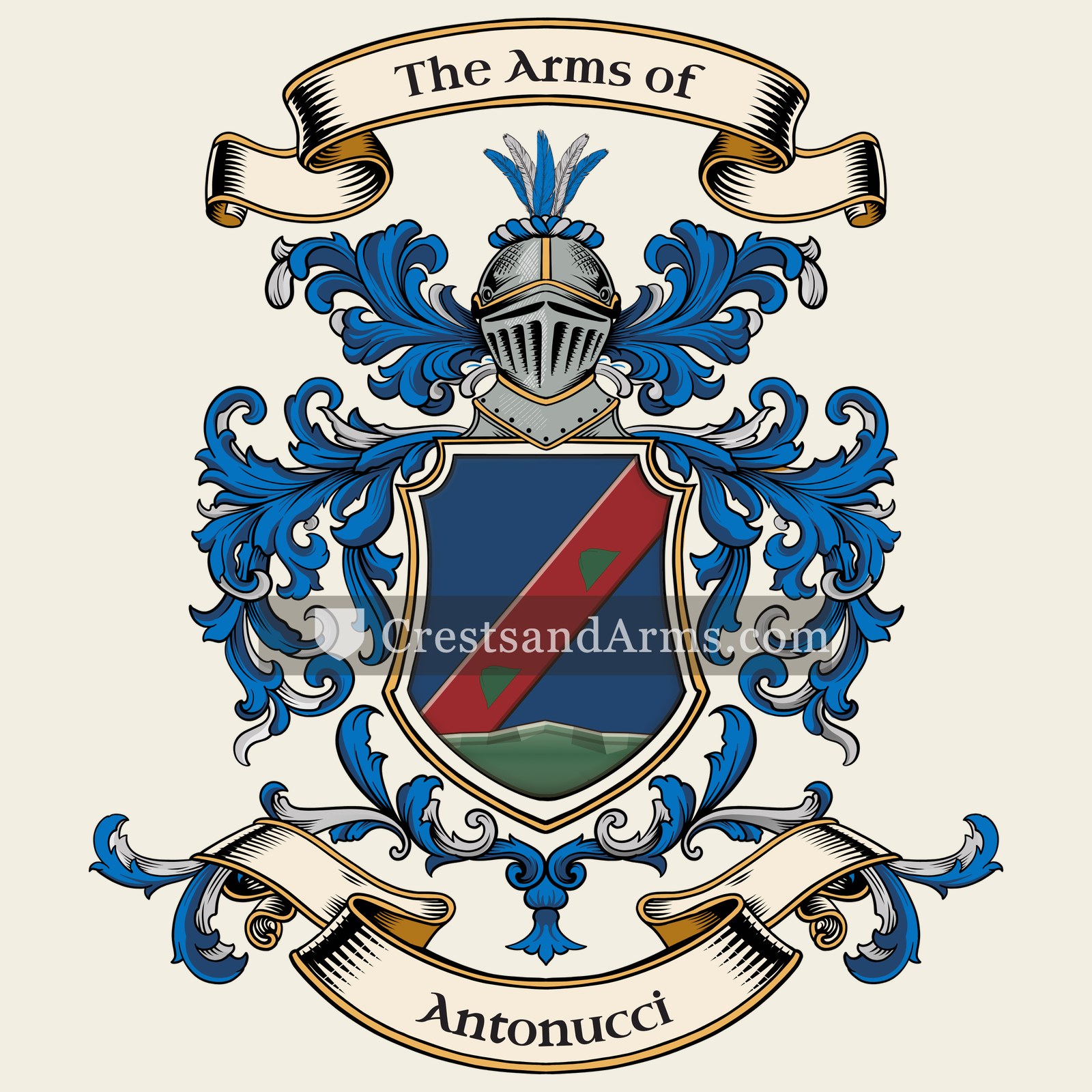


 bendDefence, and the scarf of a commander
 dovePeace, love and the Holy Spirit
 roseThe seventh son, and beauty with grace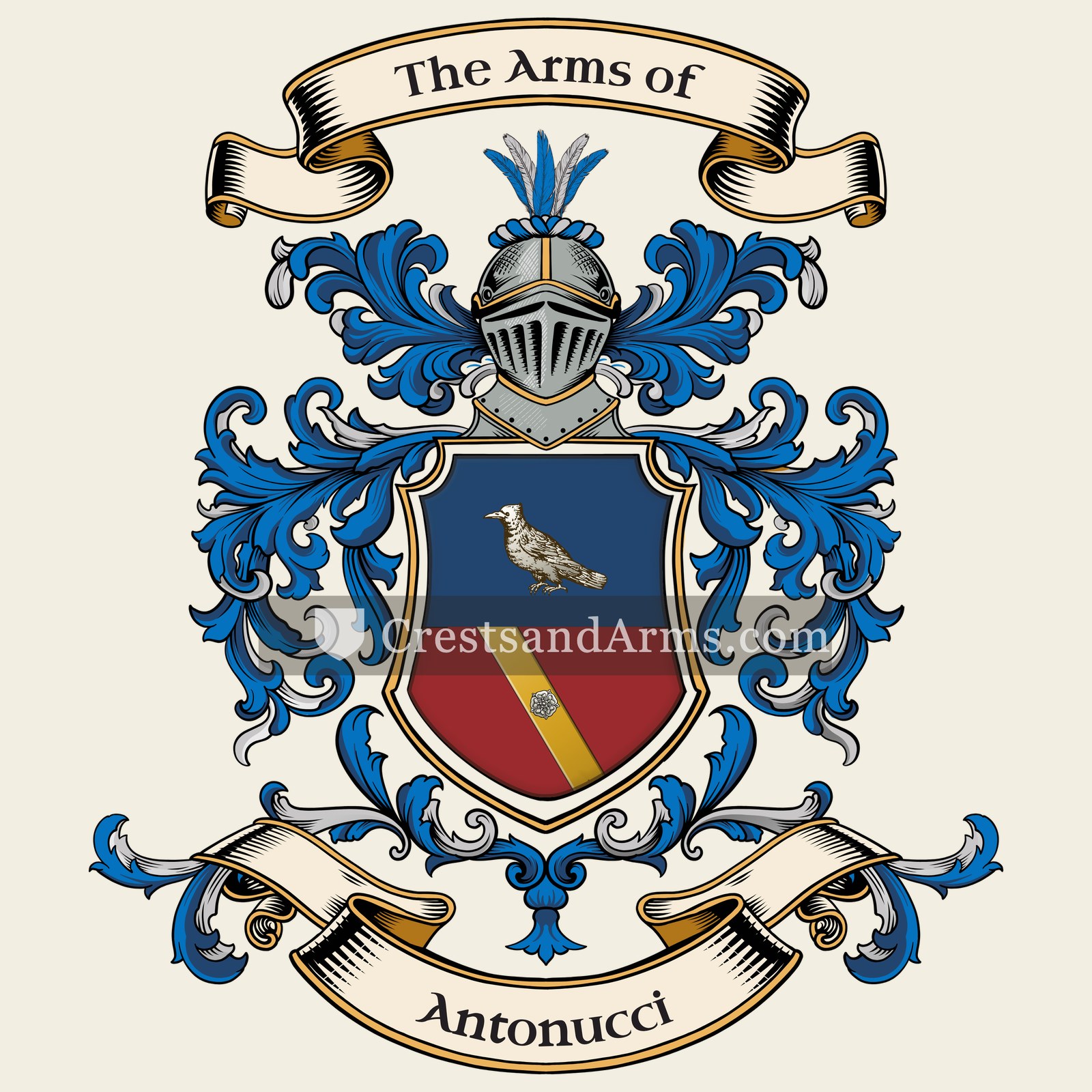

 bellA call to prayer, and a warning given
 mulletThe third son, and a divine quality from above