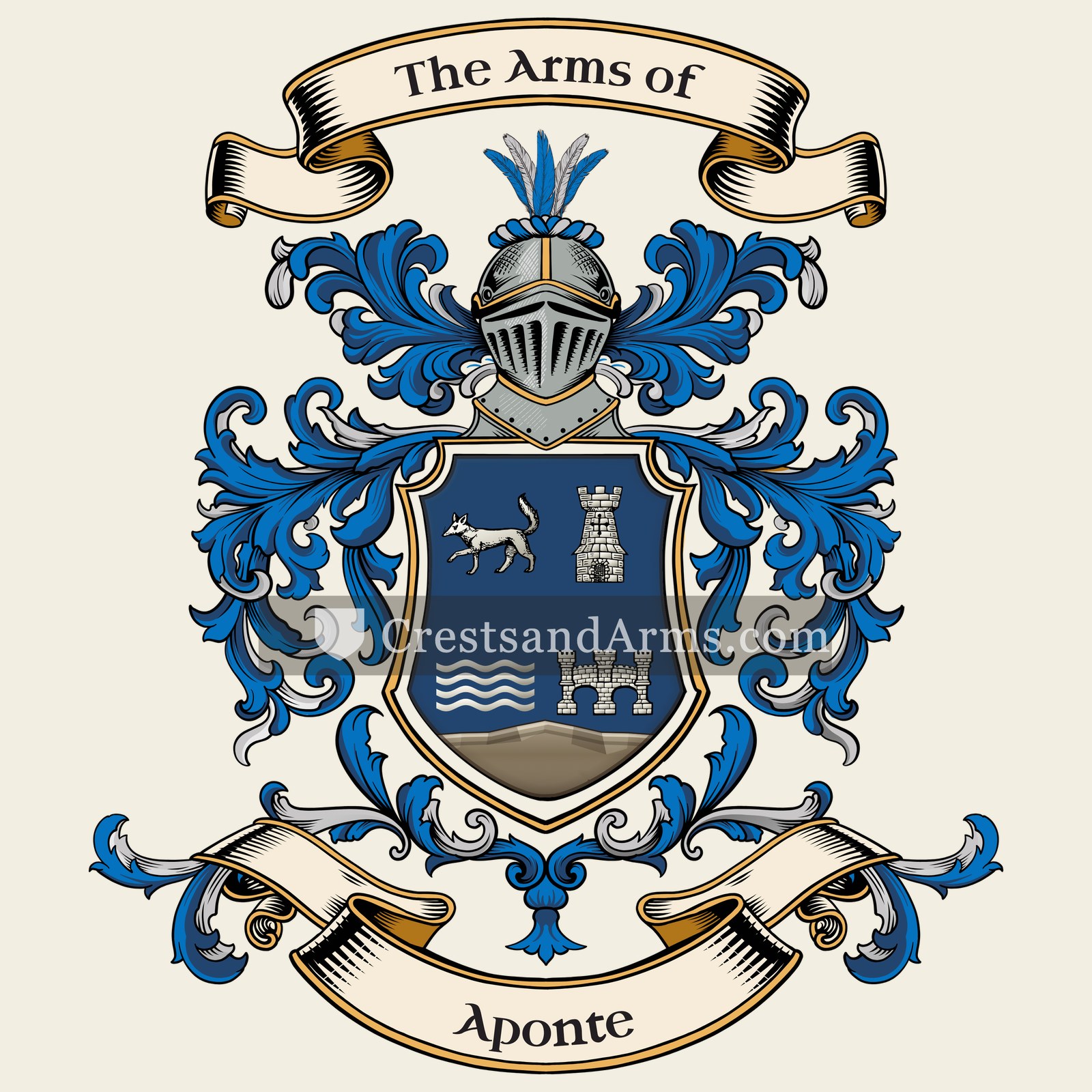
A record of documented arms, meaning and origin, researched for the Aponte family of Spain.
Reg. 9528 · Spanish, A–C
Coat of Arms & Family Crest Details
Symbols on this shield
foxWit and wisdom in defence
towerGrandeur and solidity, and a stronghold defended
riverThe bounds of a land, and life carried through it
bridgeOne who joins what was divided
Colours
Blue (Azure)Means: Loyalty and truth
Silver (Argent)Means: Peace and sincerity
Historical info
Source
J. B. Rietstap, Armorial Général, Gouda: G. B. van Goor Zonen, 1884–87
Blazon (the actual original written record)
“D'azur au pont d'arg., brisé sur le milieu, ayant deux arches à dextre et trois à sen.; la partie dextre du pont sommée d'un renard pass. et cont. au nat., tenant entre ses dents un listel flottant d'arg. inscrit des mots: ¡OH, QUE MAL PASO! en lettres de sa., et la partie sen. du pont sommée d'une tour d'arg.; ledit pont jeté sur une eau au nat.”
AndalusiaAndalusia, c. 1722
Where the Aponte Arms Were Recorded
Andalusia
Map of Spain showing where the Aponte arms are recorded
The Aponte arms were recorded in Andalusia, c. 1722.
Andalusia was the last part of Spain taken back from the Moors, and the land was shared out among the men who took it. A grant of land came with a grant of arms, so the region produced a great many.
This is where the arms were entered in the register. Families often moved to other parts of the country, so the same name can turn up in more than one region.
The body that granted and recorded arms in Spain in this period.
Philip V of Spain
Sovereign of the period
Philip V of Spain
1714–1724
Reigning in Spain when the Aponte arms are first recorded.
How Arms Worked in Spain
In Spain, a coat of arms was considered a form of property that belonged to the entire family line. These arms were passed down from a father to all his children equally. Younger branches of the family usually kept the original design without needing to add any special marks to distinguish their specific line.
Granting authority
The Cronista Rey de Armas was the official body that regulated and granted coats of arms throughout Spain.
How they got arms
Families often obtained their arms through royal grants or by proving their noble status to the official heraldic authority.
Where arms were recorded
Coats of arms were officially recorded in the registers of the Cronista Rey de Armas starting in 1496.
The family's standing
Recorded among the armigerous families of Andalusia.
Origin & History of the Aponte Family in Spain
The name Aponte is deeply rooted in the history of the Iberian Peninsula, with its origins linked to the geographical landscape of southern Spain. The name is often categorized as a topographic surname, which means it was likely used to describe someone who lived near a bridge or a specific crossing point. By the year 1722, records confirm that the Aponte family was well-established within the region of Andalusia. During this period, families in this area were often involved in the agricultural and administrative life of the Spanish countryside. As the family grew, members spread across different provinces, carrying the name into various professional and social circles. This transition from a simple description of a person's home to a formal family name reflects the broader patterns of how surnames became permanent markers of identity in early modern Spain.
Related Branches & Arms
Root word
ad pontem
Latin phrase meaning at the bridge.
This name
AponteA topographic surname for someone who lived near a bridge or a bridge-keeper.
also spelled
Apontee
Documented Sources
J. B. Rietstap, Armorial Général, Gouda: G. B. van Goor Zonen, 1884–87
Moll, Francesc de B., Els llinatges catalans, 1959
Pescador del Hoyo, María del Carmen, Apellidos en España: sociedad e historia, 1996
Archivo General de Simancas, Registro General del Sello
Digital archive packCoat of arms PNG, gold border print PDF, vector SVG and the certificate of authenticity. Sent to your email in minutes.


 foxWit and wisdom in defence
 towerGrandeur and solidity, and a stronghold defended
 riverThe bounds of a land, and life carried through it
 bridgeOne who joins what was divided
 foxWit and wisdom in defence
 towerGrandeur and solidity, and a stronghold defended
 riverThe bounds of a land, and life carried through it
 bridgeOne who joins what was divided