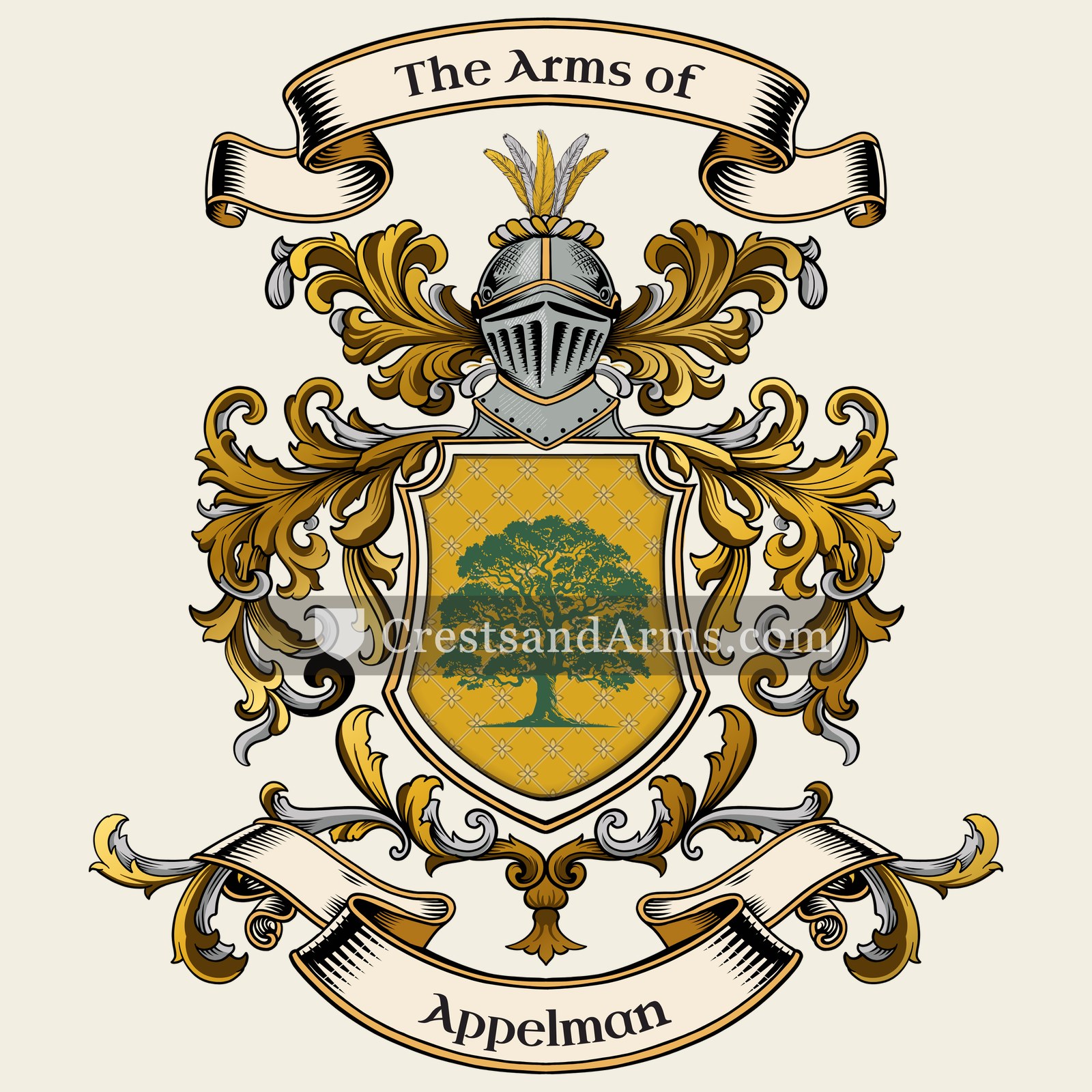
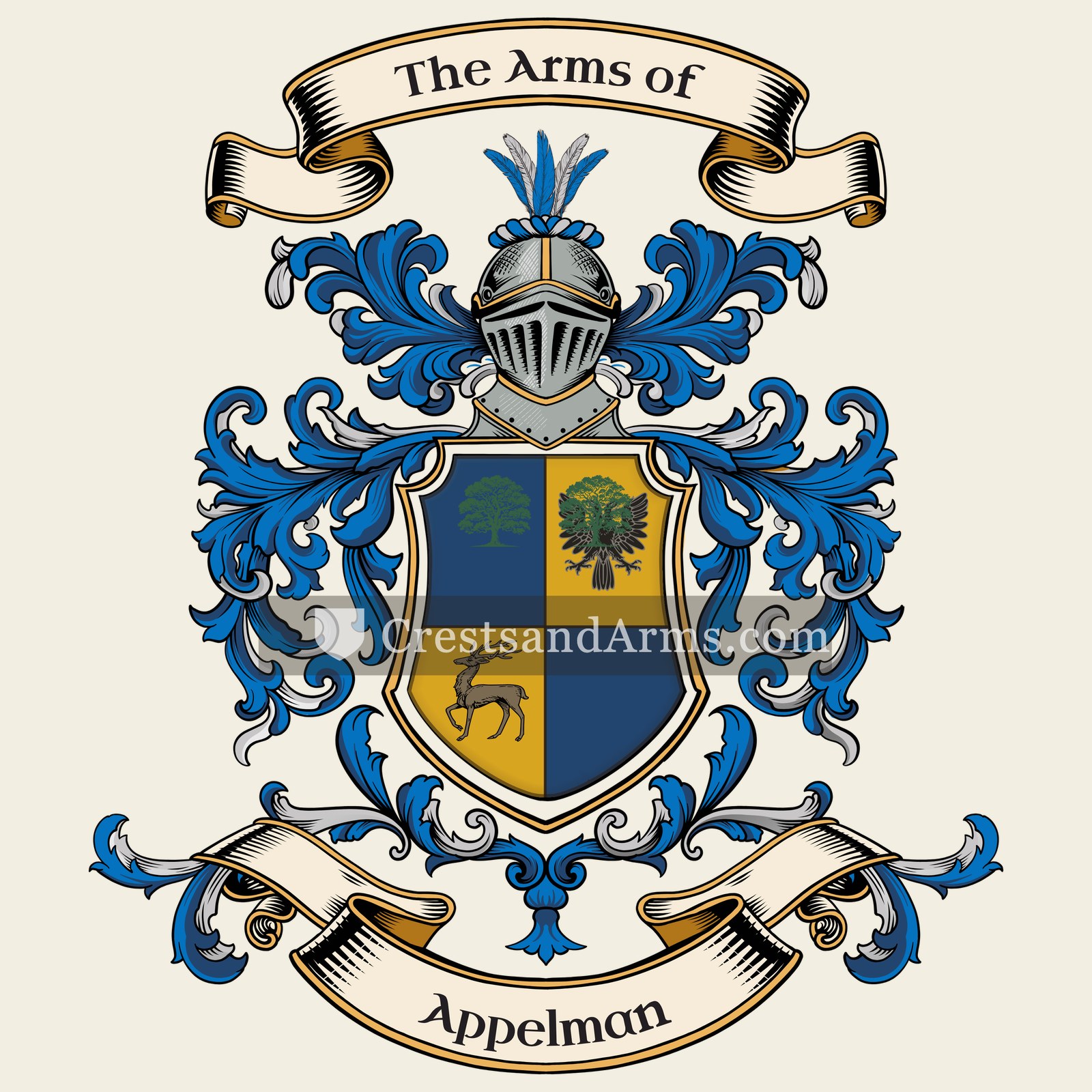
A record of documented arms, meaning and origin, researched for the Appelman family lines. Documented in 2 countries.
Reg. 8844 · Dutch, A–C
Coat of Arms & Family Crest Details
Symbols on this shield
treeLife, endurance and deep roots
Colours
Gold (Or)Means: Generosity
Green (Vert)Means: Hope
Historical info
Source
J. B. Rietstap, Armorial Général, Gouda: G. B. van Goor Zonen, 1884–87
Blazon (the actual original written record)
“D'or au pommier de sin.”
Netherlandsc. 1815
Where the Appelman Arms Were Recorded
Friesland
Map of Netherlands showing where the Appelman arms are recorded
The Appelman arms were recorded in Netherlands, c. 1815.
Arms such as these were typically recorded in Friesland.
Friesland was low, wet country on the northern coast of the Netherlands, farmed by families who had held the same land for centuries. Free landholders were unusually common there, and a free landholder could carry arms.
This is where the arms were entered in the register. Families often moved to other parts of the country, so the same name can turn up in more than one region.
Region
Friesland
First recorded
1815
Granting Authority for the Appelman Arms
Hoge Raad van Adel
Photograph made by me · CC BY-SA 3.0
The body that granted and recorded arms in Netherlands in this period.
William I of the Netherlands
Sovereign of the period
William I of the Netherlands
1815–1840
Reigning in Netherlands when the Appelman arms are first recorded.
How Arms Worked in Netherlands
In the Netherlands, coats of arms were often used by noble families and those who held specific public offices. These arms were passed down through the generations to legitimate descendants. Younger branches of a family usually kept the original design without needing to add special marks. This system ensured that the family identity remained clear and consistent over many years.
Granting authority
The Hoge Raad van Adel is the official body that regulates and manages noble titles and coats of arms in the Netherlands.
How they got arms
Families typically obtained their coats of arms through official royal grants or by proving their long-standing historical use of the symbols.
Where arms were recorded
Coats of arms are officially recorded in the registers held by the Hoge Raad van Adel, which began its work in 1814.
The family's standing
Recorded among the armigerous families of Netherlands.
Origin & History of the Appelman Family in Netherlands
The surname Appelman is deeply rooted in the historical landscape of the Netherlands, particularly within the northern province of Friesland. During the early nineteenth century, the name began to appear more frequently in official civil records, such as the population registers established around 1815. The name itself is likely a descriptive occupational or topographic surname, often linked to the cultivation or trade of apples. In the context of Dutch naming customs, families in rural areas like Friesland often adopted fixed surnames during the Napoleonic era to comply with new government requirements for civil registration. By examining these early records, we see the Appelman family as part of a broader demographic shift where local families transitioned from traditional patronymic naming systems to permanent family names that could be passed down through generations.
Coat of Arms & Family Crest Details
Symbols on this shield
saltireResolution, and St Andrew's cross
chiefAuthority, wisdom and dominion
treeLife, endurance and deep roots
eagleNobility, strength and a keen mind
stagPeace and harmony, and one who will not fight unprovoked
Colours
Blue (Azure)Means: Loyalty and truth
Gold (Or)Means: Generosity
Green (Vert)Means: Hope
Black (Sable)Means: Constancy
Historical info
Source
J. B. Rietstap, Armorial Général, Gouda: G. B. van Goor Zonen, 1884–87
Blazon (the actual original written record)
“Ec.: aux 1 et 4 d'azur à deux tubes de canon, en saut. passés dans une couronne et cant. de quatre boulets, le tout d'or; au 2 d'or à une aigle de profil de sa., cour. d'or, reg., le vol levé; au 3 d'arg. au cerf élancé au nat. Sur le tout d'azur à l'aigle d'or et au chef d'arg. ch. de deux pommiers de sin. Deux cq. cour. C.: 1º deux bras, arm. d'arg., les mains de carn. supp. ensemble une pomme d'or, tigée et feuillée de sin., la queue en bas; le tout devant deux banderoles tiercées en fasce: d'or, de sa. et d'arg.; 2º l'aigle du 2, iss.”
Swedenc. 1719
Where the Appelman Arms Were Recorded
Stockholm
Map of Sweden showing where the Appelman arms are recorded
The Appelman arms were recorded in Sweden, c. 1719.
Arms such as these were typically recorded in Stockholm.
Stockholm held the Swedish court and the House of Nobility, where every noble family's arms were entered and kept. Families ennobled for service registered there, which is why so many are recorded around the city.
This is where the arms were entered in the register. Families often moved to other parts of the country, so the same name can turn up in more than one region.
The body that granted and recorded arms in Sweden in this period.
Ulrika Eleonora I of Sweden
Sovereign of the period
Ulrika Eleonora I of Sweden
1718–1720
Reigning in Netherlands when the Appelman arms are first recorded.
How Arms Worked in Sweden
In Sweden, a coat of arms belonged to a noble family as a whole rather than just one individual. These arms were passed down through the generations to all legitimate descendants. Younger branches of the family used the same shield without needing to change it. This system ensured that the entire lineage shared the same identity and status under the law.
Granting authority
The Riddarhuset, or House of Nobility, regulated all noble coats of arms in Sweden under royal authority.
How they got arms
Families received their coats of arms through royal grants of nobility which were then officially registered with the House.
Where arms were recorded
Coats of arms were officially recorded in the Swedish House of Nobility register starting in the year 1626.
The family's standing
Recorded among the armigerous families of Sweden.
Origin & History of the Appelman Family in Sweden
The Appelman family name first appeared in the historical records of Stockholm around 1719, a time when Sweden was transitioning out of the Great Northern War. During this period, the Swedish state encouraged the use of descriptive or ornamental surnames, often inspired by nature or trade, to replace the older patronymic naming system where children took their father’s first name as their last. The name Appelman likely emerged from this cultural shift, combining the Germanic word for apple with the suffix for man. By settling in the capital city during the early eighteenth century, the family placed themselves at the center of Swedish urban development and commerce. As the city grew, early members of the family became part of the rising middle class, contributing to the administrative and social fabric of Stockholm as the nation moved toward a new era of peace and modernization.
Related Branches & Arms
Root word
Appel
A fruit-bearing tree or the fruit itself.
This name
AppelmanA topographic or occupational name for someone who lived near or grew apples.
also spelled
Appelmann
Appelmane
Apelman
Documented Sources
J. B. Rietstap, Armorial Général, Gouda: G. B. van Goor Zonen, 1884–87
Tresoar (Fries Historisch en Letterkundig Centrum), Bevolkingsregisters van Friesland
Meertens Instituut, Nederlandse Familienamenbank
Huizinga, Frans, Nederlandse achternamen, 1993
Digital archive packCoat of arms PNG, gold border print PDF, vector SVG and the certificate of authenticity. Sent to your email in minutes.


 treeLife, endurance and deep roots
 treeLife, endurance and deep roots

 saltireResolution, and St Andrew's cross
 chiefAuthority, wisdom and dominion
 eagleNobility, strength and a keen mind
 stagPeace and harmony, and one who will not fight unprovoked