Map of Netherlands showing where the Appleman arms are recorded
The Appleman arms were recorded in Netherlands, c. 1815.
Arms such as these were typically recorded in Friesland.
Friesland was low, wet country on the northern coast of the Netherlands, farmed by families who had held the same land for centuries. Free landholders were unusually common there, and a free landholder could carry arms.
This is where the arms were entered in the register. Families often moved to other parts of the country, so the same name can turn up in more than one region.
Region
Friesland
First recorded
1815
Granting Authority for the Appleman Arms
Hoge Raad van Adel
Photograph made by me · CC BY-SA 3.0
The body that granted and recorded arms in Netherlands in this period.
William I of the Netherlands
Sovereign of the period
William I of the Netherlands
1815–1840
Reigning in Netherlands when the Appleman arms are first recorded.
How Arms Worked in Netherlands
In the Netherlands, coats of arms were often used by noble families and those who held specific public offices. These arms were passed down through the generations to legitimate descendants. Younger branches of a family usually kept the original design without needing to add special marks. This system ensured that the family identity remained clear and consistent over many years.
Granting authority
The Hoge Raad van Adel is the official body that regulates and manages noble titles and coats of arms in the Netherlands.
How they got arms
Families typically obtained their coats of arms through official royal grants or by proving their long-standing historical use of the symbols.
Where arms were recorded
Coats of arms are officially recorded in the registers held by the Hoge Raad van Adel, which began its work in 1814.
The family's standing
Recorded among the armigerous families of Netherlands.
Origin & History of the Appleman Family in Netherlands
The surname Appleman in the Netherlands is deeply connected to the northern province of Friesland, where records confirm the family was established by at least 1815. During this period, the Netherlands underwent significant changes in how surnames were recorded due to the implementation of the Napoleonic civil registry. Before this time, many families in rural Friesland used patronymics, which meant a person’s last name changed based on their father’s first name. The adoption of a fixed surname like Appleman suggests that the family likely settled into a permanent trade or specific landholding that required a stable identity for tax and legal purposes. The name itself follows a common naming pattern of the era, often derived from a descriptive trait, a location, or a specific occupation related to fruit cultivation or trade. By the early 19th century, the Appleman family had become part of the local fabric of Frisian society, contributing to the agricultural and community life that defined the region during the post-Napoleonic era.
Meaning of the Appleman family crest colors & symbols
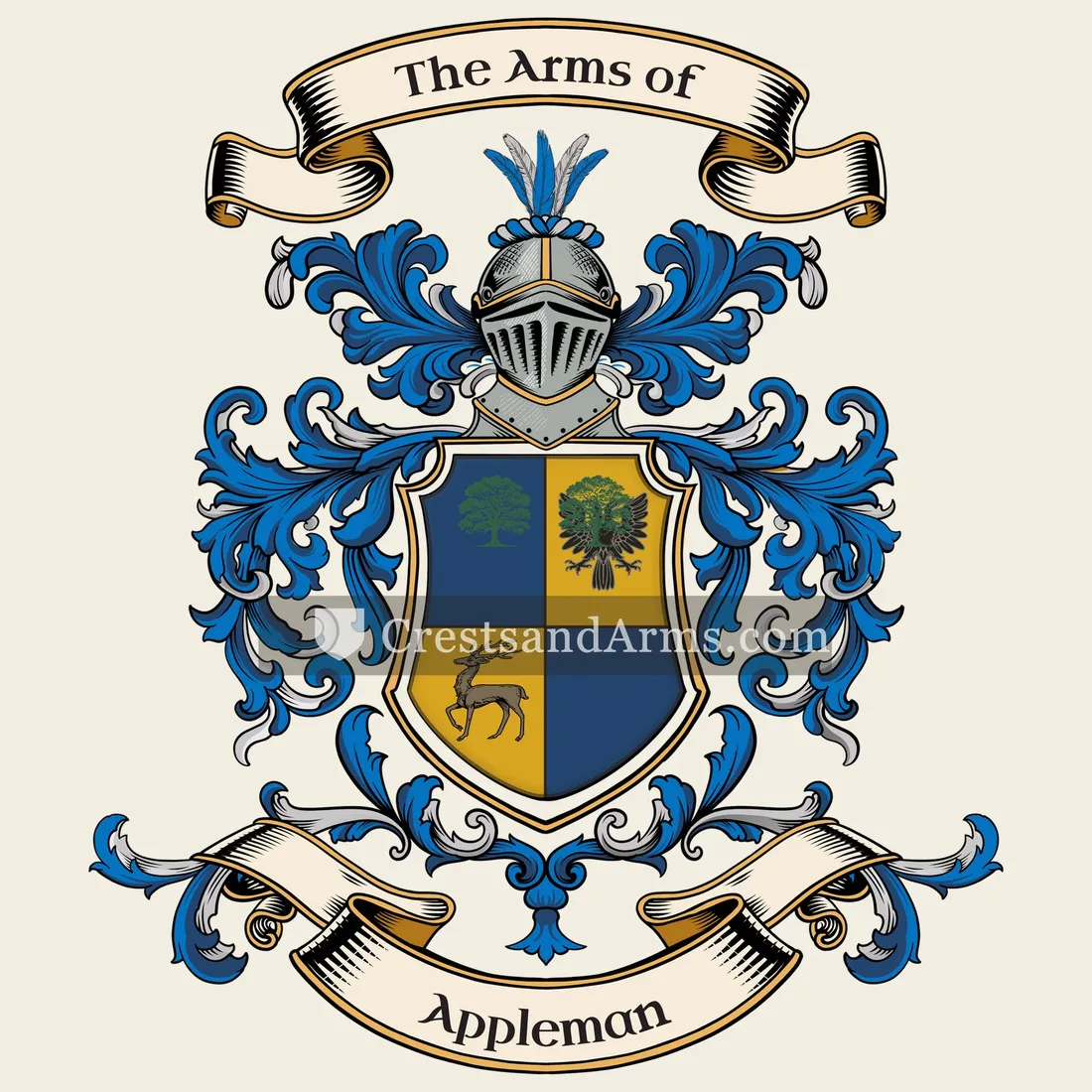
Symbols on this shield
treeLife, endurance and deep roots
eagleNobility, strength and a keen mind
stagPeace and harmony, and one who will not fight unprovoked
Colours
Blue (Azure)Means: Loyalty and truth
Gold (Or)Means: Generosity
Green (Vert)Means: Hope
Black (Sable)Means: Constancy
Historical info
Source
J. B. Rietstap, Armorial Général, Gouda: G. B. van Goor Zonen, 1884–87
Blazon (the actual original written record)
“Ec.: aux 1 et 4 d'azur à deux tubes de canon, en saut. passés dans une couronne et cant. de quatre boulets, le tout d'or; au 2 d'or à une aigle de profil de sa., cour. d'or, reg., le vol levé; au 3 d'arg. au cerf élancé au nat. Sur le tout d'azur à l'aigle d'or et au chef d'arg. ch. de deux pommiers de sin. Deux cq. cour. C.: 1º deux bras, arm. d'arg., les mains de carn. supp. ensemble une pomme d'or, tigée et feuillée de sin., la queue en bas; le tout devant deux banderoles tiercées en fasce: d'or, de sa. et d'arg.; 2º l'aigle du 2, iss.”
Swedenc. 1719
Digital archive packCoat of arms PNG, gold border print PDF, vector SVG and the certificate of authenticity. Sent to your email in minutes.
Map of Sweden showing where the Appleman arms are recorded
The Appleman arms were recorded in Sweden, c. 1719.
Arms such as these were typically recorded in Stockholm.
Stockholm held the Swedish court and the House of Nobility, where every noble family's arms were entered and kept. Families ennobled for service registered there, which is why so many are recorded around the city.
This is where the arms were entered in the register. Families often moved to other parts of the country, so the same name can turn up in more than one region.
The body that granted and recorded arms in Sweden in this period.
Ulrika Eleonora I of Sweden
Sovereign of the period
Ulrika Eleonora I of Sweden
1718–1720
Reigning in Netherlands when the Appleman arms are first recorded.
How Arms Worked in Sweden
In Sweden, a coat of arms belonged to a noble family as a whole rather than just one individual. These arms were passed down through the generations to all legitimate descendants. Younger branches of the family used the same shield without needing to change it. This system ensured that the entire lineage shared the same identity and status under the law.
Granting authority
The Riddarhuset, or House of Nobility, regulated all noble coats of arms in Sweden under royal authority.
How they got arms
Families received their coats of arms through royal grants of nobility which were then officially registered with the House.
Where arms were recorded
Coats of arms were officially recorded in the Swedish House of Nobility register starting in the year 1626.
The family's standing
Recorded among the armigerous families of Sweden.
Origin & History of the Appleman Family in Sweden
The history of the Appleman name in Sweden begins during a period of significant transition for the country in the early eighteenth century. By 1719, members of the family were established in Stockholm, a city that was then the bustling political and economic heart of the Swedish Empire. During this time, Sweden was recovering from the long and exhausting Great Northern War, which forced many families to adapt to a changing social landscape. The name itself reflects the common practice of the era where individuals adopted descriptive or nature-based surnames to distinguish themselves in growing urban centers. As residents of Stockholm, the early Appleman family lived through the dawn of the Age of Liberty, a time when the Swedish government shifted toward parliamentary rule and increased focus on trade and domestic development. These early ancestors were part of a society that valued craftsmanship and civil service, helping to build the foundations of the modern city that we recognize today.
Appleman Meaning & Related Branches
Root word
Appel
A fruit-bearing tree or the fruit itself.
This name
ApplemanAn occupational surname for a grower or seller of apples.
also spelled
Appelmann
Appelmane
Apelman
Documented Sources
J. B. Rietstap, Armorial Général, Gouda: G. B. van Goor Zonen, 1884–87
AlleFriezen, Burgerlijke Stand Friesland (Civil Registry of Friesland), 1811-1950
Tresoar (Frisian Historical and Literary Center), Bevolkingsregisters (Population Registers)
Dijkstra, B., Friese familienamen: een overzicht van hun oorsprong en verspreiding (1998)
Meertens, P.J., De betekenis van de Nederlandse familienamen (1947)
Digital archive packCoat of arms PNG, gold border print PDF, vector SVG and the certificate of authenticity. Sent to your email in minutes.


 treeLife, endurance and deep roots
 treeLife, endurance and deep roots
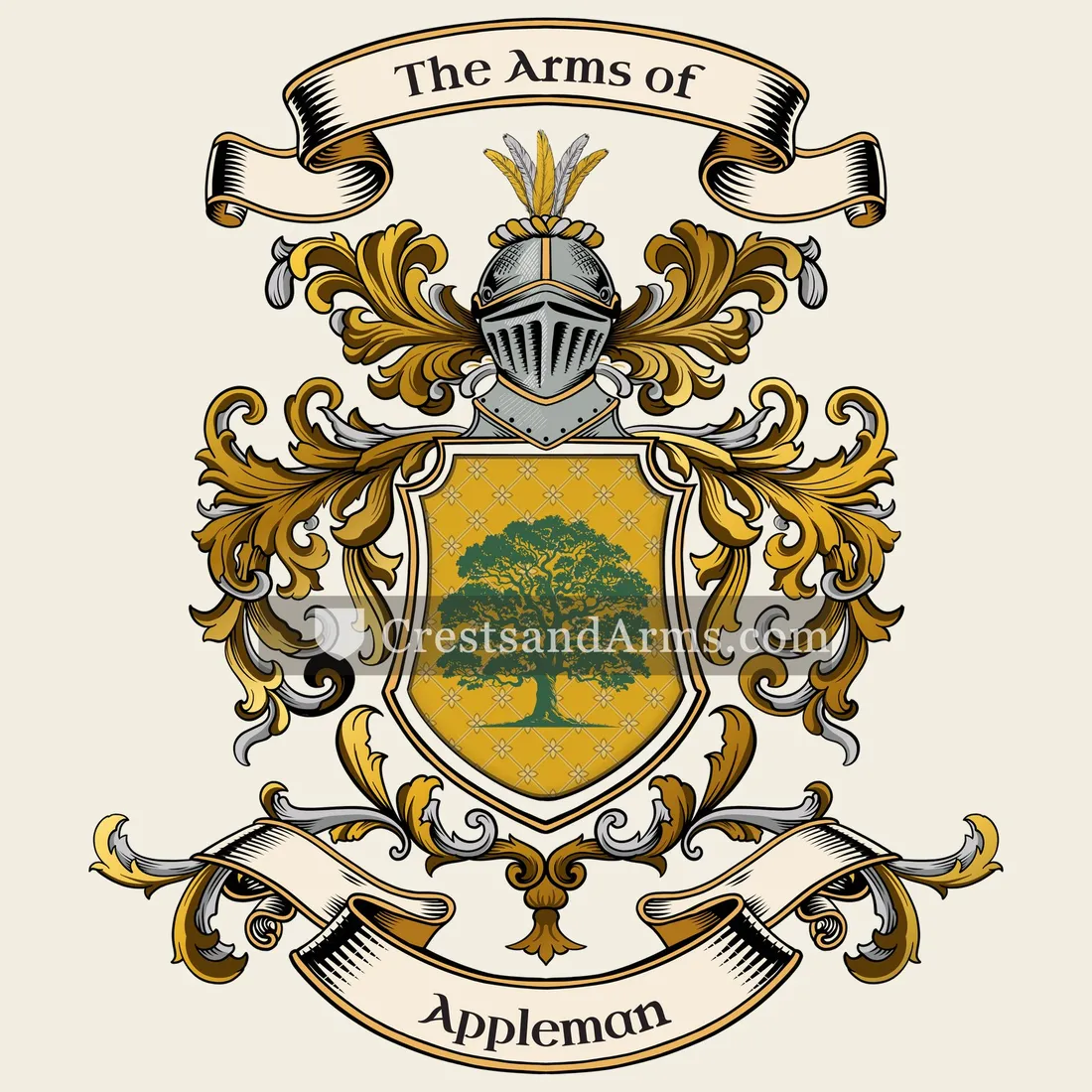


 eagleNobility, strength and a keen mind
 stagPeace and harmony, and one who will not fight unprovoked