A record of documented arms, meaning and origin, researched for the Arbon family lines. Documented in 2 countries.
Reg. 2170 · Swiss, A–C
Coat of Arms & Family Crest Details
Symbols on this shield
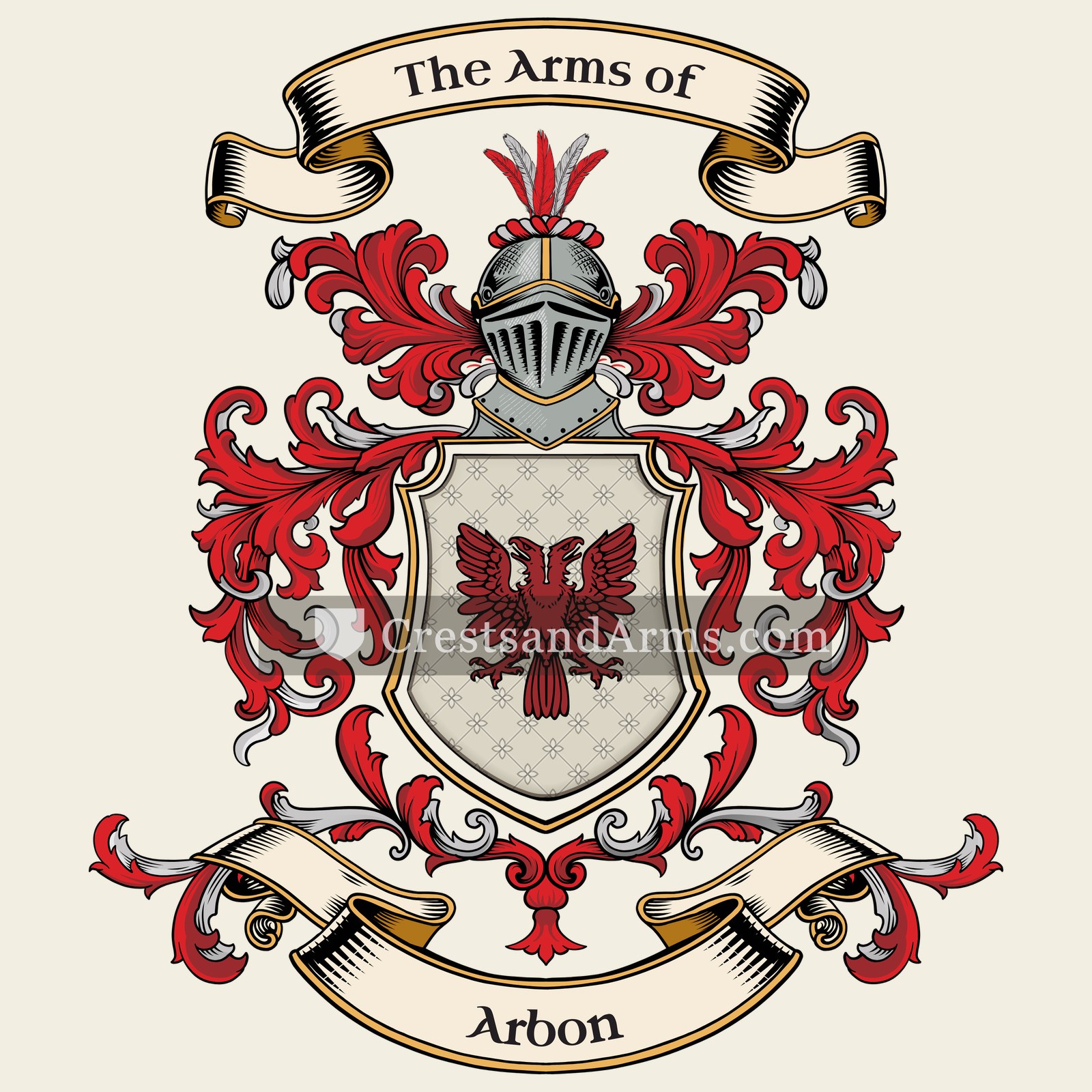
eagleNobility, strength and a keen mind
Colours
Silver (Argent)Means: Peace and sincerity
Red (Gules)Means: Military strength
Historical info
Source
J. B. Rietstap, Armorial Général, Gouda: G. B. van Goor Zonen, 1884–87
Blazon (the actual original written record)
“D'arg. à l'aigle de gu., bq. et m. d'or. C.: l'aigle, iss.”
SwitzerlandThurgovie, c. 1745
Where the Arbon Arms Were Recorded
Thurgovie
Map of Switzerland showing where the Arbon arms are recorded
The Arbon arms were recorded in Thurgovie, c. 1745.
This is where the arms were entered in the register. Families often moved to other parts of the country, so the same name can turn up in more than one region.
The body that granted and recorded arms in Switzerland in this period.
How Arms Worked in Switzerland
In Switzerland, coats of arms were not restricted to the nobility and were often adopted by common citizens and families. These symbols were passed down through generations to show family identity. When branches of a family grew, they often changed small details of the design to distinguish their own line from the original group.
Granting authority
Cantonal and civic authorities managed the use of coats of arms within their specific regions and local jurisdictions.
How they got arms
Families typically assumed their own coats of arms based on local custom rather than receiving them from a central monarch.
Where arms were recorded
Arms were recorded in various cantonal and civic registers starting from the fourteenth century throughout the Swiss region.
The family's standing
Recorded among the armigerous families of Switzerland.
Origin & History of the Arbon Family in Switzerland
The family name Arbon is deeply connected to the geography of northeastern Switzerland, specifically the region of Thurgau. While the name is famously associated with the town of Arbon on the shores of Lake Constance, families bearing this surname established themselves as local residents in the surrounding countryside by the mid-18th century. Records confirm that members of the Arbon family were living and working in Thurgau by 1745, a time when the region was a subject territory governed by the Swiss Confederation. During this era, families were often identified by their place of origin or their proximity to specific landmarks, suggesting that the ancestors of these individuals likely moved from the lakeside town into the nearby rural districts to pursue farming or local trades. As these families settled into their new communities, they became part of the social fabric of the canton, contributing to the agricultural and civic life that defined the Thurgau region during the late 1700s.
Coat of Arms & Family Crest Details
Symbols on this shield
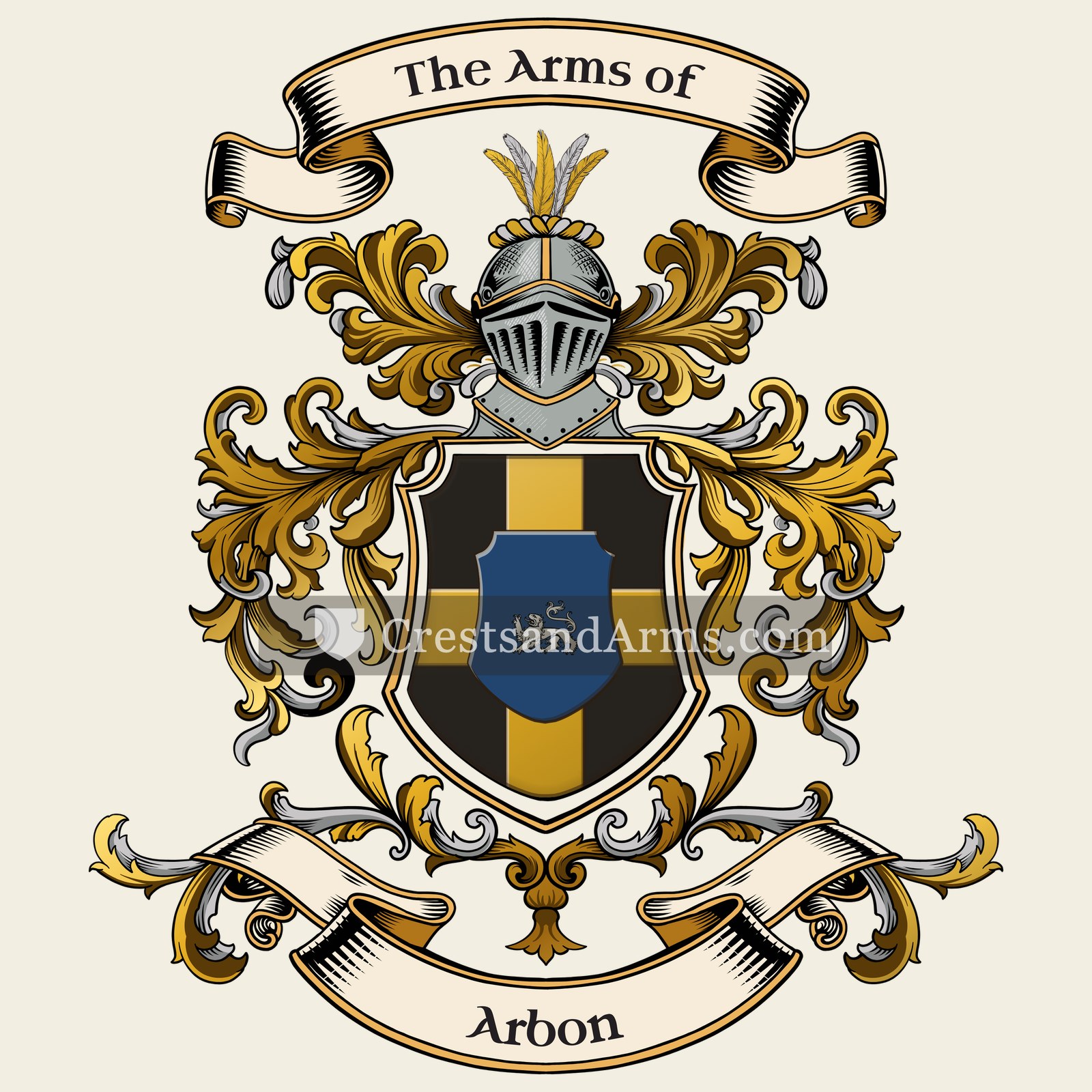
cross symbolChristian faith and service
lionCourage, strength and royalty
Colours
Black (Sable)Means: Constancy
Gold (Or)Means: Generosity
Blue (Azure)Means: Loyalty and truth
Silver (Argent)Means: Peace and sincerity
Historical info
Source
J. B. Rietstap, Armorial Général, Gouda: G. B. van Goor Zonen, 1884–87
Blazon (the actual original written record)
“De sa. à la croix ancrée d'or, ch. d'un écusson d'azur surch. d'un lion d'arg.”
Franche-ComteFranche-Comte, c. 1663
Where the Arbon Arms Were Recorded
Franche-Comte
Map of France showing where the Arbon arms are recorded
The Arbon arms were recorded in Franche-Comte, c. 1663.
Franche-Comte sat between France and the Empire and changed hands more than once. Border families held their land under arms and expected to defend it, so a shield was a practical thing rather than an ornament.
This is where the arms were entered in the register. Families often moved to other parts of the country, so the same name can turn up in more than one region.
The body that granted and recorded arms in France in this period.
Louis XIV of France
Sovereign of the period
Louis XIV of France
1643–1715
Reigning in Switzerland when the Arbon arms are first recorded.
How Arms Worked in France
In France, a coat of arms was a mark of honor that passed down through the male line to all legitimate descendants. Families often used the same shield without changes to show their shared heritage. If a branch wanted to stand out, they could add a small mark to their shield to show their specific place in the family tree.
Granting authority
The Juge d'armes de France acted as the official authority that regulated and verified coats of arms across the country.
How they got arms
Families typically inherited their arms from ancestors, though they could also receive them through royal grants or by proving their noble status.
Where arms were recorded
Coats of arms were officially recorded in the Armorial Général de France, which began its main collection in the year 1696.
The family's standing
Recorded among the armigerous families of Franche-Comte.
Origin & History of the Arbon Family in France
The family name Arbon finds its early roots in the historical region of Franche-Comté, a territory nestled between the Jura Mountains and the Saône River. By the year 1663, records confirm that members of the Arbon family were well-established within this area, which was then a crossroads of cultural and political influence between France and the Holy Roman Empire. The name itself likely evolved from local geographic markers, as the region was defined by its dense forests and rugged terrain. Families living in this part of France during the seventeenth century often relied on agriculture and trade, navigating a period marked by shifting borders and the transition of the province under the rule of King Louis XIV. These early ancestors were part of a resilient community that maintained strong local traditions despite the frequent military conflicts that defined the era. Through their presence in parish registers and regional administrative documents, the Arbon family became a small but permanent part of the complex social fabric of eastern France.
Related Branches & Arms
Root word
Arbor
Latin term referring to a tree or a wooden structure.
This name
ArbonA topographic name for someone who lived near a prominent tree or in a wooded area.
also spelled
Arbone
Arbonn
Arbont
Documented Sources
J. B. Rietstap, Armorial Général, Gouda: G. B. van Goor Zonen, 1884–87
Staatsarchiv des Kantons Thurgau, Kirchenbücher der Pfarrei Arbon (Taufen, Heiraten, Sterbefälle), 1745
Guggenbühl, Gottfried, Geschichte der Schweizerischen Eidgenossenschaft, 1947
Historischer Verein des Kantons Thurgau, Thurgauische Beiträge zur vaterländischen Geschichte, 1935
Digital archive packCoat of arms PNG, gold border print PDF, vector SVG and the certificate of authenticity. Sent to your email in minutes.


 eagleNobility, strength and a keen mind
 eagleNobility, strength and a keen mind
 cross symbolChristian faith and service
 lionCourage, strength and royalty