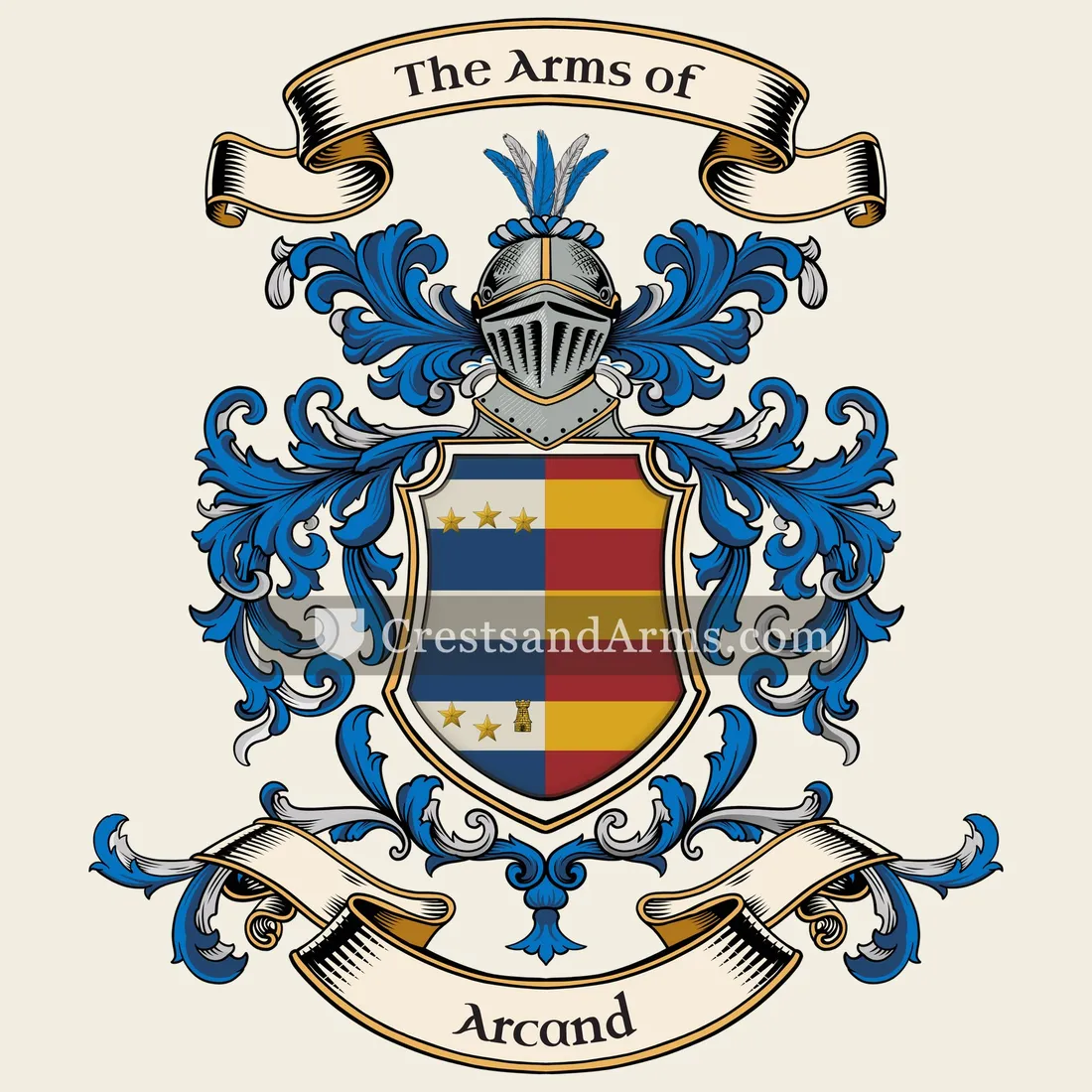
A record of documented arms, meaning and origin, researched for the Arcand family of Spain.
Reg. 5874 · Spanish, A–C
Meaning of the Arcand family crest colors & symbols
Symbols on this shield
fessThe military belt, and readiness to serve
towerGrandeur and solidity, and a stronghold defended
mulletThe third son, and a divine quality from above
Colours
Blue (Azure)Means: Loyalty and truth
Red (Gules)Means: Military strength
Silver (Argent)Means: Peace and sincerity
Gold (Or)Means: Generosity
Historical info
Source
J. B. Rietstap, Armorial Général, Gouda: G. B. van Goor Zonen, 1884–87
Blazon (the actual original written record)
“Parti: au 1 d'azur à une arche de Noé en forme de maison d'or, surm. de cinq étoiles d'or, rangées en demi-orle, 1, 2 et 2, et soutenue de trois fasces ondées d'arg.; au 2 de gu. à trois fasces d'or.”
AragonAragon, c. 1722
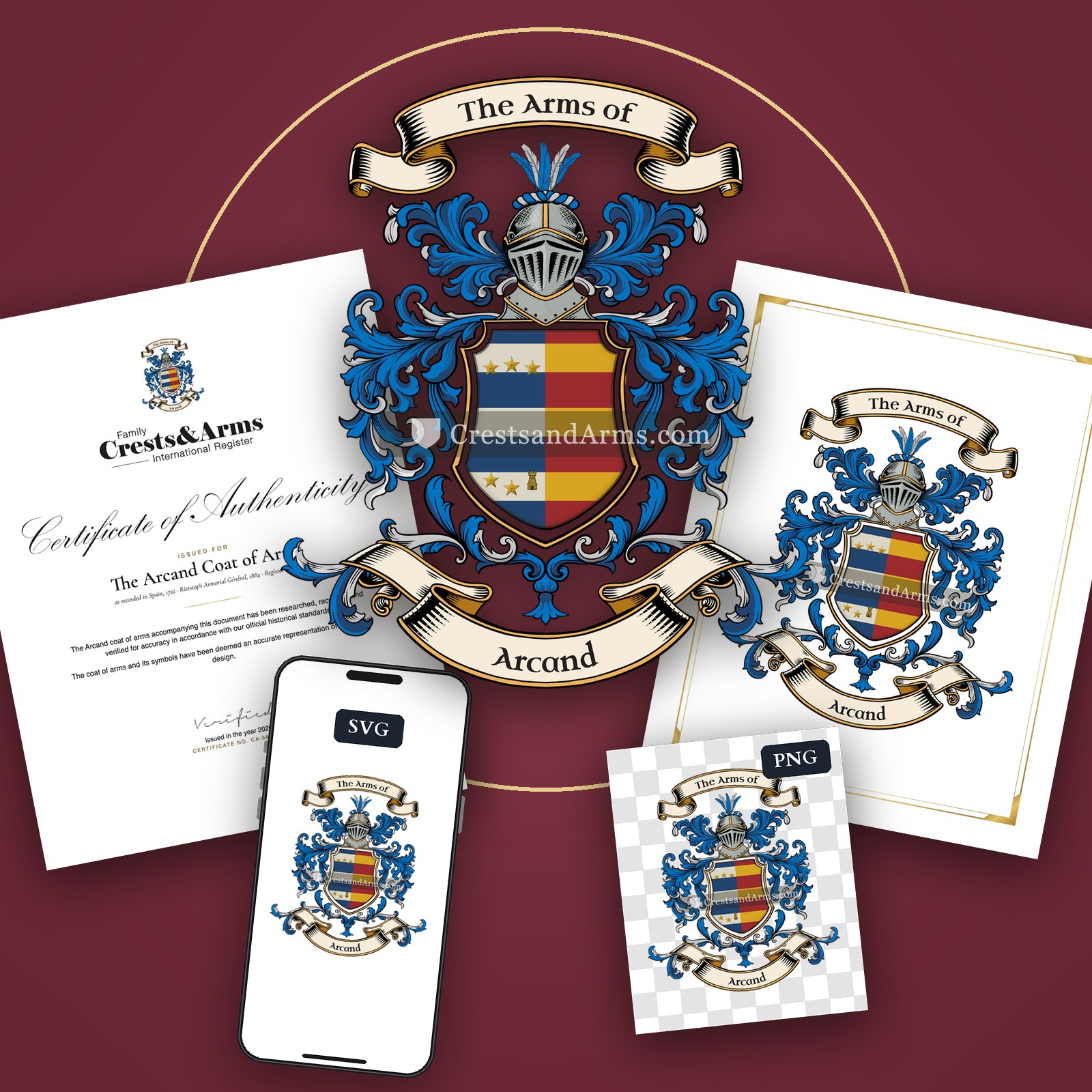
Digital archive packCoat of arms PNG, gold border print PDF, vector SVG and the certificate of authenticity. Sent to your email in minutes.
Map of Spain showing where the Arcand arms are recorded
The Arcand arms were recorded in Aragon, c. 1722.
Aragon was mountain and river country in north-eastern Spain, with a strong tradition of small independent landholders. A great many families counted as gentry there, and each one needed a shield to be told apart.
This is where the arms were entered in the register. Families often moved to other parts of the country, so the same name can turn up in more than one region.
The body that granted and recorded arms in Spain in this period.
Philip V of Spain
Sovereign of the period
Philip V of Spain
1714–1724
Reigning in Spain when the Arcand arms are first recorded.
How Arms Worked in Spain
In Spain, a coat of arms was considered a form of property that belonged to the entire family line. These arms were passed down from a father to all his children equally. Younger branches of the family usually kept the original design without needing to add any special marks to distinguish their specific line.
Granting authority
The Cronista Rey de Armas was the official body that regulated and granted coats of arms throughout Spain.
How they got arms
Families often obtained their arms through royal grants or by proving their noble status to the official heraldic authority.
Where arms were recorded
Coats of arms were officially recorded in the registers of the Cronista Rey de Armas starting in 1496.
The family's standing
Recorded among the armigerous families of Aragon.
Origin & History of the Arcand Family in Spain
The family name Arcand has deep roots that trace back to the rugged landscapes of the Aragon region in northeastern Spain. By the year 1722, records confirm that members of the family were established within this area, which served as a historical crossroads for trade and cultural exchange between the Iberian Peninsula and the rest of Europe. The name itself is thought to be linked to the geographical features of the region, as it likely described families who lived near specific natural landmarks or archways. Over the following generations, the family expanded beyond these initial settlements, eventually moving across borders and adapting to new environments. This early history reflects a pattern of resilience and movement that defined many families living in the transition between the medieval period and the modern era.
Arcand Meaning & Related Branches
Root word
Arca
Latin term referring to a chest, box, or secure storage container.
This name
ArcandDerived from a topographic or occupational descriptor for a chest maker or keeper.
also spelled
Arcaynas
Arcaynae
Arcayn
Arkaina
Documented Sources
J. B. Rietstap, Armorial Général, Gouda: G. B. van Goor Zonen, 1884–87
Archivo de la Corona de Aragón, Censo de población de 1722
Lacarra, José María, Historia política del reino de Navarra desde su fundación hasta su incorporación a Castilla, 1972
Ubieto Arteta, Antonio, Historia de Aragón: La formación territorial, 1981
Digital archive packCoat of arms PNG, gold border print PDF, vector SVG and the certificate of authenticity. Sent to your email in minutes.


 fessThe military belt, and readiness to serve
 towerGrandeur and solidity, and a stronghold defended
 mulletThe third son, and a divine quality from above
 fessThe military belt, and readiness to serve
 towerGrandeur and solidity, and a stronghold defended
 mulletThe third son, and a divine quality from above