Map of Italy showing where the Arcilla arms are recorded
The Arcilla arms were recorded in Sicily, c. 1775.
Sicily was ruled in turn by Normans, Germans, French and Spanish, and each left landed families behind. The island kept formal lists of its noble houses, which is why so many Sicilian names carry recorded arms.
This is where the arms were entered in the register. Families often moved to other parts of the country, so the same name can turn up in more than one region.
The body that granted and recorded arms in Italy in this period.
Alvise Giovanni Mocenigo
Sovereign of the period
Alvise Giovanni Mocenigo
1763–1778
Reigning in Italy when the Arcilla arms are first recorded.
How Arms Worked in Italy
In the Italian states, coats of arms were often used by noble families to show their status and history. These symbols were passed down through the generations to all legitimate male descendants. Younger branches of a family usually kept the original design but sometimes added small changes to distinguish their specific line from the main branch.
Granting authority
Various local rulers and city governments controlled the use of coats of arms across the different Italian states.
How they got arms
Families often assumed their own arms or received them as official grants from local lords, popes, or city councils.
Where arms were recorded
Arms were recorded in local city archives or private family books rather than in one single national register.
The family's standing
Recorded among the armigerous families of Sicily.
Origin & History of the Arcilla Family in Italy
The surname Arcilla is deeply rooted in the linguistic traditions of the Mediterranean, with its origins likely tied to the Latin word *argilla*, which refers to clay or potter’s earth. This suggests that the earliest families bearing this name may have been associated with the craft of pottery or lived in areas known for their rich clay deposits. By 1775, historical records confirm that members of the Arcilla family were well-established in Sicily. During this period, Sicily served as a vital cultural crossroads where families often moved between the island and the southern regions of Spain. The name reflects a history of skilled labor and regional mobility, marking the family as part of the working class that helped shape the local economy and social structure of eighteenth-century Italy.
Arcilla Meaning & Related Branches
Root word
Argilla
Latin word for clay or potter's earth.
This name
ArcillaA topographic name for someone who lived on or worked with clay-rich soil.
also spelled
Arcellae
Arcellas
Arcell
Arsela
Documented Sources
J. B. Rietstap, Armorial Général, Gouda: G. B. van Goor Zonen, 1884–87
D’Alessandro, Vincenzo. Politica e società nella Sicilia aragonese. 1963
De Felice, Emidio. Dizionario dei cognomi italiani. 1978
Archivio di Stato di Palermo, Stato Civile della Restaurazione
Digital archive packCoat of arms PNG, gold border print PDF, vector SVG and the certificate of authenticity. Sent to your email in minutes.


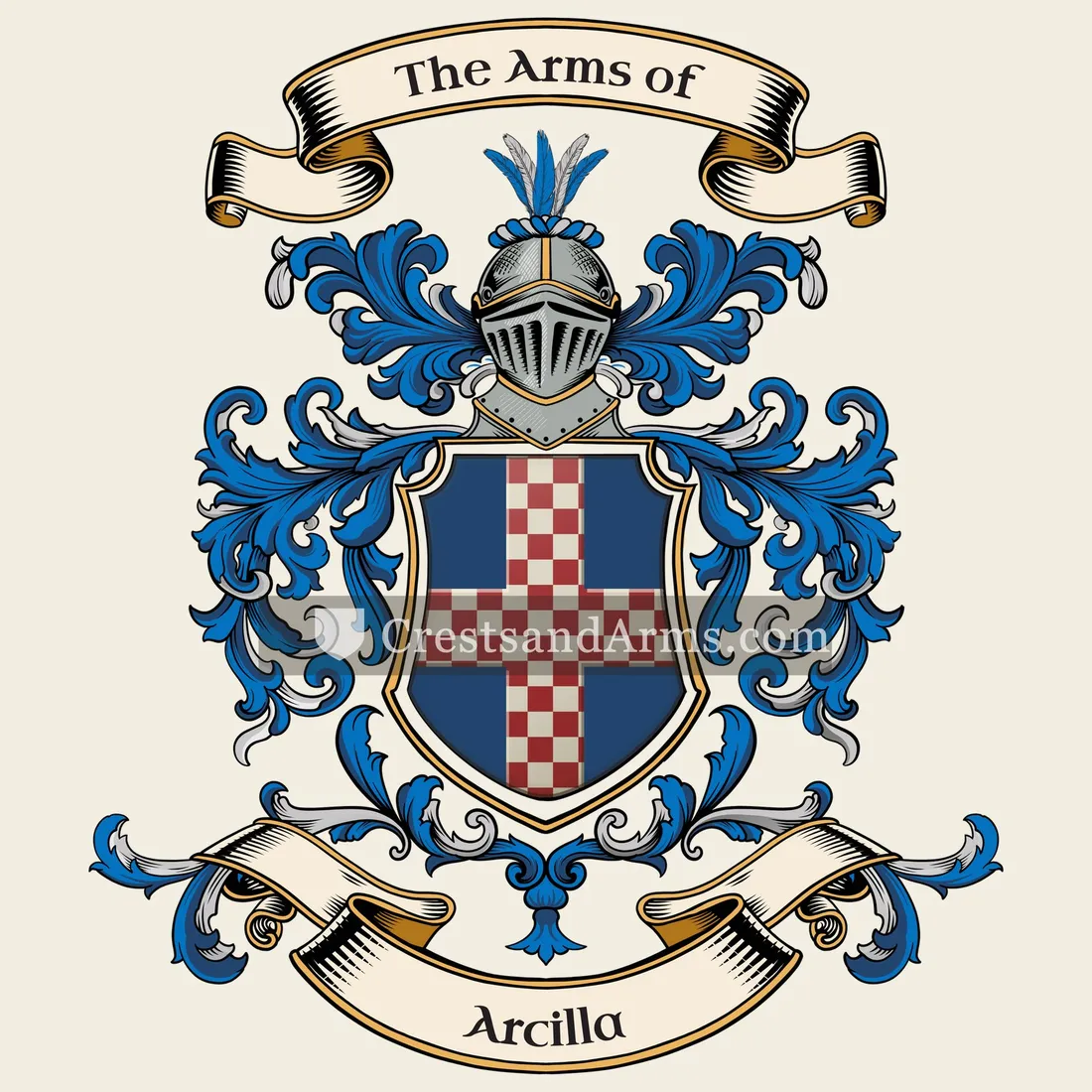
 cross symbolChristian faith and service
 chequyConstancy, and the counting-board
 cross symbolChristian faith and service
 chequyConstancy, and the counting-board