Map of Switzerland showing where the Ardon arms are recorded
The Ardon arms were recorded in Valais, c. 1745.
This is where the arms were entered in the register. Families often moved to other parts of the country, so the same name can turn up in more than one region.
The body that granted and recorded arms in Switzerland in this period.
How Arms Worked in Switzerland
In Switzerland, coats of arms were not restricted to the nobility and were often adopted by common citizens and families. These symbols were passed down through generations to show family identity. When branches of a family grew, they often changed small details of the design to distinguish their own line from the original group.
Granting authority
Cantonal and civic authorities managed the use of coats of arms within their specific regions and local jurisdictions.
How they got arms
Families typically assumed their own coats of arms based on local custom rather than receiving them from a central monarch.
Where arms were recorded
Arms were recorded in various cantonal and civic registers starting from the fourteenth century throughout the Swiss region.
The family's standing
Recorded among the armigerous families of Switzerland.
Origin & History of the Ardon Family in Switzerland
The history of the Ardon family in Switzerland is deeply rooted in the rugged landscape of the Valais region. By the mid-eighteenth century, historical records confirm that members of the family were well-established residents of this alpine canton by 1745. The name itself is closely tied to the geography of the area, as it matches the name of a village located in the central part of the Rhone Valley. Families in this era often took their names from the specific locations where they lived, worked, and managed their land. Life for the Ardon family in the 1700s revolved around the challenges of mountain agriculture and the tight-knit social structures of local parishes. As members of a community defined by high mountain passes and river valleys, the early Ardon family played a role in the local history of the Valais during a time of significant cultural and political transition in Switzerland.
Coat of Arms & Family Crest Details
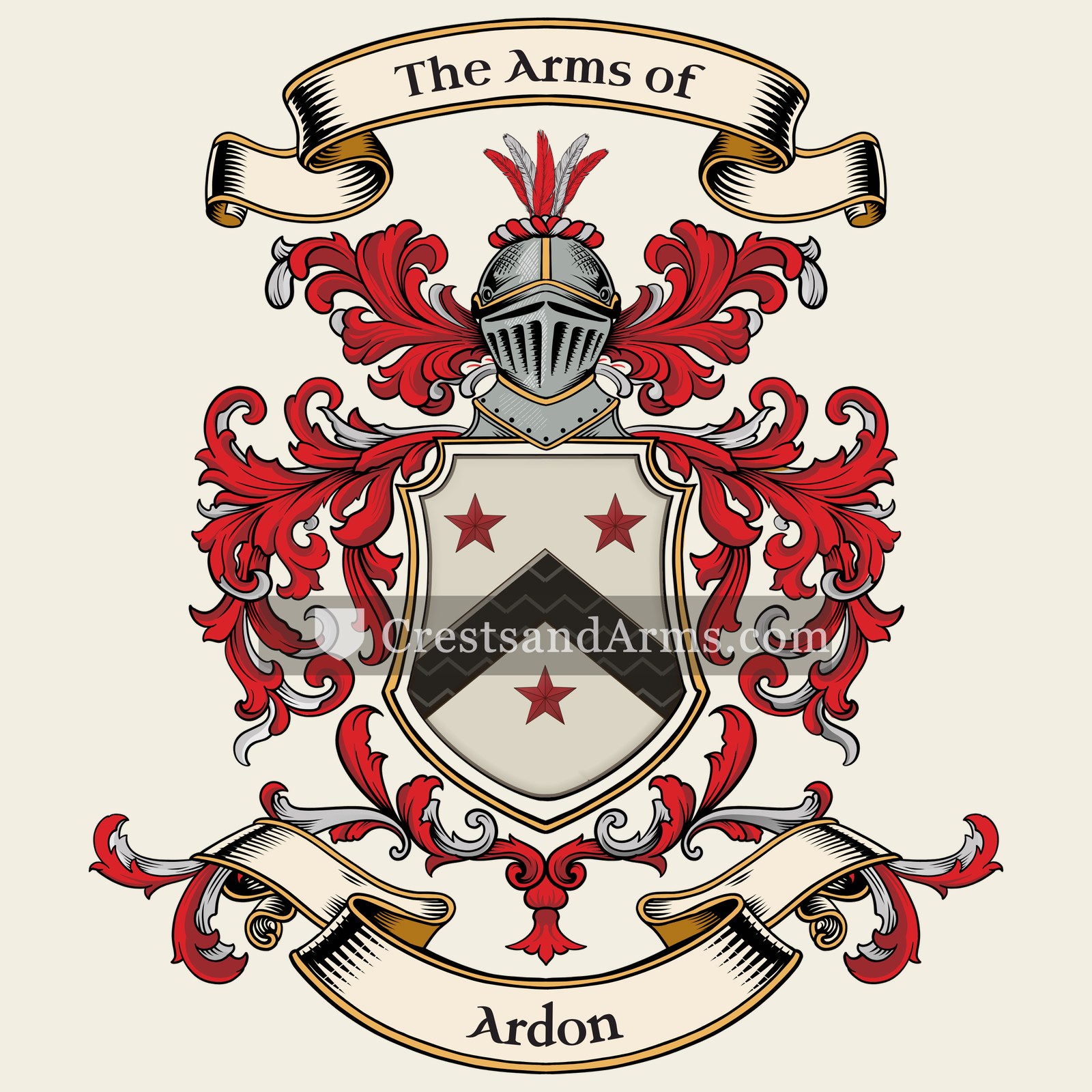
Symbols on this shield
chevronProtection, and faithful service completed
mulletThe third son, and a divine quality from above
Colours
Silver (Argent)Means: Peace and sincerity
Black (Sable)Means: Constancy
Red (Gules)Means: Military strength
Historical info
Source
Sir Bernard Burke, The General Armory of England, Scotland, Ireland and Wales, London: Harrison & Sons, 1884
Blazon (the actual original written record)
“Ar. a chev. sa. betw. three stars gu”
EssexEssex, c. 1620
Digital archive packCoat of arms PNG, gold border print PDF, vector SVG and the certificate of authenticity. Sent to your email in minutes.
Map of England showing where the Ardon arms are recorded
The Ardon arms were recorded in Essex, c. 1620.
Essex lay close enough to London for City money to buy land there. Merchants who prospered moved out to estates within a day's ride, and a new landowner almost always wanted arms to go with the ground.
This is where the arms were entered in the register. Families often moved to other parts of the country, so the same name can turn up in more than one region.
The body that granted and recorded arms in England in this period.
James VI and I
Sovereign of the period
James VI and I
1603–1625
Reigning in Switzerland when the Ardon arms are first recorded.
How Arms Worked in England
English heraldry allowed arms to be shared by all legitimate descendants of the original owner. These symbols were treated as personal property that moved through the generations to all children. While the eldest son kept the original design, other family members could use the same shield without needing to change it or register their own unique versions.
Granting authority
The College of Arms in London has regulated the use of coats of arms throughout England and Wales since 1484.
How they got arms
Families typically obtained their coats of arms through a formal grant from the Crown or by proving their ancient right to them.
Where arms were recorded
All official coats of arms are recorded in the registers kept at the College of Arms, which date back to the fifteenth century.
The family's standing
Recorded among the armigerous families of Essex.
Origin & History of the Ardon Family in England
The Ardon family name has roots that trace back to the rural landscapes of Essex during the early seventeenth century. By 1620, records confirm that members of the family were established within this region, which was a hub of agricultural activity and trade near London. The name likely evolved from local geographic features or descriptive nicknames common to the people living in the English countryside at that time. As families in Essex often worked as farmers or skilled tradespeople, the Ardon name became linked to the local parish records that tracked births, marriages, and deaths in small village communities. These early ancestors lived through a period of significant social change in England, and their presence in the historical record highlights the steady growth of families who helped shape the identity of the Essex region over several generations.
Ardon Meaning & Related Branches
Root word
Arduus
Latin term meaning steep, high, difficult, or lofty.
This name
ArdonDerived from a topographic location referring to someone living near a steep hill or mountain.
also spelled
Ardone
Ardonn
Ardo
Arden
Ardyn
Related arms
Ardanvariant spelling
Ardenvariant spelling
Ardynvariant spelling
Documented Sources
J. B. Rietstap, Armorial Général, Gouda: G. B. van Goor Zonen, 1884–87
Archives de l'État du Valais, Registres paroissiaux de la commune d'Ardon
Archives de l'État du Valais, Fonds de la famille Ardon
Anton Riva, Histoire du Valais, 2001
Jean-Émile Tamini, Essai sur l'histoire de la commune d'Ardon, 1934
Digital archive packCoat of arms PNG, gold border print PDF, vector SVG and the certificate of authenticity. Sent to your email in minutes.


 keyGuardianship, and the office of a steward
 keyGuardianship, and the office of a steward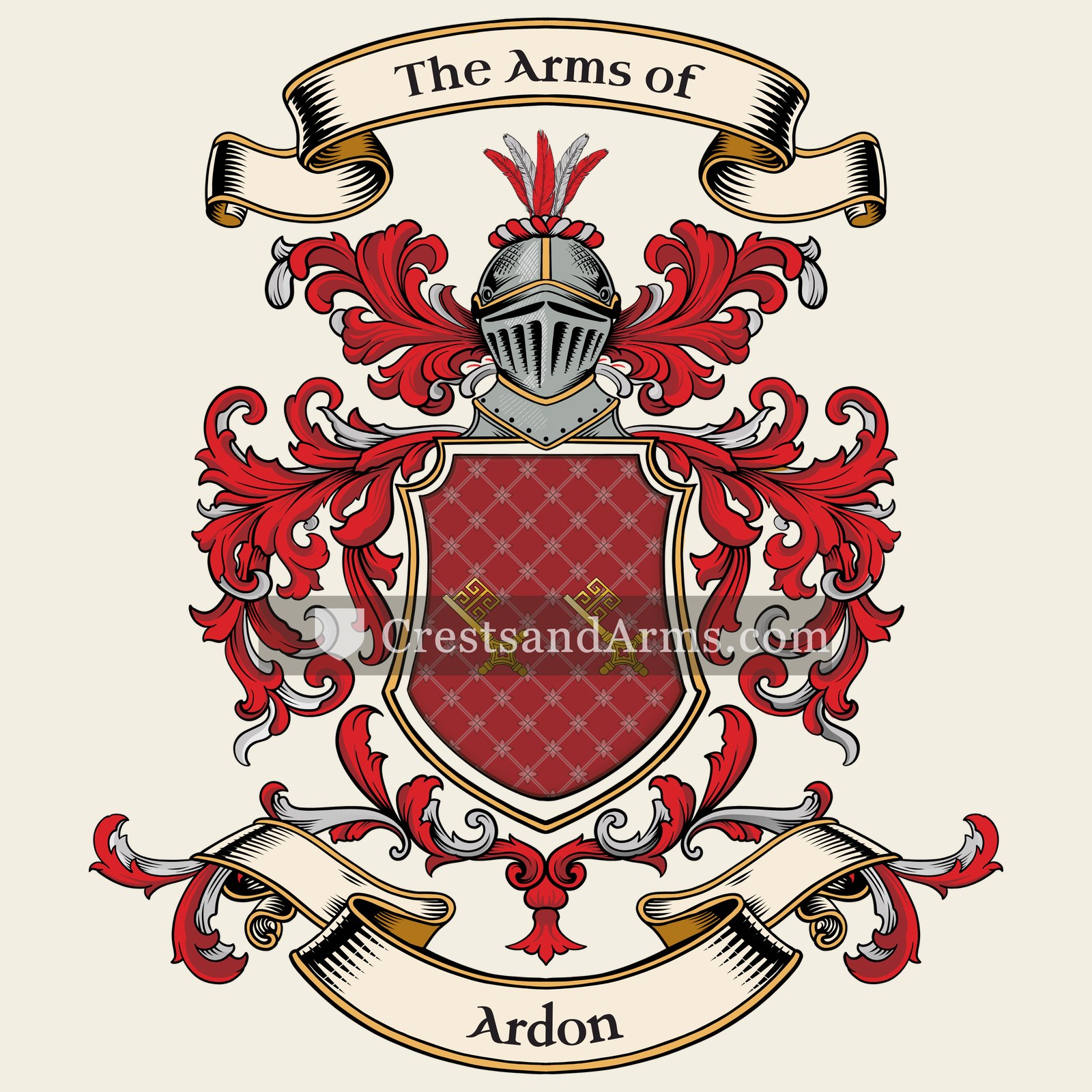

 chevronProtection, and faithful service completed
 mulletThe third son, and a divine quality from above