Map of Italy showing where the Arenas arms are recorded
The Arenas arms were recorded in Bologne, c. 1775.
This is where the arms were entered in the register. Families often moved to other parts of the country, so the same name can turn up in more than one region.
The body that granted and recorded arms in Italy in this period.
Alvise Giovanni Mocenigo
Sovereign of the period
Alvise Giovanni Mocenigo
1763–1778
Reigning in Italy when the Arenas arms are first recorded.
How Arms Worked in Italy
In the Italian states, coats of arms were often used by noble families to show their status and history. These symbols were passed down through the generations to all legitimate male descendants. Younger branches of a family usually kept the original design but sometimes added small changes to distinguish their specific line from the main branch.
Granting authority
Various local rulers and city governments controlled the use of coats of arms across the different Italian states.
How they got arms
Families often assumed their own arms or received them as official grants from local lords, popes, or city councils.
Where arms were recorded
Arms were recorded in local city archives or private family books rather than in one single national register.
The family's standing
Recorded among the armigerous families of Italy.
Origin & History of the Arenas Family in Italy
The family name Arenas is primarily of Spanish origin, derived from the word for sand, which often described people who lived near sandy areas or riverbanks. While the name is deeply rooted in the Iberian Peninsula, historical records confirm that members of the family had established a presence in the city of Bologna by 1775. During the eighteenth century, Bologna served as a major crossroads for travelers, scholars, and merchants moving between Spain and the Italian states. The presence of the Arenas family in this region suggests they were likely part of the professional or merchant classes who moved across Europe to pursue trade or administrative roles. Their relocation to such a significant cultural hub highlights the family's involvement in the broader social and economic shifts occurring across the Mediterranean world during that era.
Related Branches & Arms
Root word
Arena
Latin term for sand or a sandy place.
This name
ArenasRefers to a person who lived near a sandy area or a coastal region.
also spelled
Arenae
Arenas
Aren
Documented Sources
J. B. Rietstap, Armorial Général, Gouda: G. B. van Goor Zonen, 1884–87
De Felice, Emidio. Dizionario dei cognomi italiani. 1978
Moll, Francesc de B. Els llinatges catalans. 1959
Archivio di Stato di Bologna, Stato civile della Restaurazione
Digital archive packCoat of arms PNG, gold border print PDF, vector SVG and the certificate of authenticity. Sent to your email in minutes.


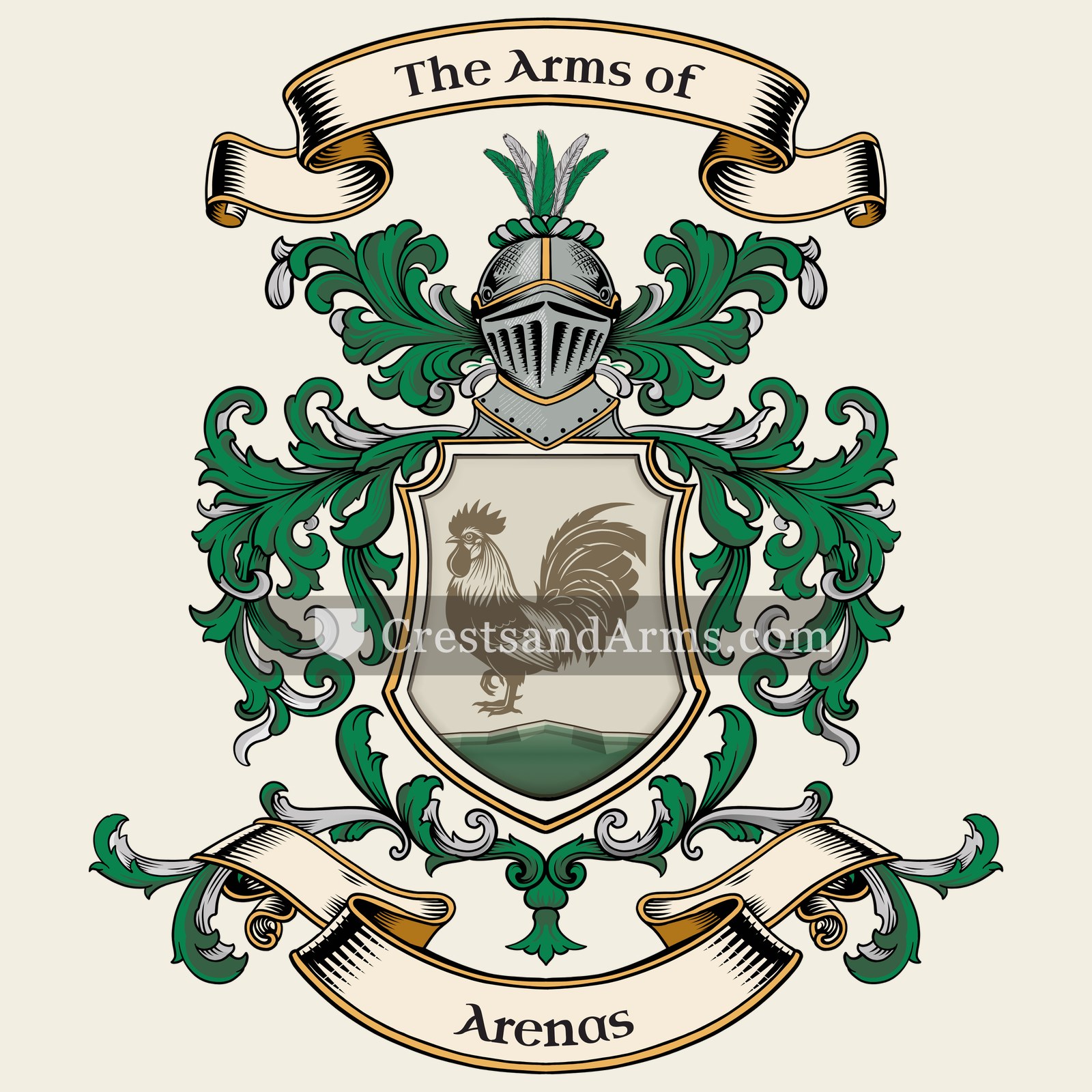
 mountThe ground held, and steadfastness upon it
 cockCourage, vigilance and readiness for battle
 mountThe ground held, and steadfastness upon it
 cockCourage, vigilance and readiness for battle