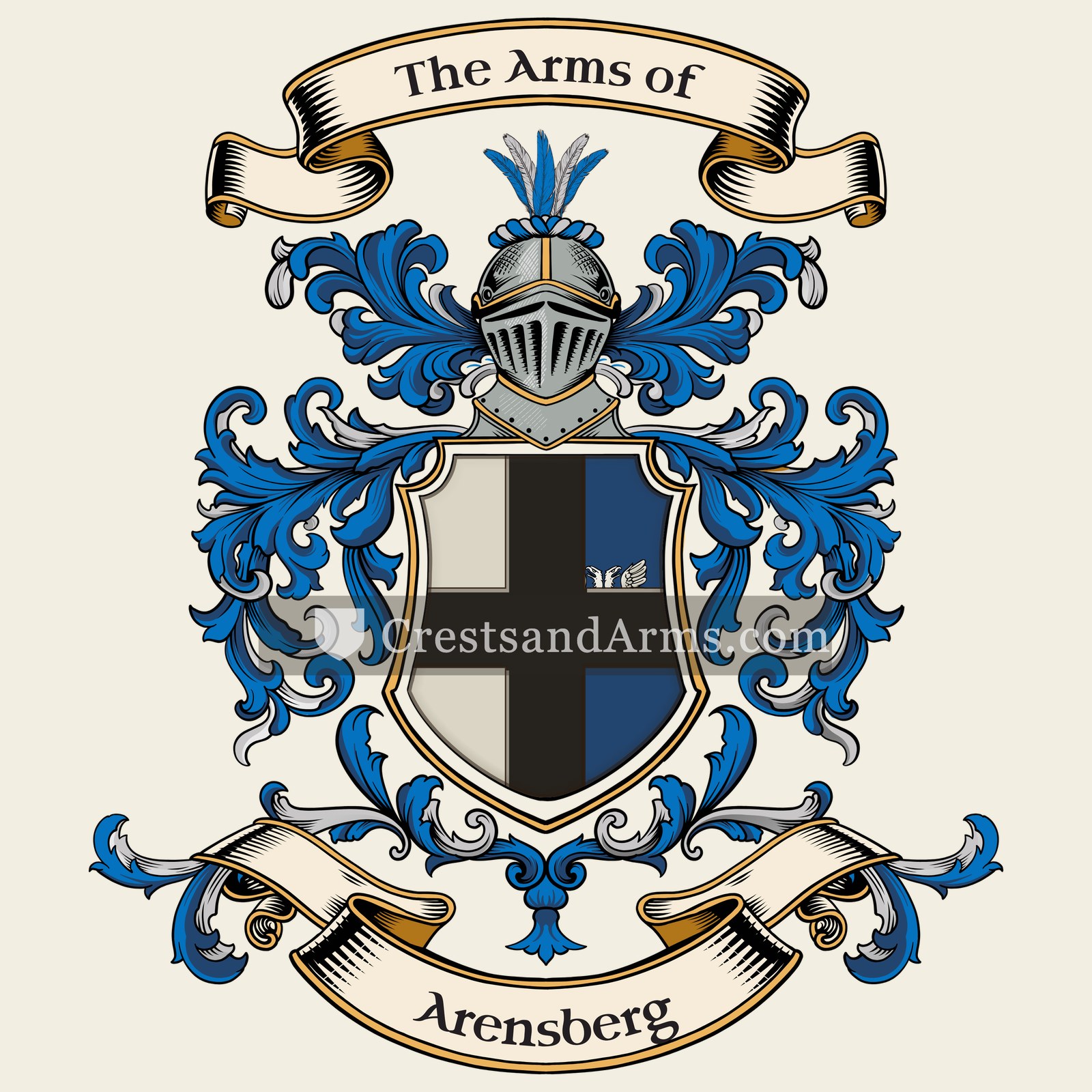
A record of documented arms, meaning and origin, researched for the Arensberg family of France.
Reg. 9952 · French, A–C
Coat of Arms & Family Crest Details
Symbols on this shield
cross symbolChristian faith and service
eagleNobility, strength and a keen mind
Colours
Silver (Argent)Means: Peace and sincerity
Blue (Azure)Means: Loyalty and truth
Black (Sable)Means: Constancy
Historical info
Source
J. B. Rietstap, Armorial Général, Gouda: G. B. van Goor Zonen, 1884–87
Blazon (the actual original written record)
“Parti: au 1 d'arg. à la croix de sa.; au 2 d'azur à l'aigle d'arg. Cq. cour. C.: un lion iss. de gu., tenant de sa patte dextre une rose du même, tigée et feuillée de sin. L.: à dextre d'arg. et d'azur, à sen. d'or et de sa.”
BavariaBavaria, c. 1818
Digital archive packCoat of arms PNG, gold border print PDF, vector SVG and the certificate of authenticity. Sent to your email in minutes.
Map of France showing where the Arensberg arms are recorded
The Arensberg arms were recorded in Bavaria, c. 1818.
Bavaria was a country of old landed families and walled market towns. Estates passed down the same line for centuries, and both the landowners and the leading townsmen kept arms, which is why so many Bavarian names sit in the registers.
This is where the arms were entered in the register. Families often moved to other parts of the country, so the same name can turn up in more than one region.
The body that granted and recorded arms in France in this period.
How Arms Worked in France
In France, a coat of arms was a mark of honor that passed down through the male line to all legitimate descendants. Families often used the same shield without changes to show their shared heritage. If a branch wanted to stand out, they could add a small mark to their shield to show their specific place in the family tree.
Granting authority
The Juge d'armes de France acted as the official authority that regulated and verified coats of arms across the country.
How they got arms
Families typically inherited their arms from ancestors, though they could also receive them through royal grants or by proving their noble status.
Where arms were recorded
Coats of arms were officially recorded in the Armorial Général de France, which began its main collection in the year 1696.
The family's standing
Recorded among the armigerous families of Bavaria.
Origin & History of the Arensberg Family in France
The family name Arensberg is a topographic surname, meaning it was originally derived from the physical landscape where the earliest ancestors lived. The name is composed of two German words, with "Aren" likely referring to an eagle and "Berg" meaning a mountain or hill. This suggests that the first people to carry the name lived near a prominent, eagle-inhabited peak or a fortified settlement built upon high ground. By the year 1818, records confirm that members of the Arensberg family were well-established in the Bavarian region of Germany. During this period, the family likely lived as part of the rural agricultural society that defined the Bavarian landscape, where they would have been subject to the local administrative and church record-keeping systems of the time. The name remained tied to these regional roots as families moved through the various towns and villages of southern Germany, maintaining their identity through a period of significant political and social change in the early nineteenth century.
Arensberg Meaning & Related Branches
Root word
Aren-Berg
Eagle mountain or eagle hill
This name
ArensbergRefers to a dweller near a mountain associated with eagles or a fortified hill.
also spelled
Arensberge
Arensbergg
Arensberk
Arensburg
Documented Sources
J. B. Rietstap, Armorial Général, Gouda: G. B. van Goor Zonen, 1884–87
Bahlow, Hans, Deutsches Namenlexikon: Familien- und Vornamen nach Ursprung und Sinn erklärt, 1967
Bayerisches Hauptstaatsarchiv, Kirchenbücher und Standesregister, 1818
Heintze, Albert, Die deutschen Familien-Namen: geschichtlich, geographisch, sprachlich, 1903
Digital archive packCoat of arms PNG, gold border print PDF, vector SVG and the certificate of authenticity. Sent to your email in minutes.


 cross symbolChristian faith and service
 eagleNobility, strength and a keen mind
 cross symbolChristian faith and service
 eagleNobility, strength and a keen mind