Map of France showing where the Armbruster arms are recorded
The Armbruster arms were recorded in Strasbourg, c. 1663.
This is where the arms were entered in the register. Families often moved to other parts of the country, so the same name can turn up in more than one region.
The body that granted and recorded arms in France in this period.
Louis XIV of France
Sovereign of the period
Louis XIV of France
1643–1715
Reigning in France when the Armbruster arms are first recorded.
How Arms Worked in France
In France, a coat of arms was a mark of honor that passed down through the male line to all legitimate descendants. Families often used the same shield without changes to show their shared heritage. If a branch wanted to stand out, they could add a small mark to their shield to show their specific place in the family tree.
Granting authority
The Juge d'armes de France acted as the official authority that regulated and verified coats of arms across the country.
How they got arms
Families typically inherited their arms from ancestors, though they could also receive them through royal grants or by proving their noble status.
Where arms were recorded
Coats of arms were officially recorded in the Armorial Général de France, which began its main collection in the year 1696.
The family's standing
Recorded among the armigerous families of France.
Origin & History of the Armbruster Family in France
The surname Armbruster is of German origin and serves as a classic example of an occupational name. It is derived from the Middle High German word *armbrust*, which means crossbow, and the suffix *-er*, which identifies a person by their trade. Historically, an Armbruster was a professional maker or repairer of crossbows, a vital role in medieval society before the widespread use of firearms. By 1663, records confirm that members of the Armbruster family were established in Strasbourg, a city that served as a major cultural and economic crossroads between the German and French worlds. During this period, the family likely benefited from the city’s status as a hub for skilled craftsmen and trade guilds. As the crossbow eventually gave way to newer military technologies, families carrying this name often transitioned into other forms of metalworking, carpentry, or civic administration, allowing the name to persist through the centuries as a reminder of their ancestors' technical expertise.
Armbruster Meaning & Related Branches
Root word
Armbrust
A crossbow or a weapon used for shooting projectiles.
This name
ArmbrusterAn occupational surname for a crossbow maker or a soldier who used a crossbow.
also spelled
Armbrusteri
Armbrust
Armbrustor
Armbrustar
Related arms
Ersteinsimilar arms
Documented Sources
J. B. Rietstap, Armorial Général, Gouda: G. B. van Goor Zonen, 1884–87
Bahlow, Hans, Deutsches Namenlexikon: Familien- und Vornamen nach Ursprung und Sinn erklärt, 1967
Heintze, Albert, Die deutschen Familiennamen: geschichtlich, geographisch, sprachlich, 1903
Archives de la ville et de l'Eurométropole de Strasbourg, Registres paroissiaux et d'état civil
Digital archive packCoat of arms PNG, gold border print PDF, vector SVG and the certificate of authenticity. Sent to your email in minutes.


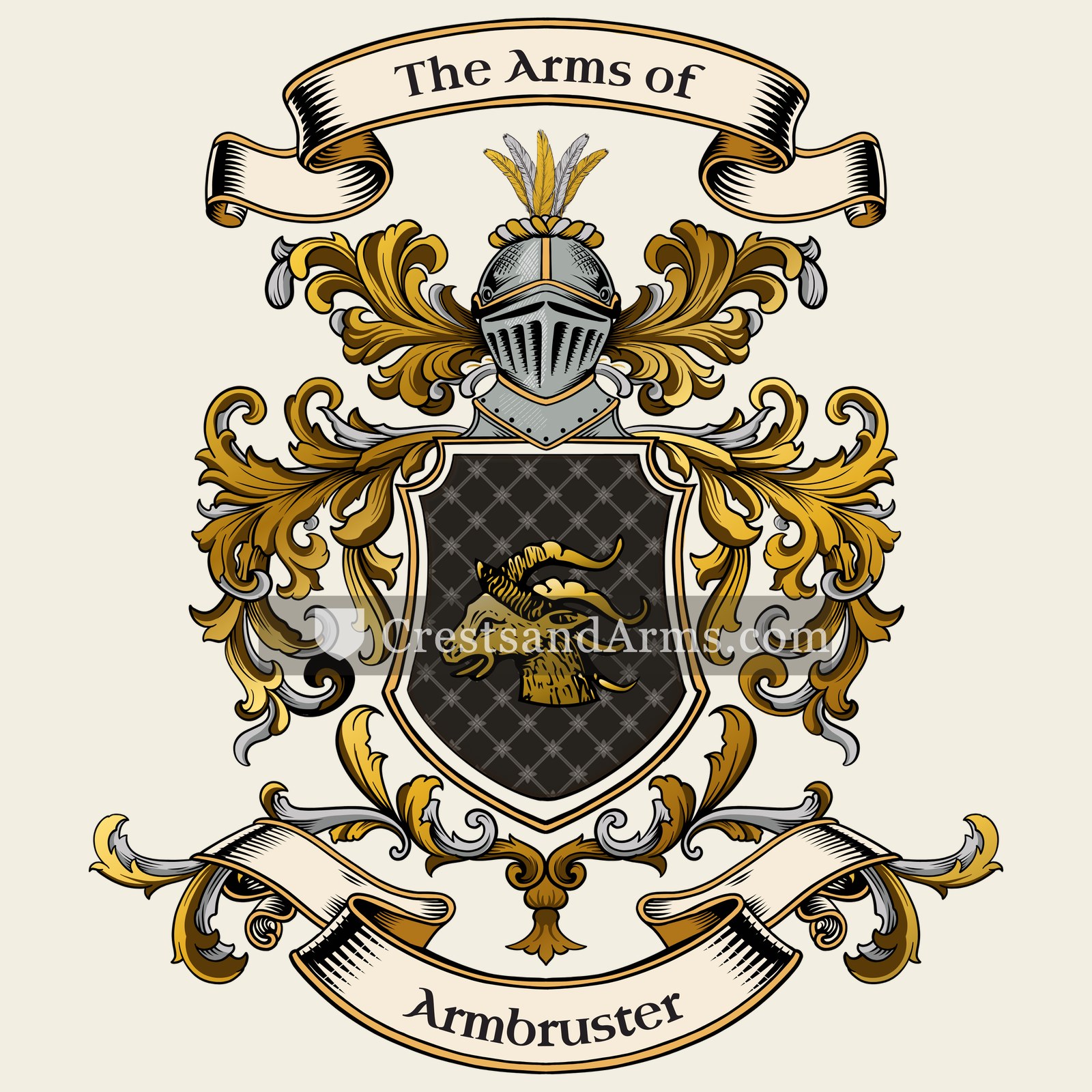
 goats headWisdom, and one who wins by policy rather than force
 goats headWisdom, and one who wins by policy rather than force