Map of France showing where the Arnaud arms are recorded
The Arnaud arms were recorded in Berry, c. 1663.
Berry was central French farming country, quiet and long-settled. Its estates were modest and stayed in the same hands for centuries, and steady landholding of that kind is exactly what puts a name into the heraldic records.
This is where the arms were entered in the register. Families often moved to other parts of the country, so the same name can turn up in more than one region.
The body that granted and recorded arms in France in this period.
Louis XIV of France
Sovereign of the period
Louis XIV of France
1643–1715
Reigning in France when the Arnaud arms are first recorded.
How Arms Worked in France
In France, a coat of arms was a mark of honor that passed down through the male line to all legitimate descendants. Families often used the same shield without changes to show their shared heritage. If a branch wanted to stand out, they could add a small mark to their shield to show their specific place in the family tree.
Granting authority
The Juge d'armes de France acted as the official authority that regulated and verified coats of arms across the country.
How they got arms
Families typically inherited their arms from ancestors, though they could also receive them through royal grants or by proving their noble status.
Where arms were recorded
Coats of arms were officially recorded in the Armorial Général de France, which began its main collection in the year 1696.
The family's standing
Recorded among the armigerous families of Berry.
Origin & History of the Arnaud Family in France
The name Arnaud is a classic example of a personal name evolving into a hereditary surname during the Middle Ages in France. It originates from the Germanic name Arnwald, which combines the words for eagle and power. Because this name was popular among the Frankish nobility and early Christian figures, it spread rapidly across different regions of the country. By the time the family was documented in the province of Berry in 1663, the name had already been established for centuries as a common identifier for families of various social standings. In the rural landscape of central France, families like the Arnauds often lived as landowners or skilled tradespeople who helped shape the local economy. Their presence in Berry during the seventeenth century reflects a long history of families putting down deep roots in specific provinces, where they contributed to the agricultural and social life of the region for generations.
Coat of Arms & Family Crest Details
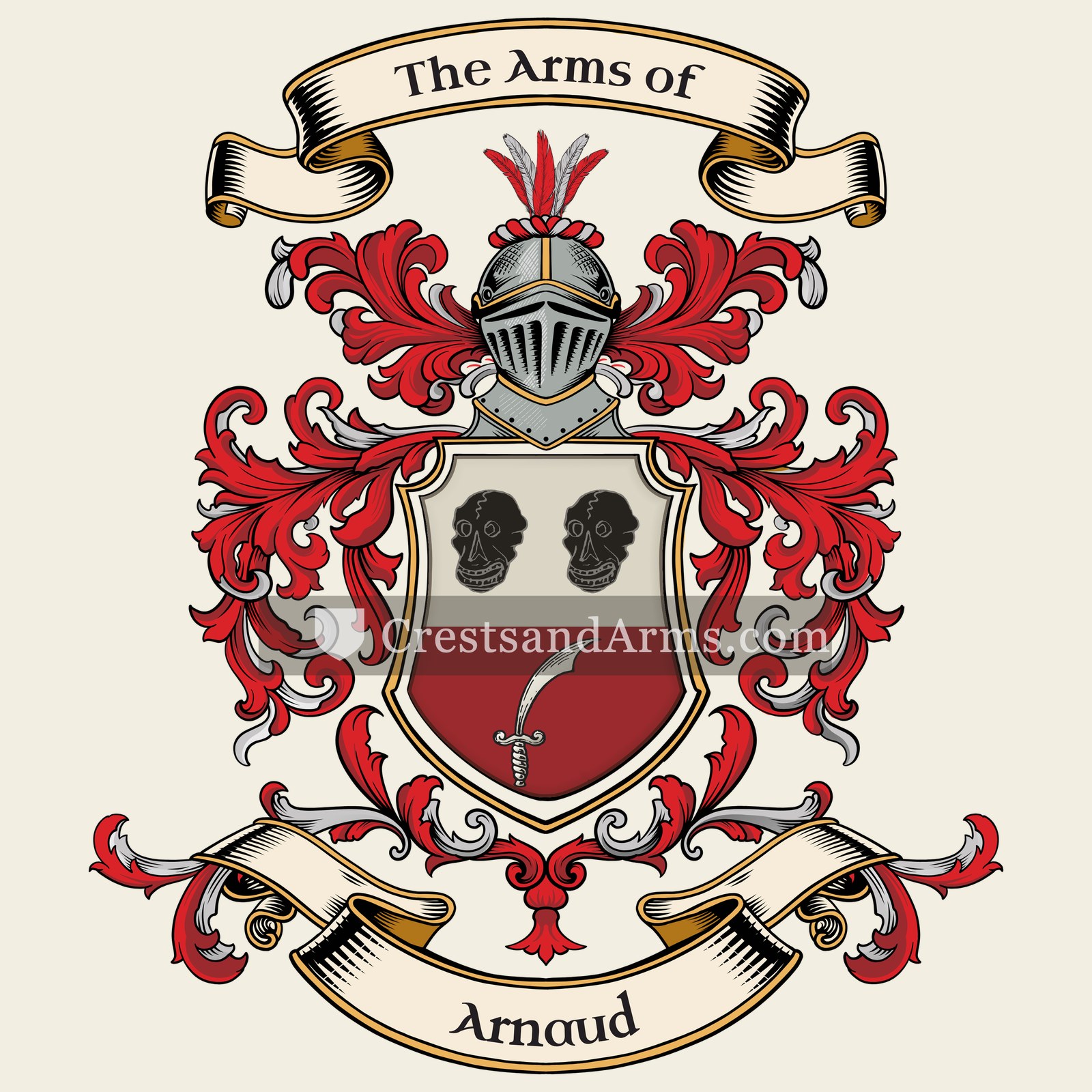
Symbols on this shield
skullMortality remembered, and courage in the face of death
swordJustice, and military honour
Colours
Silver (Argent)Means: Peace and sincerity
Red (Gules)Means: Military strength
Black (Sable)Means: Constancy
Historical info
Source
J. B. Rietstap, Armorial Général, Gouda: G. B. van Goor Zonen, 1884–87
Blazon (the actual original written record)
“Coupé: au 1 d'arg. à deux crânes de boeufs de sa., accornés d'or, accostés; au 2 de gu. à une épée d'arg., posée en fasce, garnie d'or.”
Netherlandsc. 1815
Digital archive packCoat of arms PNG, gold border print PDF, vector SVG and the certificate of authenticity. Sent to your email in minutes.
Map of Netherlands showing where the Arnaud arms are recorded
The Arnaud arms were recorded in Netherlands, c. 1815.
Arms such as these were typically recorded in Friesland.
Friesland was low, wet country on the northern coast of the Netherlands, farmed by families who had held the same land for centuries. Free landholders were unusually common there, and a free landholder could carry arms.
This is where the arms were entered in the register. Families often moved to other parts of the country, so the same name can turn up in more than one region.
Region
Friesland
First recorded
1815
Granting Authority for the Arnaud Arms
Hoge Raad van Adel
Photograph made by me · CC BY-SA 3.0
The body that granted and recorded arms in Netherlands in this period.
William I of the Netherlands
Sovereign of the period
William I of the Netherlands
1815–1840
Reigning in France when the Arnaud arms are first recorded.
How Arms Worked in Netherlands
In the Netherlands, coats of arms were often used by noble families and those who held specific public offices. These arms were passed down through the generations to legitimate descendants. Younger branches of a family usually kept the original design without needing to add special marks. This system ensured that the family identity remained clear and consistent over many years.
Granting authority
The Hoge Raad van Adel is the official body that regulates and manages noble titles and coats of arms in the Netherlands.
How they got arms
Families typically obtained their coats of arms through official royal grants or by proving their long-standing historical use of the symbols.
Where arms were recorded
Coats of arms are officially recorded in the registers held by the Hoge Raad van Adel, which began its work in 1814.
The family's standing
Recorded among the armigerous families of Netherlands.
Origin & History of the Arnaud Family in Netherlands
The surname Arnaud carries a deep history that traces back to ancient Germanic roots, meaning "eagle power." While the name is often associated with French origins, its presence in the Netherlands highlights the movement of families across European borders during times of political change. By 1815, records confirm that members of the Arnaud family were established in the northern province of Friesland. This period was a time of great transition for the Dutch people as they transitioned from the Napoleonic era into the newly formed United Kingdom of the Netherlands. Families living in Friesland during this time were often part of a society that valued local tradition while adapting to new national laws. The appearance of the Arnaud name in these regional registers suggests that the family had integrated into the local community, likely participating in the agricultural or professional life that defined the Frisian landscape in the early nineteenth century.
Arnaud Meaning & Related Branches
Root word
Arnwald
A Germanic compound meaning eagle and power or ruler.
This name
ArnaudDerived from the Old French form of a Germanic name signifying the power of an eagle.
also spelled
Arnault
Arno
Related arms
Espezsimilar arms
Arnauld de Calavonvariant spelling
Arnaultvariant spelling
Arnault de Sarasignacvariant spelling
Documented Sources
J. B. Rietstap, Armorial Général, Gouda: G. B. van Goor Zonen, 1884–87
Dauzat, Albert. Dictionnaire étymologique des noms et prénoms de France. 1951
Morlet, Marie-Thérèse. Dictionnaire étymologique des noms de famille. 1991
Archives Départementales du Cher, Registres paroissiaux et état civil
Digital archive packCoat of arms PNG, gold border print PDF, vector SVG and the certificate of authenticity. Sent to your email in minutes.


 chevronProtection, and faithful service completed
 mulletThe third son, and a divine quality from above
 crescentHonour by the sovereign, and the second son
 chevronProtection, and faithful service completed
 mulletThe third son, and a divine quality from above
 crescentHonour by the sovereign, and the second son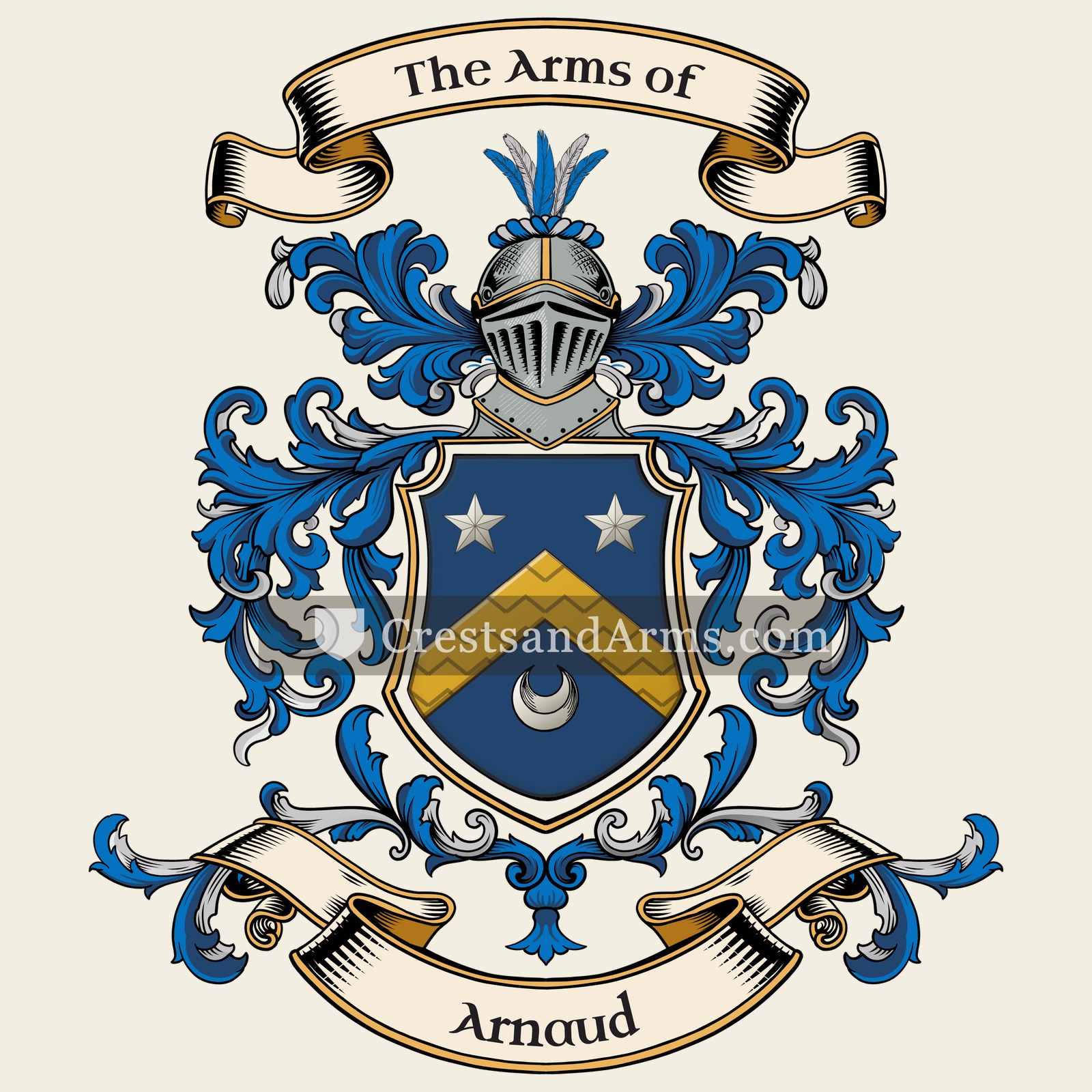


 skullMortality remembered, and courage in the face of death
 swordJustice, and military honour