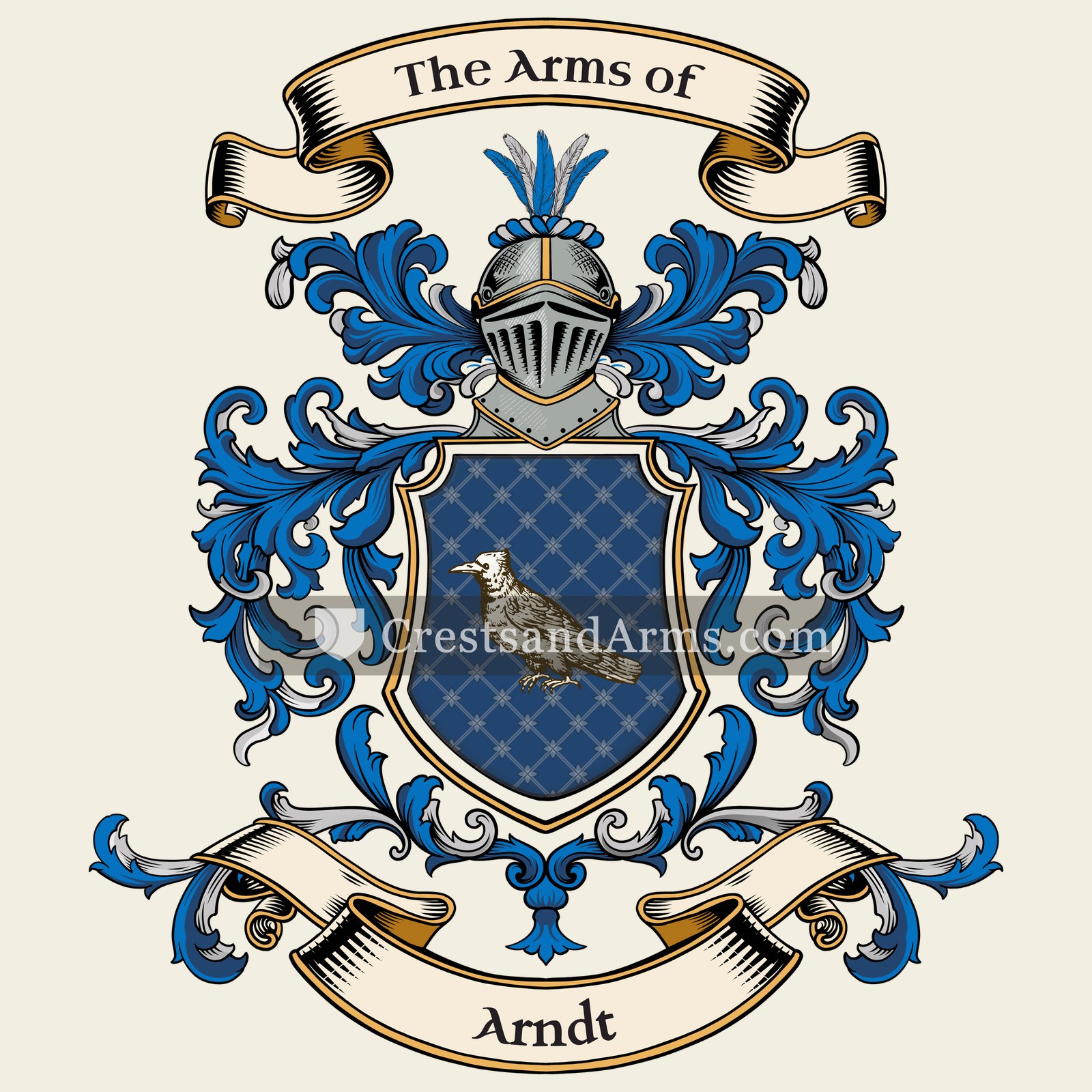
A record of documented arms, meaning and origin, researched for the Arndt family lines. Documented in 2 countries.
Reg. 8173 · German, A–C
Coat of Arms & Family Crest Details
Symbols on this shield
columnFortitude and constancy
mulletThe third son, and a divine quality from above
buckleFidelity, and a bond firmly held
boars headA fierce fighter who battles to the end
Colours
Red (Gules)Means: Military strength
Blue (Azure)Means: Loyalty and truth
Gold (Or)Means: Generosity
Silver (Argent)Means: Peace and sincerity
Black (Sable)Means: Constancy
Historical info
Source
J. B. Rietstap, Armorial Général, Gouda: G. B. van Goor Zonen, 1884–87
Blazon (the actual original written record)
“Parti: au 1 de gu. à la colonne d'arg., surm. d'une étoile d'or; au 2 d'azur au fermail ovale d'arg., l'ardillon à dextre, acc. de deux hures de sanglier de sa., défendues d'arg., 1 en chef et 1 en p. L'écu bordé d'or. Cq. cour. C.: une chouette au nat., posée de front. L. d'or et de gu. D.: RECTITUDINE STO.”
Germanyc. 1798
Digital archive packCoat of arms PNG, gold border print PDF, vector SVG and the certificate of authenticity. Sent to your email in minutes.
Map of Germany showing where the Arndt arms are recorded
The Arndt arms were recorded in Germany, c. 1798.
Arms such as these were typically recorded in Bavaria.
Bavaria was a country of old landed families and walled market towns. Estates passed down the same line for centuries, and both the landowners and the leading townsmen kept arms, which is why so many Bavarian names sit in the registers.
This is where the arms were entered in the register. Families often moved to other parts of the country, so the same name can turn up in more than one region.
The body that granted and recorded arms in Germany in this period.
Francis II, Holy Roman Emperor
Sovereign of the period
Francis II, Holy Roman Emperor
1792–1806
Reigning in Germany when the Arndt arms are first recorded.
How Arms Worked in Germany
In the Holy Roman Empire, coats of arms were often granted to individuals by the Emperor or his representatives. These arms were then passed down through the generations to all legitimate descendants of the original holder. Younger branches of a family usually kept the same shield design without needing to change it, as the arms belonged to the entire lineage.
Granting authority
The Holy Roman Emperor held the sole power to grant new coats of arms throughout his vast imperial territories.
How they got arms
Families typically obtained their coats of arms through a formal imperial grant or by proving their noble status to the authorities.
Where arms were recorded
These grants were officially recorded in the Imperial Chancery registers, which began keeping formal records of such honors during the Middle Ages.
The family's standing
Recorded among the armigerous families of Germany.
Origin & History of the Arndt Family in Germany
The surname Arndt finds its origins in the Germanic regions as a shortened form of the ancient name Arnold, which combines the Old High German words for eagle and power. Because surnames were not strictly regulated in the early modern period, families often adopted variations of this name based on local dialects and regional naming customs. By the late 18th century, the Arndt name was well-established across various German states, including Bavaria. Records confirm that members of the Arndt family were living in Bavarian communities by 1798, a time when the region was undergoing significant social and political shifts. During this era, families with this name were often integrated into the local agricultural or trade sectors, contributing to the development of village life and the broader economy of southern Germany. The name reflects a long history of Germanic naming traditions that emphasized strength and leadership, qualities that remained central to the identity of those who carried the name through the centuries.
Coat of Arms & Family Crest Details
Symbols on this shield
dovePeace, love and the Holy Spirit
Colours
Blue (Azure)Means: Loyalty and truth
Silver (Argent)Means: Peace and sincerity
Historical info
Source
J. B. Rietstap, Armorial Général, Gouda: G. B. van Goor Zonen, 1884–87
Blazon (the actual original written record)
“D'azur à une colombe d'arg., le vol levé, tenant en son bec un rameau d'olivier de sin. Cq. cour. C.: la colombe, entre deux prob. d'azur.”
PolandPosnanie, c. 1841
Digital archive packCoat of arms PNG, gold border print PDF, vector SVG and the certificate of authenticity. Sent to your email in minutes.
Map of Poland showing where the Arndt arms are recorded
The Arndt arms were recorded in Posnanie, c. 1841.
This is where the arms were entered in the register. Families often moved to other parts of the country, so the same name can turn up in more than one region.
Region
Posnanie
Town
Posnanie
First recorded
1841
Granting Authority for the Arndt Arms
Ennoblement by the Sejm
Author: Olek Remesz · CC BY-SA 3.0
The body that granted and recorded arms in Poland in this period.
How Arms Worked in Poland
Polish noble families shared a single coat of arms across many different surnames, creating large clans rather than individual designs. These symbols were held collectively by all members of the clan regardless of their specific family name. When a new family joined the nobility, they were adopted into an existing clan and began using that group's established shield.
Granting authority
The Sejm, which was the Polish parliament, held the power to grant noble status and the right to bear arms.
How they got arms
Families typically received their coat of arms through a formal act of ennoblement granted by the Sejm for distinguished service.
Where arms were recorded
These grants were officially recorded in the Crown Metrica, which served as the central archive for state documents starting in the sixteenth century.
The family's standing
Recorded among the armigerous families of Poland.
Origin & History of the Arndt Family in Poland
The surname Arndt is a shortened form of the Germanic name Arnold, which carries the meaning of an eagle ruler. While the name has deep roots in German-speaking lands, families bearing this name established a significant presence in the Polish region of Posnania by the early nineteenth century. During this period, Posnania was part of the Prussian partition of Poland, which encouraged the migration and settlement of families across shifting borders. By 1841, records show that Arndt families were already well-integrated into the local social fabric of this province. These early ancestors often worked as skilled tradespeople or farmers, contributing to the agricultural and economic development of the region. Their presence in Posnania reflects the complex history of movement and cultural exchange that defined the lives of many families living in Central Europe during the nineteenth century.
Arndt Meaning & Related Branches
Root word
Arnwald
A Germanic compound meaning eagle and power or ruler.
This name
ArndtA shortened form of names containing the element eagle, symbolizing strength and courage.
also spelled
Arnd
Arnt
Related arms
Oedersimilar arms
Ramelsimilar arms
Documented Sources
J. B. Rietstap, Armorial Général, Gouda: G. B. van Goor Zonen, 1884–87
Bahlow, Hans, Deutsches Namenlexikon: Familien- und Vornamen nach Ursprung und Sinn erklärt, 1967
Heintze, Albert, Die deutschen Familien-Namen: geschichtlich, geographisch, sprachlich, 1903


 columnFortitude and constancy
 mulletThe third son, and a divine quality from above
 buckleFidelity, and a bond firmly held
 boars headA fierce fighter who battles to the end
 columnFortitude and constancy
 mulletThe third son, and a divine quality from above
 buckleFidelity, and a bond firmly held
 boars headA fierce fighter who battles to the end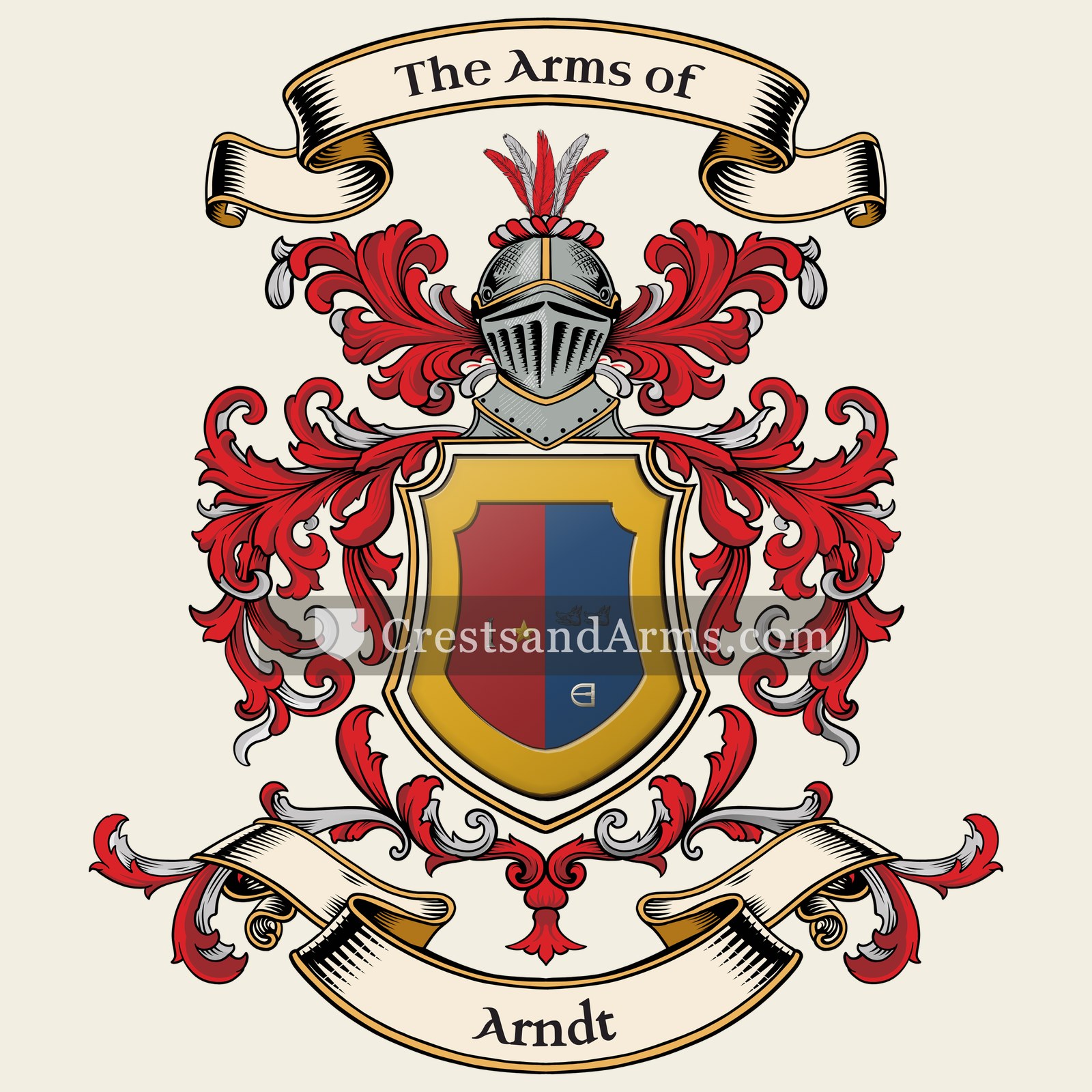


 dovePeace, love and the Holy Spirit