Map of Spain showing where the Arno arms are recorded
The Arno arms were recorded in Spain, c. 1722.
Arms such as these were typically recorded in Castile.
Castile was the heart of Spain and the source of most of its noble families. Land won in the long wars against the Moors was granted out to fighting men, and a man granted land was granted arms along with it.
This is where the arms were entered in the register. Families often moved to other parts of the country, so the same name can turn up in more than one region.
The body that granted and recorded arms in Spain in this period.
Philip V of Spain
Sovereign of the period
Philip V of Spain
1714–1724
Reigning in Spain when the Arno arms are first recorded.
How Arms Worked in Spain
In Spain, a coat of arms was considered a form of property that belonged to the entire family line. These arms were passed down from a father to all his children equally. Younger branches of the family usually kept the original design without needing to add any special marks to distinguish their specific line.
Granting authority
The Cronista Rey de Armas was the official body that regulated and granted coats of arms throughout Spain.
How they got arms
Families often obtained their arms through royal grants or by proving their noble status to the official heraldic authority.
Where arms were recorded
Coats of arms were officially recorded in the registers of the Cronista Rey de Armas starting in 1496.
The family's standing
Recorded among the armigerous families of Spain.
Origin & History of the Arno Family in Spain
The surname Arno carries a rich history that is deeply rooted in the cultural landscape of the Iberian Peninsula. By the early 18th century, records confirm that members of the family were well-established in the region of Castile, Spain. During this period, the name was often associated with families living near prominent waterways, as the term itself is frequently linked to ancient linguistic roots describing flowing rivers. As these early ancestors navigated the social and economic shifts of 1722 Castile, they likely participated in the agricultural and administrative life that defined the Spanish heartland. Over time, the family name became a marker of regional identity, reflecting the movement and settlement patterns of people who helped shape the local communities of the era.
Arno Meaning & Related Branches
Root word
Arnus
Latin term referring to an eagle or a river.
This name
ArnoDerived from a toponymic reference to the Arno River or an eagle-related descriptor.
also spelled
Arnault
Arnauld
Arnao
Arnaux
Arno
Documented Sources
J. B. Rietstap, Armorial Général, Gouda: G. B. van Goor Zonen, 1884–87
Archivo de la Real Chancillería de Valladolid, Registro de Ejecutorias
Instituto Nacional de Estadística, Diccionario de apellidos españoles, 2010
Moll, Francesc de Borja, Els llinatges catalans, 1959
Digital archive packCoat of arms PNG, gold border print PDF, vector SVG and the certificate of authenticity. Sent to your email in minutes.


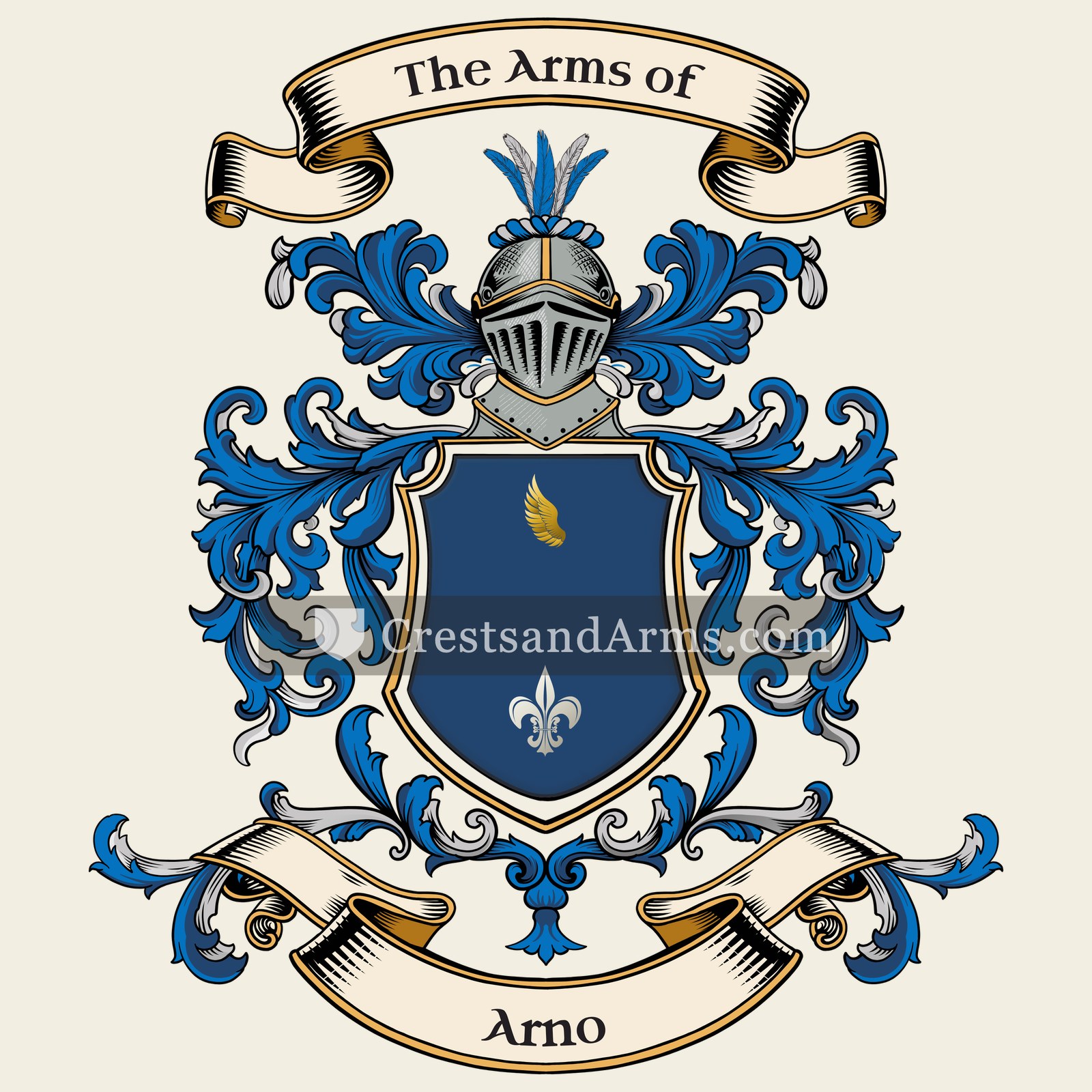
 wingSwiftness, and protection under a raised wing
 fleur de lisPurity, light, and the sixth son
 wingSwiftness, and protection under a raised wing
 fleur de lisPurity, light, and the sixth son