A record of documented arms, meaning and origin, researched for the Arnoldi family lines. Documented in 3 countries.
Reg. 7355 · Dutch, A–C
Coat of Arms & Family Crest Details
Symbols on this shield
saltireResolution, and St Andrew's cross
roseThe seventh son, and beauty with grace
Colours
Gold (Or)Means: Generosity
Blue (Azure)Means: Loyalty and truth
Black (Sable)Means: Constancy
Red (Gules)Means: Military strength
Silver (Argent)Means: Peace and sincerity
Historical info
Source
J. B. Rietstap, Armorial Général, Gouda: G. B. van Goor Zonen, 1884–87
Blazon (the actual original written record)
“Ec.: aux 1 et 4 d'or au saut. de sa.; et une los. de gu., ch. d'une rose d'arg., br. sur le saut.; aux 2 et 3 d'azur à un buste de femme de carn., posé de profil, les yeux bandés de sa. C.: le buste du 2. L. d'or et d'azur.”
NetherlandsLeeuwarden Frise, c. 1815
Digital archive packCoat of arms PNG, gold border print PDF, vector SVG and the certificate of authenticity. Sent to your email in minutes.
Map of Netherlands showing where the Arnoldi arms are recorded
The Arnoldi arms were recorded in Leeuwarden Frise, c. 1815.
This is where the arms were entered in the register. Families often moved to other parts of the country, so the same name can turn up in more than one region.
Region
Leeuwarden
Town
Leeuwarden Frise
First recorded
1815
Granting Authority for the Arnoldi Arms
Hoge Raad van Adel
Photograph made by me · CC BY-SA 3.0
The body that granted and recorded arms in Netherlands in this period.
William I of the Netherlands
Sovereign of the period
William I of the Netherlands
1815–1840
Reigning in Netherlands when the Arnoldi arms are first recorded.
How Arms Worked in Netherlands
In the Netherlands, coats of arms were often used by noble families and those who held specific public offices. These arms were passed down through the generations to legitimate descendants. Younger branches of a family usually kept the original design without needing to add special marks. This system ensured that the family identity remained clear and consistent over many years.
Granting authority
The Hoge Raad van Adel is the official body that regulates and manages noble titles and coats of arms in the Netherlands.
How they got arms
Families typically obtained their coats of arms through official royal grants or by proving their long-standing historical use of the symbols.
Where arms were recorded
Coats of arms are officially recorded in the registers held by the Hoge Raad van Adel, which began its work in 1814.
The family's standing
Recorded among the armigerous families of Netherlands.
Origin & History of the Arnoldi Family in Netherlands
The family name Arnoldi carries a history rooted in the Germanic tradition, where it originated as a patronymic derived from the personal name Arnold, meaning eagle power. While the name has deep roots across Europe, its presence in the Netherlands became firmly established by the early nineteenth century. Official records confirm that members of the Arnoldi family were living in the city of Leeuwarden by 1815. During this period, the Netherlands was undergoing significant social changes following the end of French rule and the establishment of the United Kingdom of the Netherlands. Families like the Arnoldis were part of a growing urban middle class that navigated these shifting political landscapes. By settling in Friesland, the family integrated into the local administrative and social fabric of the region, leaving a paper trail in municipal registers that documents their transition into Dutch society during the Napoleonic era.
Coat of Arms & Family Crest Details
Symbols on this shield
eagleNobility, strength and a keen mind
swordJustice, and military honour
Colours
Silver (Argent)Means: Peace and sincerity
Blue (Azure)Means: Loyalty and truth
Historical info
Source
J. B. Rietstap, Armorial Général, Gouda: G. B. van Goor Zonen, 1884–87
Blazon (the actual original written record)
“Parti: au 1 d'arg. à l'aigle cont. d'azur; au 2 d'azur à deux épées d'arg., garnies d'or, les pointes en bas. Cq. cour. C.: l'aigle, iss.”
GermanyNassau, c. 1803
Digital archive packCoat of arms PNG, gold border print PDF, vector SVG and the certificate of authenticity. Sent to your email in minutes.
Map of Germany showing where the Arnoldi arms are recorded
The Arnoldi arms were recorded in Nassau, c. 1803.
This is where the arms were entered in the register. Families often moved to other parts of the country, so the same name can turn up in more than one region.
The body that granted and recorded arms in Germany in this period.
Francis II, Holy Roman Emperor
Sovereign of the period
Francis II, Holy Roman Emperor
1792–1806
Reigning in Netherlands when the Arnoldi arms are first recorded.
How Arms Worked in Germany
In the Holy Roman Empire, coats of arms were often granted to individuals by the Emperor or his representatives. These arms were then passed down through the generations to all legitimate descendants of the original holder. Younger branches of a family usually kept the same shield design without needing to change it, as the arms belonged to the entire lineage.
Granting authority
The Holy Roman Emperor held the sole power to grant new coats of arms throughout his vast imperial territories.
How they got arms
Families typically obtained their coats of arms through a formal imperial grant or by proving their noble status to the authorities.
Where arms were recorded
These grants were officially recorded in the Imperial Chancery registers, which began keeping formal records of such honors during the Middle Ages.
The family's standing
Recorded among the armigerous families of Germany.
Origin & History of the Arnoldi Family in Germany
The Arnoldi family name is rooted in the ancient Germanic tradition of forming surnames from personal names. It is a patronymic name derived from Arnold, which combines the Germanic words for eagle and power. By the early 19th century, members of the family were well-established in the region of Nassau, which was a significant territory within the Holy Roman Empire and later the German Confederation. During this era, families in Nassau often held positions in local administration, trade, or the clergy, as the region served as a crossroads for political and social development. The presence of the Arnoldi name in Nassau by 1803 suggests that the family was part of the stable middle class that helped shape the local community during a time of great change in Central Europe. As the Napoleonic Wars reshaped the map of Germany, the Arnoldi family remained connected to the cultural and civic life of the Nassau region, contributing to the professional and social fabric of their home.
Coat of Arms & Family Crest Details
Symbols on this shield
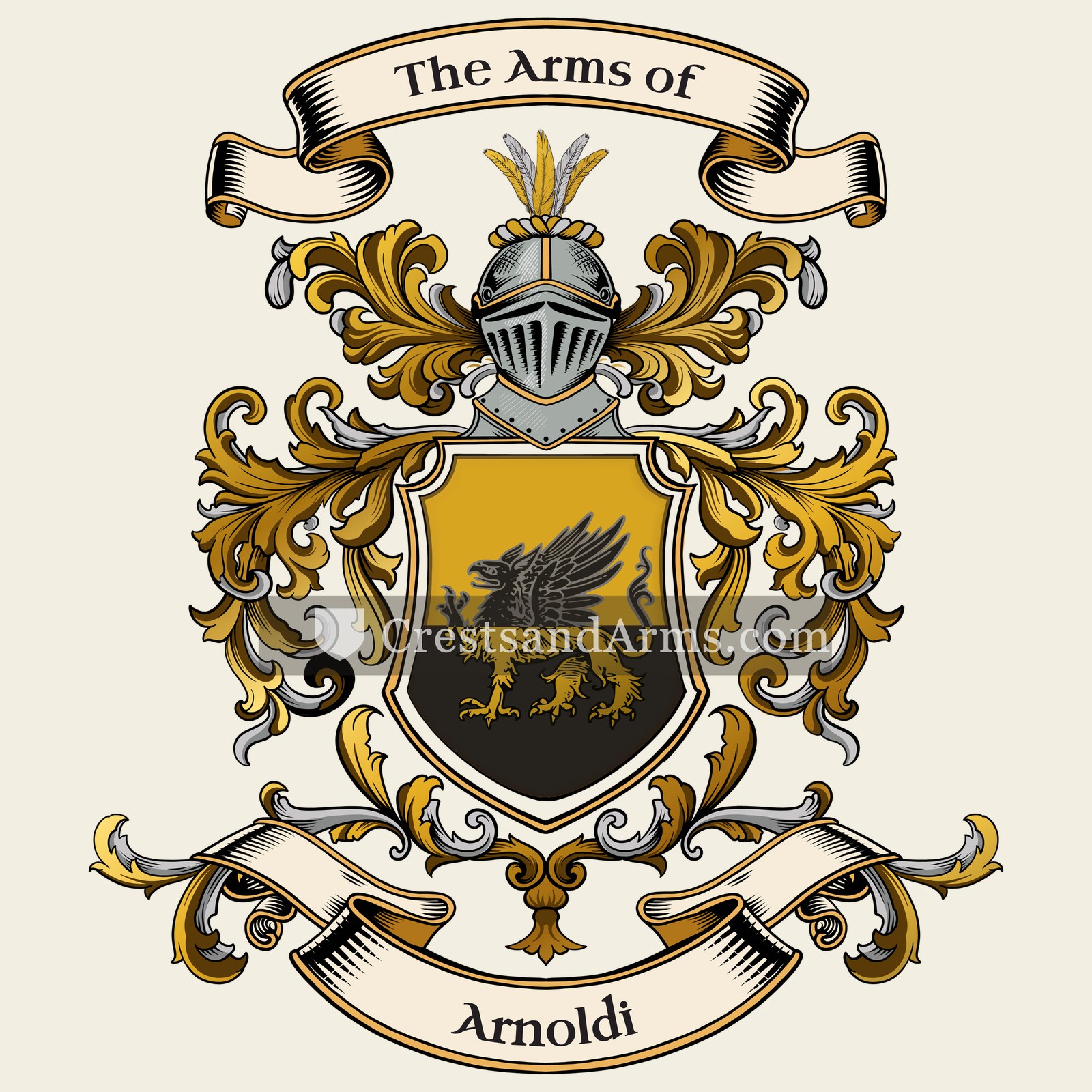
griffinValour and vigilance, guarding great treasure
Colours
Gold (Or)Means: Generosity
Black (Sable)Means: Constancy
Historical info
Source
J. B. Rietstap, Armorial Général, Gouda: G. B. van Goor Zonen, 1884–87
Blazon (the actual original written record)
“Coupé d'or sur sa.; au griffon de l'un en l'autre”
ItalyBologne, c. 1775
Digital archive packCoat of arms PNG, gold border print PDF, vector SVG and the certificate of authenticity. Sent to your email in minutes.
Map of Italy showing where the Arnoldi arms are recorded
The Arnoldi arms were recorded in Bologne, c. 1775.
This is where the arms were entered in the register. Families often moved to other parts of the country, so the same name can turn up in more than one region.
The body that granted and recorded arms in Italy in this period.
Alvise Giovanni Mocenigo
Sovereign of the period
Alvise Giovanni Mocenigo
1763–1778
Reigning in Netherlands when the Arnoldi arms are first recorded.
How Arms Worked in Italy
In the Italian states, coats of arms were often used by noble families to show their status and history. These symbols were passed down through the generations to all legitimate male descendants. Younger branches of a family usually kept the original design but sometimes added small changes to distinguish their specific line from the main branch.
Granting authority
Various local rulers and city governments controlled the use of coats of arms across the different Italian states.
How they got arms
Families often assumed their own arms or received them as official grants from local lords, popes, or city councils.
Where arms were recorded
Arms were recorded in local city archives or private family books rather than in one single national register.
The family's standing
Recorded among the armigerous families of Italy.
Origin & History of the Arnoldi Family in Italy
The Arnoldi family name traces its roots to the Germanic personal name Arnold, which combines the words for eagle and power. As this name spread across Europe during the Middle Ages, it became a common surname in northern Italy, particularly within the region of Emilia-Romagna. By the late eighteenth century, the family established a notable presence in the city of Bologna. Records from 1775 indicate that members of the Arnoldi family were active participants in the social and civic life of this historic university city. During this period, Bologna was a hub of intellectual and cultural exchange under the administration of the Papal States, and families like the Arnoldi often contributed to the local economy and professional guilds. Their residence in Bologna reflects the broader movement of families who settled in major Italian urban centers to pursue trade, law, and administration during the Enlightenment era.
Arnoldi Meaning & Related Branches
Root word
Arnwald
Derived from Germanic elements meaning eagle and power or ruler.
This name
ArnoldiA patronymic surname meaning son of Arnold, signifying one with the power of an eagle.
also spelled
Arnoldy
Related arms
Arnoldyvariant spelling
Boelemarecorded with Arnoldi, same area
Documented Sources
J. B. Rietstap, Armorial Général, Gouda: G. B. van Goor Zonen, 1884–87
AlleFriezen, Burgerlijke Stand Leeuwarden (Civil Registry of Leeuwarden)
Tresoar, Fries Historisch en Letterkundig Centrum, Bevolkingsregisters van Leeuwarden (Population Registers of Leeuwarden)
Van der Schaar, J., Woordenboek van voornamen, 1964
De Vries, J.W., Nederlandse familienamen, 1992
Digital archive packCoat of arms PNG, gold border print PDF, vector SVG and the certificate of authenticity. Sent to your email in minutes.


 saltireResolution, and St Andrew's cross
 roseThe seventh son, and beauty with grace
 saltireResolution, and St Andrew's cross
 roseThe seventh son, and beauty with grace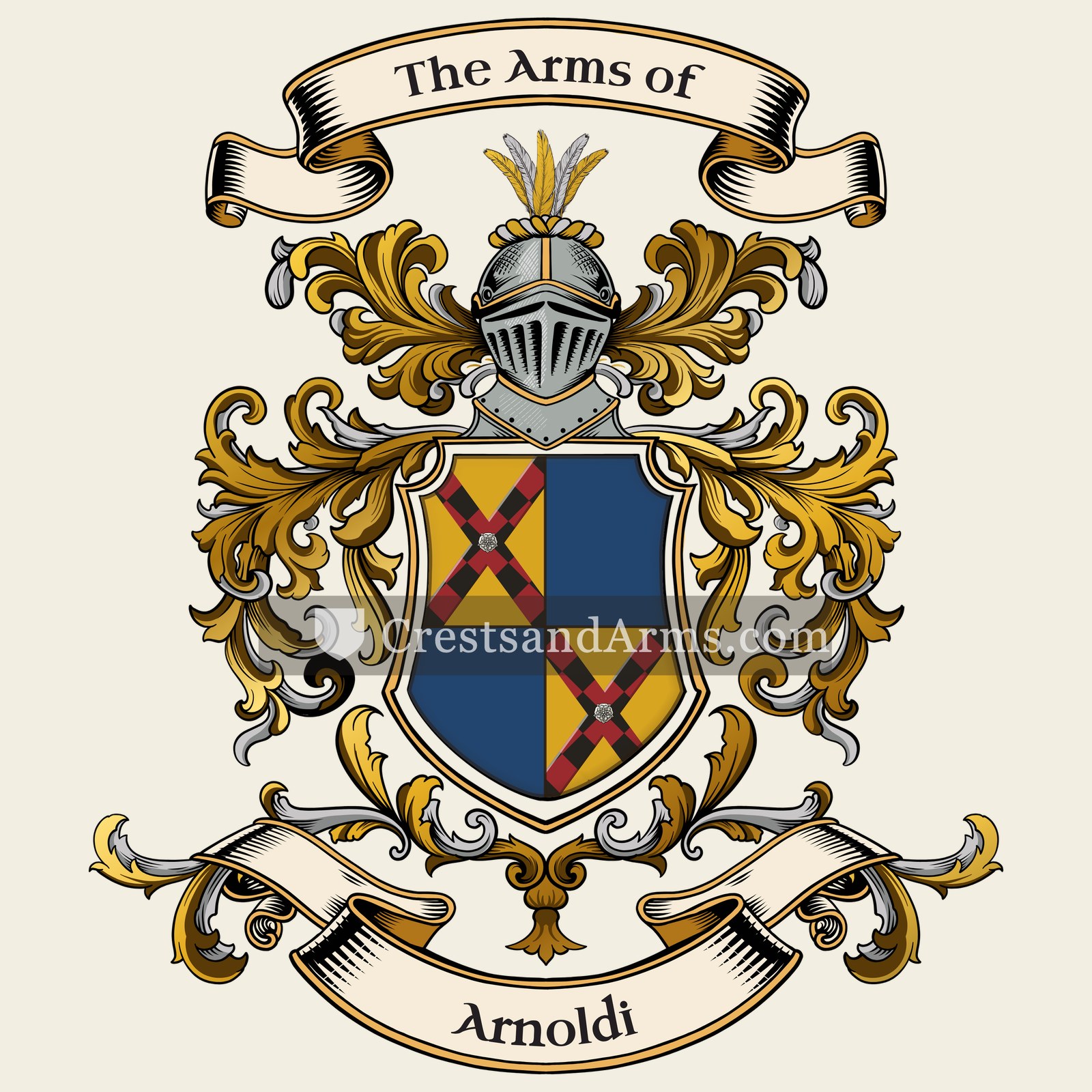


 eagleNobility, strength and a keen mind
 swordJustice, and military honour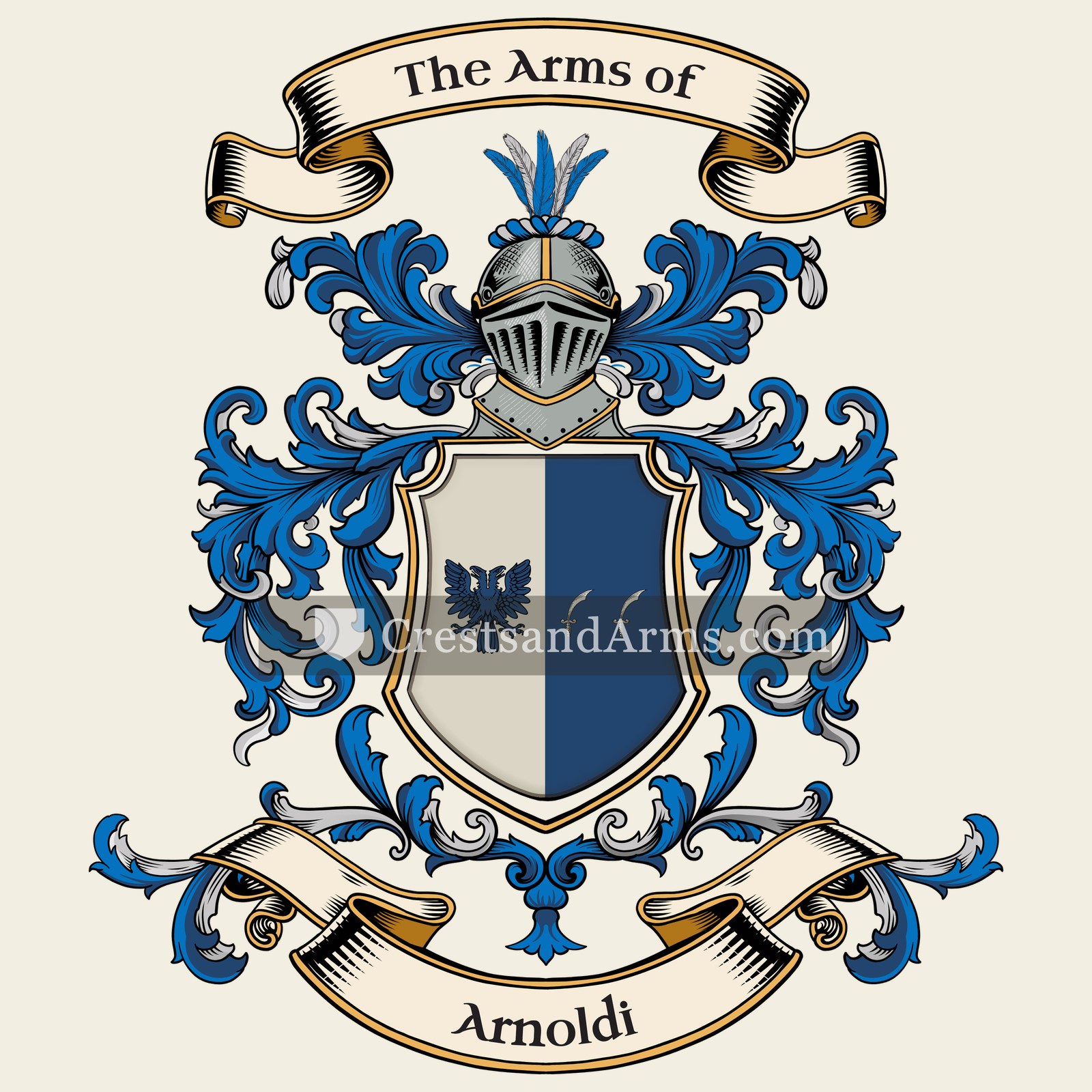


 griffinValour and vigilance, guarding great treasure