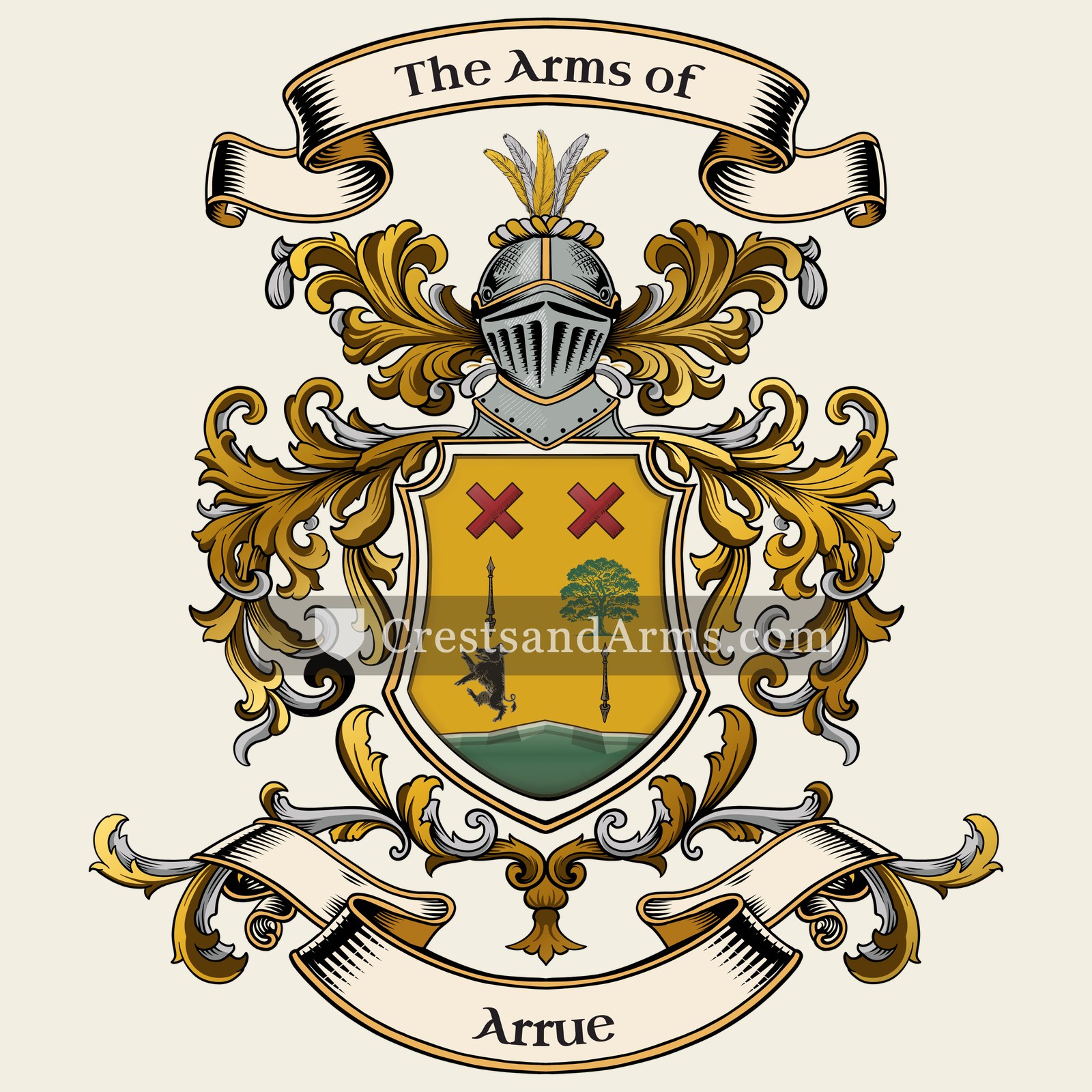
A record of documented arms, meaning and origin, researched for the Arrue family of France.
Reg. 6401 · French, A–C
Coat of Arms & Family Crest Details
Symbols on this shield
mountThe ground held, and steadfastness upon it
treeLife, endurance and deep roots
boarA fierce fighter who battles to the end
lanceKnightly service and the tilt
saltire coupedResolution, and the cross of St Andrew
Colours
Gold (Or)Means: Generosity
Green (Vert)Means: Hope
Black (Sable)Means: Constancy
Red (Gules)Means: Military strength
Historical info
Source
J. B. Rietstap, Armorial Général, Gouda: G. B. van Goor Zonen, 1884–87
Blazon (the actual original written record)
“D'or à un arbre de sin., et un sanglier pass. de sa., br. sur le fût, qui est accosté de deux lances de tournoi au nat., armées d'arg., posées en chev., appuyées contre le feuillage; le tout soutenu d'une terrasse de sin. et acc. en chef de deux flanchis de gu.”
NavarreNavarre, c. 1663
Digital archive packCoat of arms PNG, gold border print PDF, vector SVG and the certificate of authenticity. Sent to your email in minutes.
Map of France showing where the Arrue arms are recorded
The Arrue arms were recorded in Navarre, c. 1663.
Navarre was mountain country straddling the Pyrenees, with a strong class of small independent landholders. A great many households counted as gentry there, and each needed a shield to be told apart.
This is where the arms were entered in the register. Families often moved to other parts of the country, so the same name can turn up in more than one region.
The body that granted and recorded arms in France in this period.
Louis XIV of France
Sovereign of the period
Louis XIV of France
1643–1715
Reigning in France when the Arrue arms are first recorded.
How Arms Worked in France
In France, a coat of arms was a mark of honor that passed down through the male line to all legitimate descendants. Families often used the same shield without changes to show their shared heritage. If a branch wanted to stand out, they could add a small mark to their shield to show their specific place in the family tree.
Granting authority
The Juge d'armes de France acted as the official authority that regulated and verified coats of arms across the country.
How they got arms
Families typically inherited their arms from ancestors, though they could also receive them through royal grants or by proving their noble status.
Where arms were recorded
Coats of arms were officially recorded in the Armorial Général de France, which began its main collection in the year 1696.
The family's standing
Recorded among the armigerous families of Navarre.
Origin & History of the Arrue Family in France
The family name Arrue originates from the Basque region of northern Spain, specifically within the historical Kingdom of Navarre. Linguistic experts believe the name is derived from the Basque word "arru," which refers to a rocky ravine or a steep gorge. This suggests that the earliest ancestors of the Arrue family likely lived near such geographical features, as many Basque surnames were originally topographical descriptions used to identify people by their homes or lands. By 1663, records confirm that members of the Arrue family were well-established in Navarre, participating in the local social and agricultural life of the region. During this period, the family would have been deeply integrated into the rural structure of the Pyrenees, where they maintained strong ties to their ancestral villages and the unique traditions of the Basque people.
Arrue Meaning & Related Branches
Root word
Arro
Basque word referring to a ravine, gorge, or rocky valley.
This name
ArrueDerived from a topographic location indicating someone who lived near a ravine or gorge.
also spelled
Arruwe
Aroo
Arru
Related arms
Miramontesimilar arms
Documented Sources
J. B. Rietstap, Armorial Général, Gouda: G. B. van Goor Zonen, 1884–87
Mikel Belasko, Diccionario etimológico de los nombres de los pueblos, villas y ciudades de Navarra, 1999
Endika de Mogrobejo, Diccionario hispano de apellidos y blasones, 1995
Archivo Real y General de Navarra, Sección de Procesos Judiciales, 1663
Digital archive packCoat of arms PNG, gold border print PDF, vector SVG and the certificate of authenticity. Sent to your email in minutes.


 mountThe ground held, and steadfastness upon it
 treeLife, endurance and deep roots
 boarA fierce fighter who battles to the end
 lanceKnightly service and the tilt
 saltire coupedResolution, and the cross of St Andrew
 mountThe ground held, and steadfastness upon it
 treeLife, endurance and deep roots
 boarA fierce fighter who battles to the end
 lanceKnightly service and the tilt
 saltire coupedResolution, and the cross of St Andrew