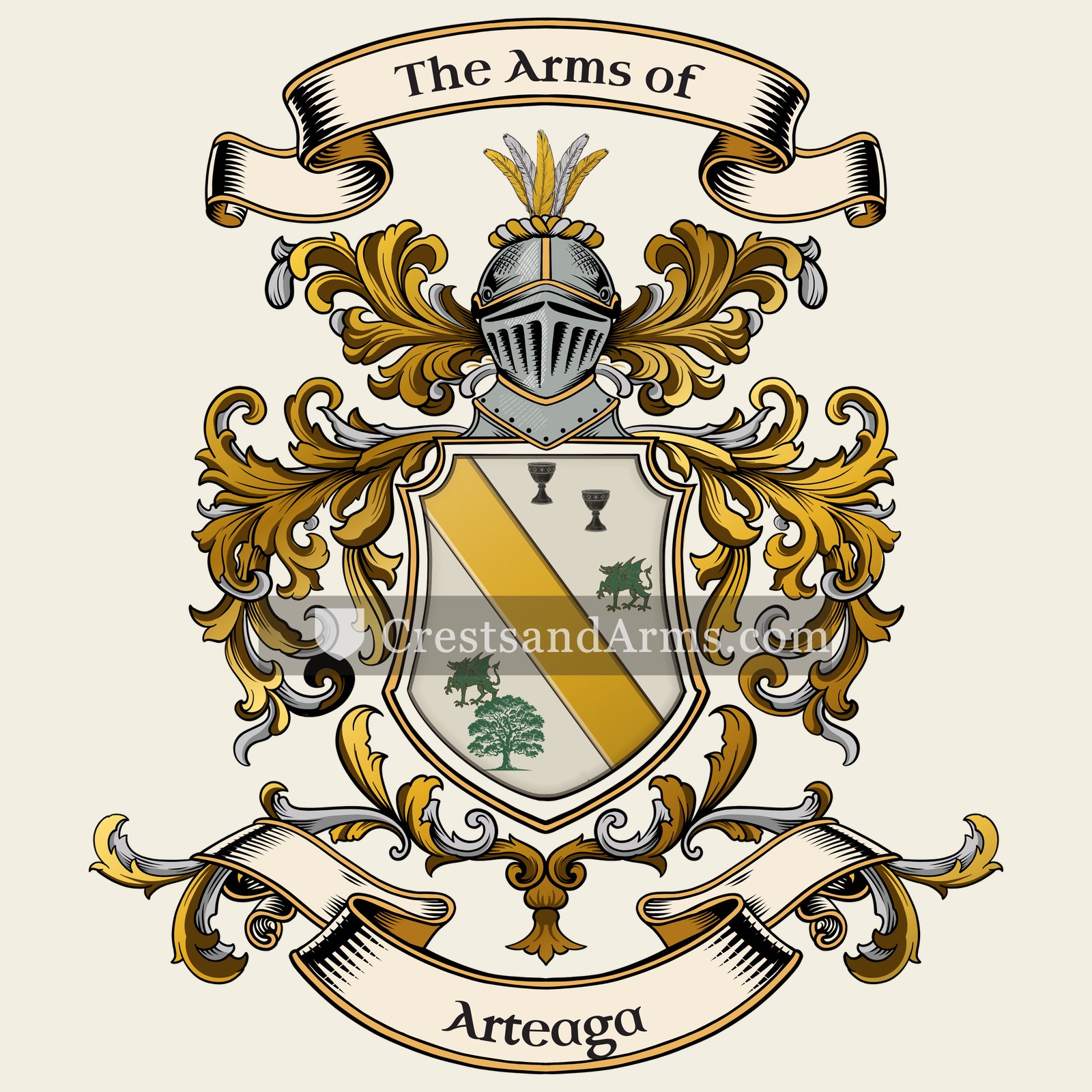
A record of documented arms, meaning and origin, researched for the Arteaga family of Spain.
Reg. 6572 · Spanish, A–C
Coat of Arms & Family Crest Details
Symbols on this shield
bendDefence, and the scarf of a commander
dragonA most valiant defender of treasure
cupFaith, office, and a trust discharged
treeLife, endurance and deep roots
Colours
Silver (Argent)Means: Peace and sincerity
Gold (Or)Means: Generosity
Green (Vert)Means: Hope
Black (Sable)Means: Constancy
Historical info
Source
J. B. Rietstap, Armorial Général, Gouda: G. B. van Goor Zonen, 1884–87
Blazon (the actual original written record)
“D'arg. à la bande d'or engoulée de deux têtes de dragon de sin., acc. en chef de deux chaudières accostées de sa., et en p. d'un arbre de sin., iss. d'une mer d'azur agitée d'arg.”
SpainGuipuzcoa, c. 1722
Digital archive packCoat of arms PNG, gold border print PDF, vector SVG and the certificate of authenticity. Sent to your email in minutes.
Map of Spain showing where the Arteaga arms are recorded
The Arteaga arms were recorded in Guipuzcoa, c. 1722.
This is where the arms were entered in the register. Families often moved to other parts of the country, so the same name can turn up in more than one region.
The body that granted and recorded arms in Spain in this period.
Philip V of Spain
Sovereign of the period
Philip V of Spain
1714–1724
Reigning in Spain when the Arteaga arms are first recorded.
How Arms Worked in Spain
In Spain, a coat of arms was considered a form of property that belonged to the entire family line. These arms were passed down from a father to all his children equally. Younger branches of the family usually kept the original design without needing to add any special marks to distinguish their specific line.
Granting authority
The Cronista Rey de Armas was the official body that regulated and granted coats of arms throughout Spain.
How they got arms
Families often obtained their arms through royal grants or by proving their noble status to the official heraldic authority.
Where arms were recorded
Coats of arms were officially recorded in the registers of the Cronista Rey de Armas starting in 1496.
The family's standing
Recorded among the armigerous families of Spain.
Origin & History of the Arteaga Family in Spain
The surname Arteaga originates from the Basque Country in northern Spain, specifically within the province of Guipuzcoa. The name is derived from the Basque words "arte," meaning an evergreen oak, and the suffix "aga," which signifies a place where something grows in abundance. This suggests that the family’s earliest ancestors were likely named after the specific landscape or forest where they lived. By the early 18th century, the family was well-established in the region, as evidenced by local records from 1722 that document their presence in the area. These early Arteaga families were typically tied to the land, often working as farmers or local landowners who helped shape the rural development of the Basque territory. Their history reflects the deep connection between the Basque people and their natural environment, as the name itself serves as a permanent link to the geography of their ancestral home.
Arteaga Meaning & Related Branches
Root word
Arte
Basque word meaning holm oak or evergreen oak tree.
This name
ArteagaA topographical surname referring to a place abundant with holm oak trees.
Documented Sources
J. B. Rietstap, Armorial Général, Gouda: G. B. van Goor Zonen, 1884–87
Gorrotxategi Nieto, Mikel. Nombres de familia en el País Vasco. 2009
Mendizábal, Juan José. Historia de los apellidos vascos. 1995
Archivo Histórico Diocesano de San Sebastián. Libros de Bautismos y Matrimonios de Guipuzcoa. 1722
Digital archive packCoat of arms PNG, gold border print PDF, vector SVG and the certificate of authenticity. Sent to your email in minutes.


 bendDefence, and the scarf of a commander
 dragonA most valiant defender of treasure
 cupFaith, office, and a trust discharged
 treeLife, endurance and deep roots
 bendDefence, and the scarf of a commander
 dragonA most valiant defender of treasure
 cupFaith, office, and a trust discharged
 treeLife, endurance and deep roots