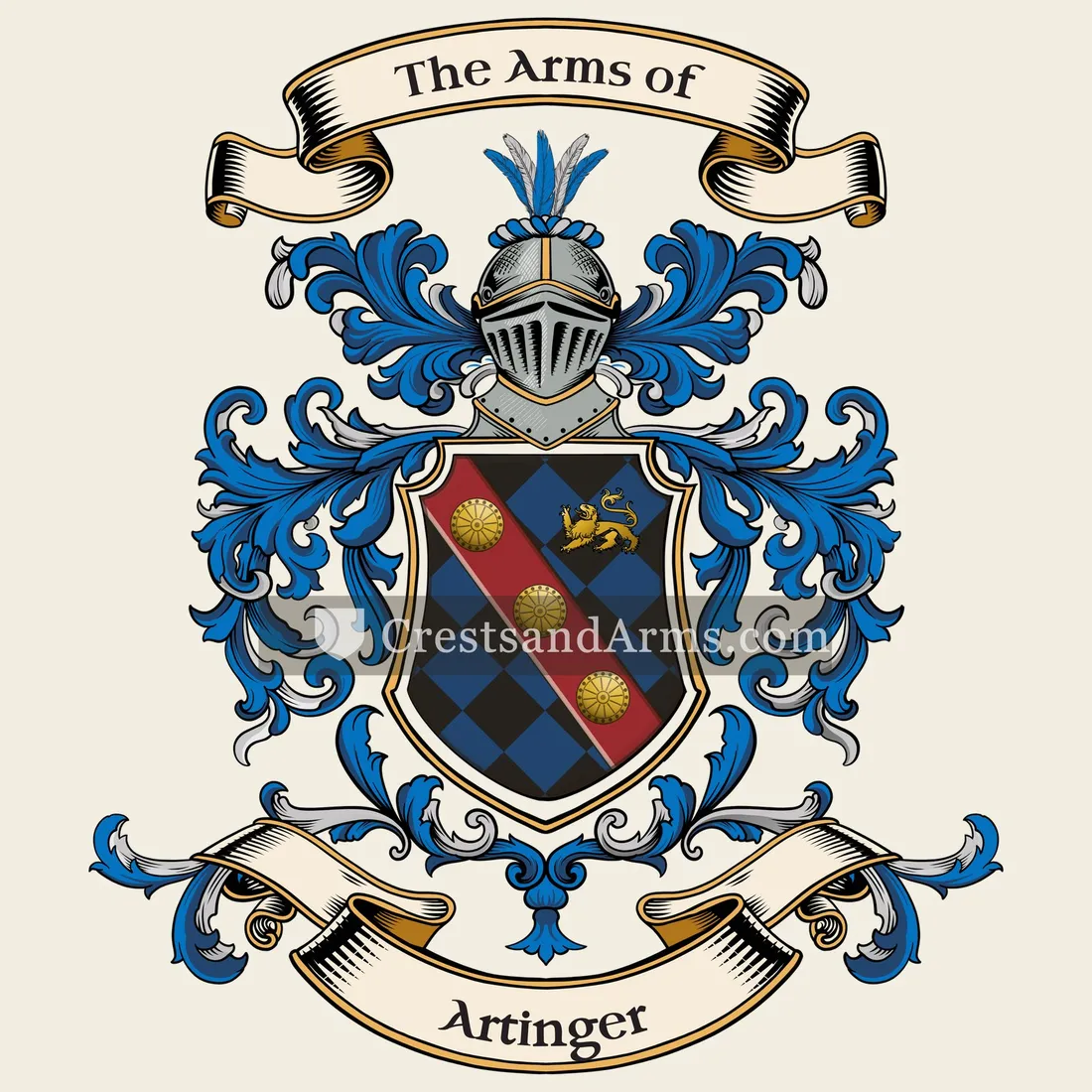
A record of documented arms, meaning and origin, researched for the Artinger family of Austria.
Reg. 8264 · Austrian, A–C
Meaning of the Artinger family crest colors & symbols
Symbols on this shield
bendDefence, and the scarf of a commander
lionCourage, strength and royalty
roundelA coin, and one who has been to the crusades
Colours
Black (Sable)Means: Constancy
Red (Gules)Means: Military strength
Gold (Or)Means: Generosity
Blue (Azure)Means: Loyalty and truth
Historical info
Source
J. B. Rietstap, Armorial Général, Gouda: G. B. van Goor Zonen, 1884–87
Blazon (the actual original written record)
“Tranché, de sa. au lion d'or, sur un losangé en bande d'arg. et d'azur; à la bande de gu., ch. de trois bes. d'or, br. sur le tranché. Cq. cour. C.: un lion iss. d'or, tenant de sa patte dextre une épée d'arg., garnie d'or: entre deux prob. coupées, à dextre de sa. sur or, à sen. d'azur sur arg. L. conformes aux émaux des prob.”
Austriac. 1772
Digital archive packCoat of arms PNG, gold border print PDF, vector SVG and the certificate of authenticity. Sent to your email in minutes.
Map of Austria showing where the Artinger arms are recorded
The Artinger arms were recorded in Austria, c. 1772.
Arms such as these were typically recorded in Tyrol.
Tyrol was mountain country in western Austria, where the valleys were held by families who had been there a very long time. Old tenure counted for more than money, and old families carried arms.
This is where the arms were entered in the register. Families often moved to other parts of the country, so the same name can turn up in more than one region.
Region
Tyrol
First recorded
1772
Granting Authority for the Artinger Arms
Imperial and Royal chancery
Sodacan · CC BY-SA 3.0
The body that granted and recorded arms in Austria in this period.
Joseph II, Holy Roman Emperor
Sovereign of the period
Joseph II, Holy Roman Emperor
1765–1790
Reigning in Austria when the Artinger arms are first recorded.
How Arms Worked in Austria
Austrian coats of arms were often linked directly to noble titles granted by the Emperor. These symbols belonged to the entire family line rather than just one individual. When a family grew, new branches kept the original design without needing to change it. This system allowed all members of a noble house to share the same identity across many generations.
Granting authority
The Imperial and Royal chancery managed all heraldic matters and controlled the official granting of arms throughout the Austrian lands.
How they got arms
Families typically received their arms through a formal imperial decree that often accompanied the elevation of a person to noble status.
Where arms were recorded
Official records of these grants were kept in the Imperial Register of Nobility which began its formal documentation process in 1453.
The family's standing
Recorded among the armigerous families of Austria.
Origin & History of the Artinger Family in Austria
The Artinger family name originates from the Alpine regions of Central Europe, with deep roots established in the Tyrol territory by the late eighteenth century. The name is classified as a topographic or locative surname, which means it likely described the specific land or farmstead where the earliest ancestors lived and worked. During the 1700s, families in this mountainous area were often identified by the name of their homestead rather than just their given names. This practice helped local officials track land ownership and tax obligations within the rugged valleys of the Austrian Empire. By 1772, records confirm that the Artinger family was well-integrated into the social and agricultural life of the region. They were part of a resilient community that navigated the challenges of high-altitude farming and the complex administrative systems of the time. This history reflects a long tradition of rural stewardship and local identity that defined the lives of families living in the Tyrol during the pre-industrial era.
Artinger Meaning & Related Branches
Root word
Art
Derived from the Germanic personal name Ort meaning point or edge.
This name
ArtingerA habitational name for someone originating from a place named Arting in Austria.
Documented Sources
J. B. Rietstap, Armorial Général, Gouda: G. B. van Goor Zonen, 1884–87
Kranzmayer, Eberhard. Ortsnamenbuch von Österreich. 1956


 bendDefence, and the scarf of a commander
 lionCourage, strength and royalty
 roundelA coin, and one who has been to the crusades
 bendDefence, and the scarf of a commander
 lionCourage, strength and royalty
 roundelA coin, and one who has been to the crusades