Map of Belgium showing where the Arts arms are recorded
The Arts arms were recorded in Hasselt Limb, c. 1737.
This is where the arms were entered in the register. Families often moved to other parts of the country, so the same name can turn up in more than one region.
The body that granted and recorded arms in Belgium in this period.
Charles VI, Holy Roman Emperor
Sovereign of the period
Charles VI, Holy Roman Emperor
1711–1740
Reigning in Belgium when the Arts arms are first recorded.
How Arms Worked in Belgium
In Belgium, a coat of arms is considered personal property that is passed down through the male line to legitimate descendants. Families often use the same shield design across generations to show their shared heritage. If a branch of the family wants to change the design, they must apply for an official update to their specific version of the arms.
Granting authority
The Conseil héraldique is the official body that regulates and approves all coats of arms in Belgium.
How they got arms
Families obtain their coats of arms through formal royal grants or by confirming their historical right to use existing designs.
Where arms were recorded
All approved coats of arms are officially recorded in the public registers of the Conseil héraldique since 1844.
The family's standing
Recorded among the armigerous families of Belgium.
Origin & History of the Arts Family in Belgium
The surname Arts is a patronymic name, which means it originated as a way to identify a person as the son of someone named Art or Aert. This given name was a common short form of Arnold, a name that signifies strength and power. By the year 1737, records confirm that members of the Arts family were well-established residents of Hasselt, a historic city in present-day Belgium. During this period, families in the region often lived in close-knit communities where their surname helped distinguish them from neighbors with similar first names. Because the name was tied to a popular given name rather than a specific location or trade, it likely emerged independently in several different areas. This explains why the name became a common identifier for families throughout the Low Countries as they transitioned from using single names to permanent family surnames.
Arts Meaning & Related Branches
Root word
Arnold
Derived from the Germanic elements for eagle and power or ruler.
This name
ArtsA patronymic surname meaning son of Art, a short form of Arnold.
also spelled
Artz
Related arms
Aertssimilar arms
de Schiervelrecorded with Arts, same area
van Cauberghrecorded with Arts, same area
Voskensrecorded with Arts, same area
Documented Sources
J. B. Rietstap, Armorial Général, Gouda: G. B. van Goor Zonen, 1884–87
Stadsarchief Hasselt, Doopregisters van de Sint-Quintinusparochie (1737)
Rijksarchief in Limburg, Registers van de Burgerlijke Stand en Parochieregisters
Debrabandere, Frans, Woordenboek van de familienamen in België en Noord-Frankrijk (1993)
Leys, O., De familienamen in de Nederlanden (1987)
Digital archive packCoat of arms PNG, gold border print PDF, vector SVG and the certificate of authenticity. Sent to your email in minutes.


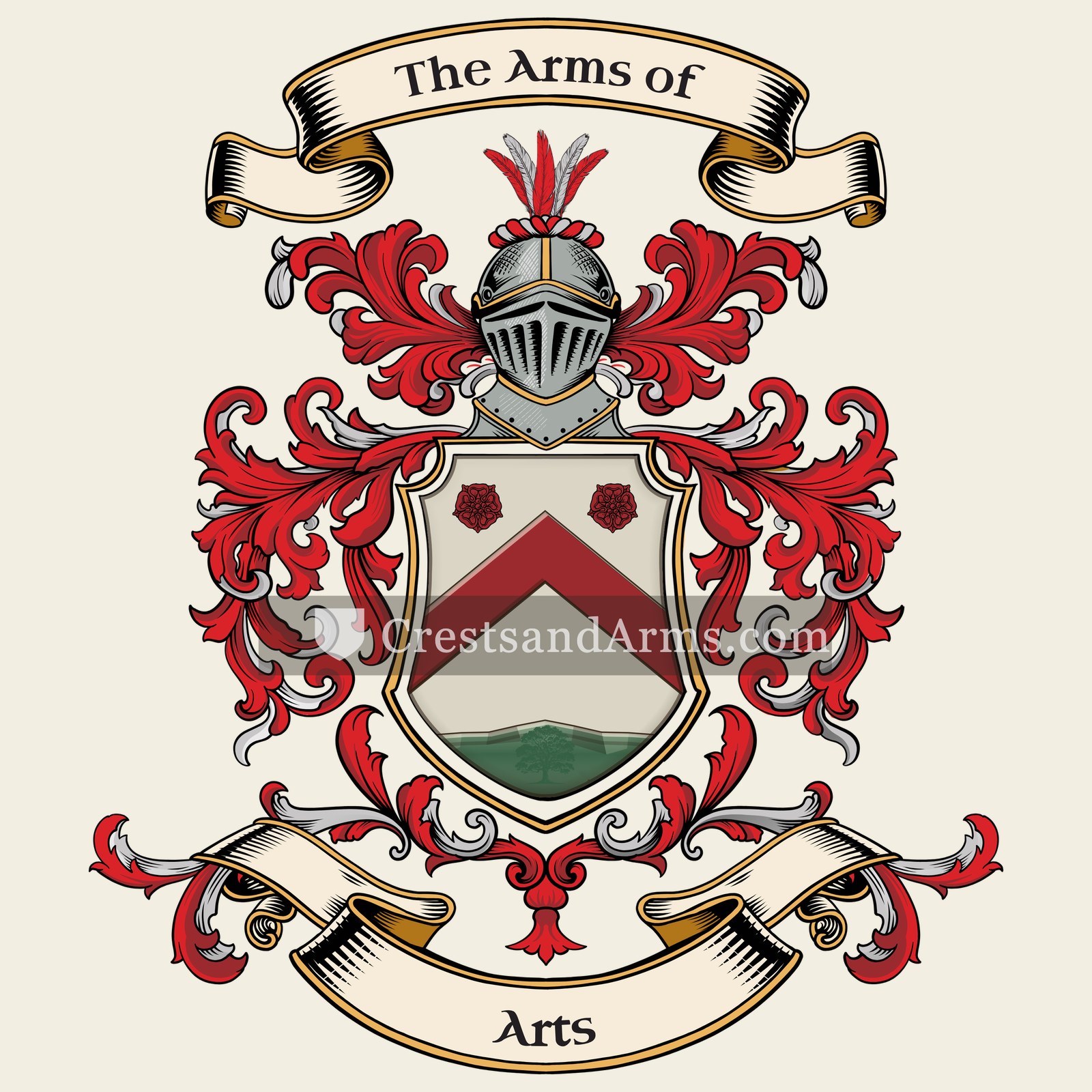
 chevronProtection, and faithful service completed
 mountThe ground held, and steadfastness upon it
 roseThe seventh son, and beauty with grace
 treeLife, endurance and deep roots
 chevronProtection, and faithful service completed
 mountThe ground held, and steadfastness upon it
 roseThe seventh son, and beauty with grace
 treeLife, endurance and deep roots