Map of England showing where the Ashenhurst arms are recorded
The Ashenhurst arms were recorded in Derby, c. 1662.
Derbyshire had lead mines in its hills and good grazing in its valleys. Both made steady money, and families who made it bought manors, which is what put their names into the heraldic records.
This is where the arms were entered in the register. Families often moved to other parts of the country, so the same name can turn up in more than one region.
The body that granted and recorded arms in England in this period.
Charles II of England
Sovereign of the period
Charles II of England
1660–1685
Reigning in England when the Ashenhurst arms are first recorded.
How Arms Worked in England
English heraldry allowed arms to be shared by all legitimate descendants of the original owner. These symbols were treated as personal property that moved through the generations to all children. While the eldest son kept the original design, other family members could use the same shield without needing to change it or register their own unique versions.
Granting authority
The College of Arms in London has regulated the use of coats of arms throughout England and Wales since 1484.
How they got arms
Families typically obtained their coats of arms through a formal grant from the Crown or by proving their ancient right to them.
Where arms were recorded
All official coats of arms are recorded in the registers kept at the College of Arms, which date back to the fifteenth century.
The family's standing
Recorded among the armigerous families of Derby.
Origin & History of the Ashenhurst Family in England
The surname Ashenhurst is a locative name, meaning it originated from a specific place rather than a trade or a nickname. Historical records indicate that the family took its name from a small settlement or homestead known as Ashenhurst, which is derived from Old English words meaning a wooded hill or grove where ash trees grew. By the mid-seventeenth century, members of the family had established a notable presence in the town of Derby. In 1662, records show individuals bearing this name were active within the local community, likely participating in the social and economic life of the region during a period of significant political change in England. The family name remained tied to these geographic roots for generations, reflecting the common practice of families adopting the names of the lands they inhabited or managed.
Ashenhurst Meaning & Related Branches
Root word
Aesc-hyrst
Old English for ash tree and a wooded hill or grove.
This name
AshenhurstRefers to a person who lived near a wooded hill covered in ash trees.
also spelled
Ashenhirst
Ashenherst
Ashenhust
Documented Sources
Sir Bernard Burke, The General Armory of England, Scotland, Ireland and Wales, London: Harrison & Sons, 1884
Reaney, P.H., A Dictionary of British Surnames, 1958
Derbyshire Record Office, Quarter Sessions Records, Q/SR
Digital archive packCoat of arms PNG, gold border print PDF, vector SVG and the certificate of authenticity. Sent to your email in minutes.


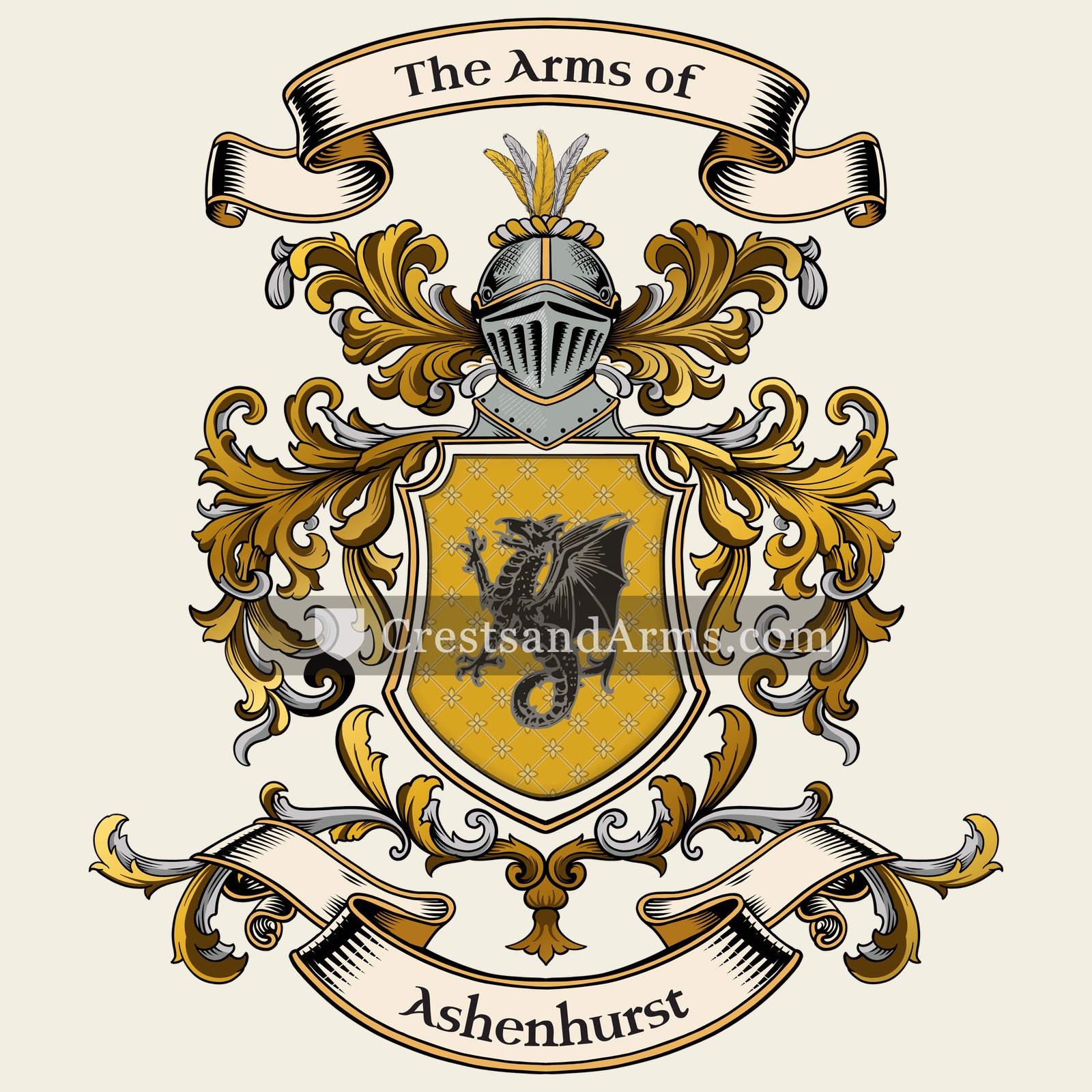
 wyvernValour and protection, and victory over the plague
 wyvernValour and protection, and victory over the plague