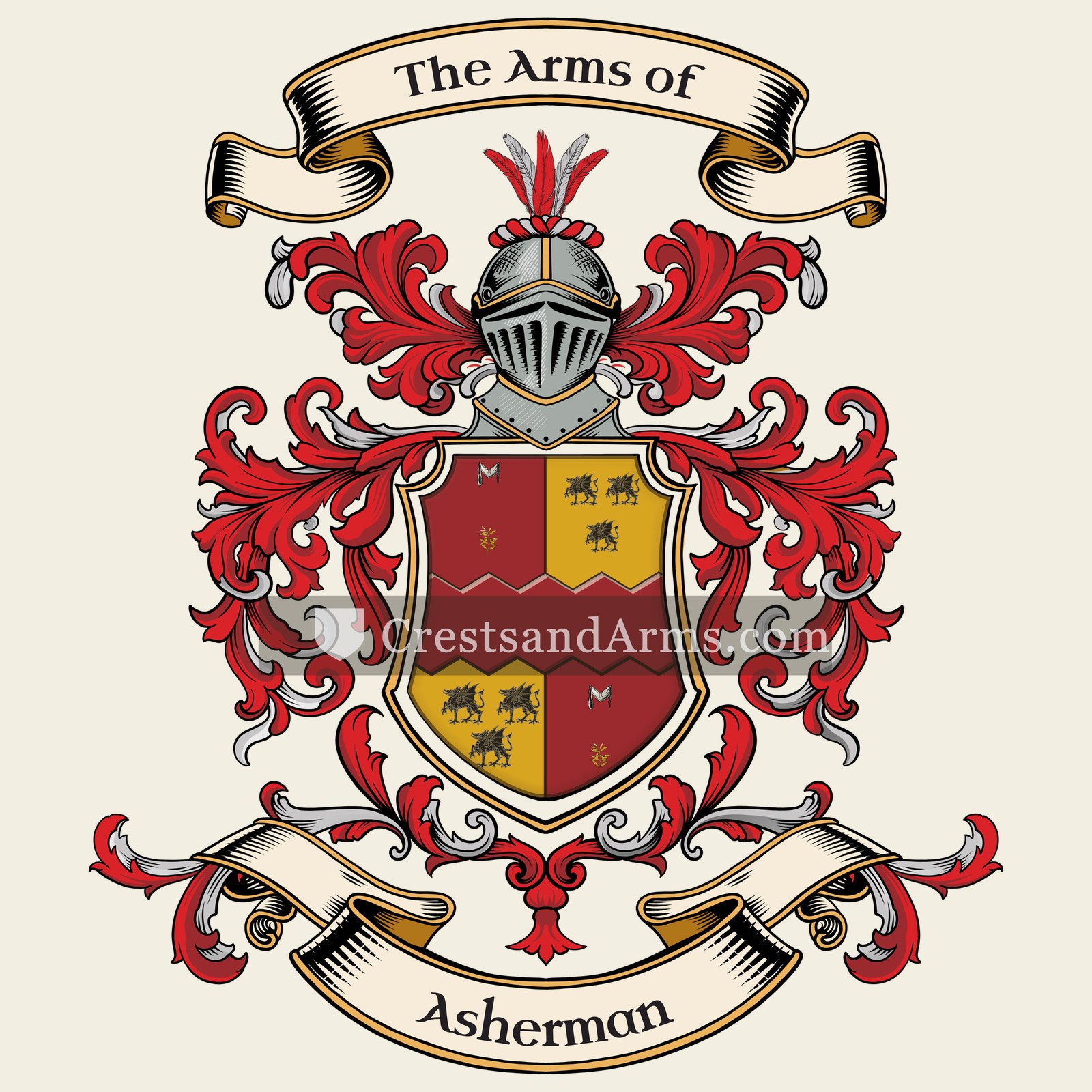
A record of documented arms, meaning and origin, researched for the Asherman family of England.
Reg. 0106 · English, A–C
Coat of Arms & Family Crest Details
Symbols on this shield
fessThe military belt, and readiness to serve
maunchThe lady's sleeve, worn as a favour
branchPeace, and new growth
dragonA most valiant defender of treasure
Colours
Red (Gules)Means: Military strength
Gold (Or)Means: Generosity
Silver (Argent)Means: Peace and sincerity
Historical info
Source
Sir Bernard Burke, The General Armory of England, Scotland, Ireland and Wales, London: Harrison & Sons, 1884
Blazon (the actual original written record)
“Quarterly per fesse indented first and fourth, gu. in chief a maunch ar. in base an acorn sprig or, second and third or, three dragons' heads couped of the first”
SurreySurrey, c. 1761
Digital archive packCoat of arms PNG, gold border print PDF, vector SVG and the certificate of authenticity. Sent to your email in minutes.
Map of England showing where the Asherman arms are recorded
The Asherman arms were recorded in Surrey, c. 1761.
Surrey sat just south of London and filled up with families who had made money in the City. Buying an estate there was the usual next step, and an estate was the usual reason to take arms.
This is where the arms were entered in the register. Families often moved to other parts of the country, so the same name can turn up in more than one region.
The body that granted and recorded arms in England in this period.
George III of Great Britain
Sovereign of the period
George III of Great Britain
1760–1801
Reigning in England when the Asherman arms are first recorded.
How Arms Worked in England
English heraldry allowed arms to be shared by all legitimate descendants of the original owner. These symbols were treated as personal property that moved through the generations to all children. While the eldest son kept the original design, other family members could use the same shield without needing to change it or register their own unique versions.
Granting authority
The College of Arms in London has regulated the use of coats of arms throughout England and Wales since 1484.
How they got arms
Families typically obtained their coats of arms through a formal grant from the Crown or by proving their ancient right to them.
Where arms were recorded
All official coats of arms are recorded in the registers kept at the College of Arms, which date back to the fifteenth century.
The family's standing
Recorded among the armigerous families of Surrey.
Origin & History of the Asherman Family in England
The surname Asherman is rooted in the occupational history of England, likely originating as a descriptive name for someone who worked with ash. During the eighteenth century, the production of potash from wood ash was a vital industry used for making glass, soap, and fertilizer. By 1761, records confirm that members of the Asherman family were well established in the county of Surrey. At this time, Surrey was a landscape of both bustling market towns and rural woodlands, providing ample opportunity for families involved in trade and agriculture. As the family settled into this region, they became part of the local social fabric, leaving behind traces in parish registers and tax records that document their daily lives and contributions to the community. Over the generations, the name evolved from a simple description of a worker into a distinct family identity that persisted through the changing landscape of southern England.
Related Branches & Arms
Root word
Ash
Old English word for the ash tree.
This name
AshermanAn occupational surname for someone who lived near an ash tree or worked as a burner of ash wood.
also spelled
Ackerman
Documented Sources
Sir Bernard Burke, The General Armory of England, Scotland, Ireland and Wales, London: Harrison & Sons, 1884
Surrey History Centre, Surrey Quarter Sessions Records, 1761
Surrey History Centre, Parish Registers of Surrey, 1761
Digital archive packCoat of arms PNG, gold border print PDF, vector SVG and the certificate of authenticity. Sent to your email in minutes.


 fessThe military belt, and readiness to serve
 maunchThe lady's sleeve, worn as a favour
 branchPeace, and new growth
 dragonA most valiant defender of treasure
 fessThe military belt, and readiness to serve
 maunchThe lady's sleeve, worn as a favour
 branchPeace, and new growth
 dragonA most valiant defender of treasure