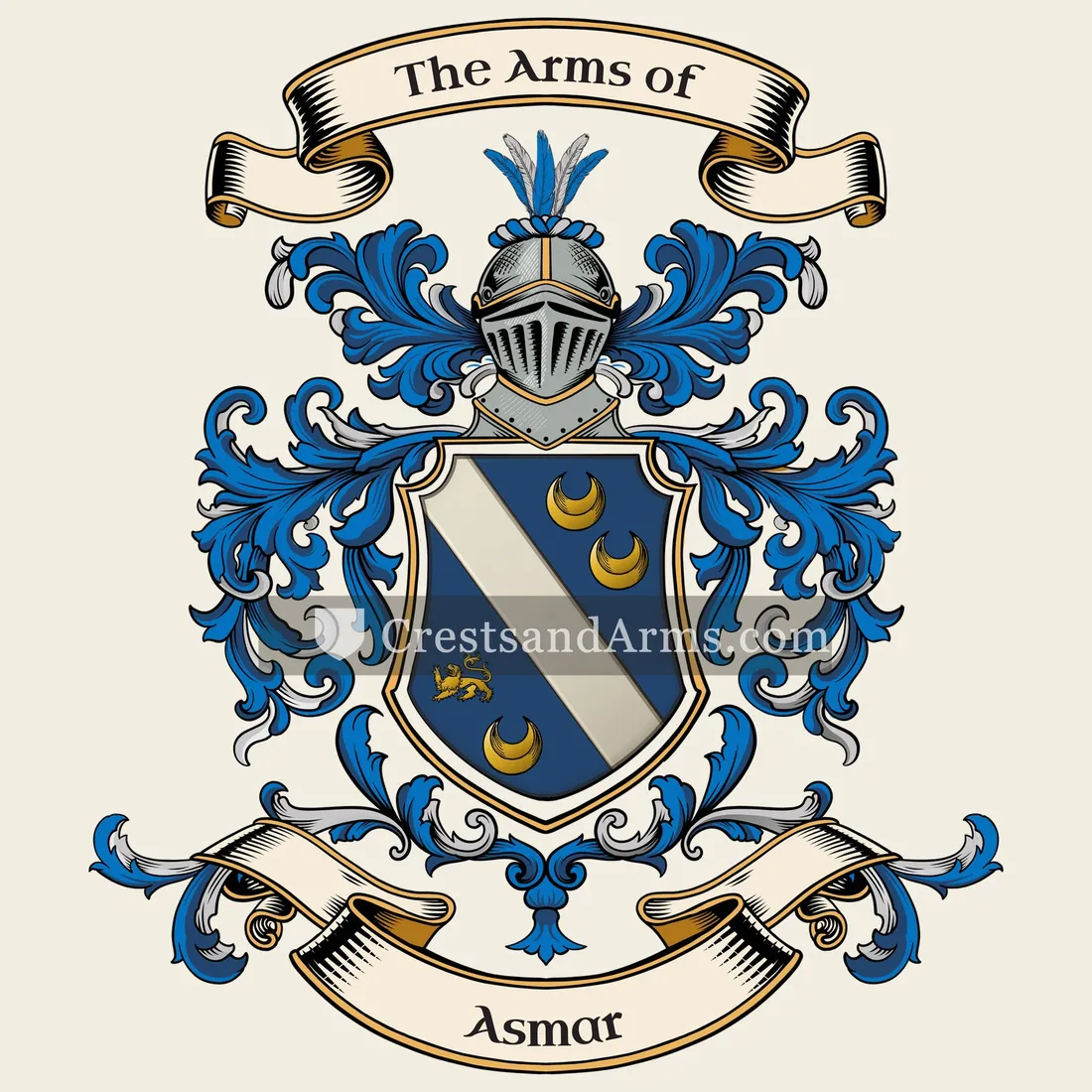
A record of documented arms, meaning and origin, researched for the Asmar family of Austria.
Reg. 3578 · Austrian, A–C
Meaning of the Asmar family crest colors & symbols
Symbols on this shield
bendDefence, and the scarf of a commander
lionCourage, strength and royalty
crescentHonour by the sovereign, and the second son
Colours
Blue (Azure)Means: Loyalty and truth
Silver (Argent)Means: Peace and sincerity
Gold (Or)Means: Generosity
Historical info
Source
J. B. Rietstap, Armorial Général, Gouda: G. B. van Goor Zonen, 1884–87
Blazon (the actual original written record)
“D'azur à la bande d'arg., acc. en chef d'un lion d'or et en p. de trois croiss. d'or, côtoyant la bande. Deux cq., le 1er cour. C.: 1° cinq pl. d'aut., alt. d'azur et d'arg.; 1. d'arg. et d'azur; 2° un lion iss. d'or; 1. d'or et d'azur.”
Austriac. 1792
Digital archive packCoat of arms PNG, gold border print PDF, vector SVG and the certificate of authenticity. Sent to your email in minutes.
Map of Austria showing where the Asmar arms are recorded
The Asmar arms were recorded in Austria, c. 1792.
Arms such as these were typically recorded in Tyrol.
Tyrol was mountain country in western Austria, where the valleys were held by families who had been there a very long time. Old tenure counted for more than money, and old families carried arms.
This is where the arms were entered in the register. Families often moved to other parts of the country, so the same name can turn up in more than one region.
Region
Tyrol
First recorded
1792
Granting Authority for the Asmar Arms
Imperial and Royal chancery
Sodacan · CC BY-SA 3.0
The body that granted and recorded arms in Austria in this period.
Leopold II, Holy Roman Emperor
Sovereign of the period
Leopold II, Holy Roman Emperor
1790–1792
Reigning in Austria when the Asmar arms are first recorded.
How Arms Worked in Austria
Austrian coats of arms were often linked directly to noble titles granted by the Emperor. These symbols belonged to the entire family line rather than just one individual. When a family grew, new branches kept the original design without needing to change it. This system allowed all members of a noble house to share the same identity across many generations.
Granting authority
The Imperial and Royal chancery managed all heraldic matters and controlled the official granting of arms throughout the Austrian lands.
How they got arms
Families typically received their arms through a formal imperial decree that often accompanied the elevation of a person to noble status.
Where arms were recorded
Official records of these grants were kept in the Imperial Register of Nobility which began its formal documentation process in 1453.
The family's standing
Recorded among the armigerous families of Austria.
Origin & History of the Asmar Family in Austria
The family name Asmar carries a deep history that connects to the mountainous landscapes of Tyrol by at least 1792. During this period, the region was part of the Holy Roman Empire and served as a vital crossroads for trade and cultural exchange between Central Europe and the Mediterranean. The name itself is often associated with linguistic roots meaning dark or tanned, which suggests that early ancestors may have been identified by their physical appearance or by their origins in warmer climates before settling in the Alpine terrain. As residents of Tyrol, these early family members lived through a time of significant political transition as the region faced the pressures of the Napoleonic Wars. By maintaining a presence in this area, the family became part of a resilient community of mountain dwellers who relied on agriculture, craftsmanship, and local trade to sustain their households across generations.
Asmar Meaning & Related Branches
Root word
Asmar
Derived from the Arabic root s-m-r meaning brown or dark.
This name
AsmarRefers to a person with a dark or tanned complexion.
also spelled
Asmar
Documented Sources
J. B. Rietstap, Armorial Général, Gouda: G. B. van Goor Zonen, 1884–87
Tiroler Landesarchiv, Standesbücher der Pfarreien (Parish registers of Tyrol)


 bendDefence, and the scarf of a commander
 lionCourage, strength and royalty
 crescentHonour by the sovereign, and the second son
 bendDefence, and the scarf of a commander
 lionCourage, strength and royalty
 crescentHonour by the sovereign, and the second son