Map of France showing where the Assouline arms are recorded
The Assouline arms were recorded in Ile-de-France, c. 1663.
Ile-de-France is the country around Paris, and proximity to the court mattered. Families who served the crown were rewarded with land near it, and land near the capital carried arms almost as a matter of course.
This is where the arms were entered in the register. Families often moved to other parts of the country, so the same name can turn up in more than one region.
The body that granted and recorded arms in France in this period.
Louis XIV of France
Sovereign of the period
Louis XIV of France
1643–1715
Reigning in France when the Assouline arms are first recorded.
How Arms Worked in France
In France, a coat of arms was a mark of honor that passed down through the male line to all legitimate descendants. Families often used the same shield without changes to show their shared heritage. If a branch wanted to stand out, they could add a small mark to their shield to show their specific place in the family tree.
Granting authority
The Juge d'armes de France acted as the official authority that regulated and verified coats of arms across the country.
How they got arms
Families typically inherited their arms from ancestors, though they could also receive them through royal grants or by proving their noble status.
Where arms were recorded
Coats of arms were officially recorded in the Armorial Général de France, which began its main collection in the year 1696.
The family's standing
Recorded among the armigerous families of Ile-de-France.
Origin & History of the Assouline Family in France
The family name Assouline has deep roots that trace back to the Jewish communities of North Africa, where the name originated as a variation of the Berber word for "rock." This linguistic connection suggests that early ancestors were likely associated with mountainous regions or held a reputation for being steadfast and strong. By 1663, records confirm that members of the family had established a presence in the Île-de-France region, marking a significant migration from their ancestral lands to the heart of France. During this period, families with this surname often worked as merchants or skilled tradespeople, navigating the complex social structures of the seventeenth century. Their ability to integrate into the local economy while maintaining their unique cultural identity highlights the resilience and adaptability that defined the family during their early years in Europe.
Related Branches & Arms
Root word
Ayyun
Arabic term referring to eyes or springs of water.
This name
AssoulineA Sephardic Jewish surname derived from the Arabic word for eyes, often signifying one with keen vision.
also spelled
Asleen
Documented Sources
J. B. Rietstap, Armorial Général, Gouda: G. B. van Goor Zonen, 1884–87
Attal, Robert. Les Juifs d'Afrique du Nord: Dénombrement et généalogie. 1995
Archives Nationales de France. Minutier central des notaires de Paris, Series Etudes I-CXXII
Digital archive packCoat of arms PNG, gold border print PDF, vector SVG and the certificate of authenticity. Sent to your email in minutes.


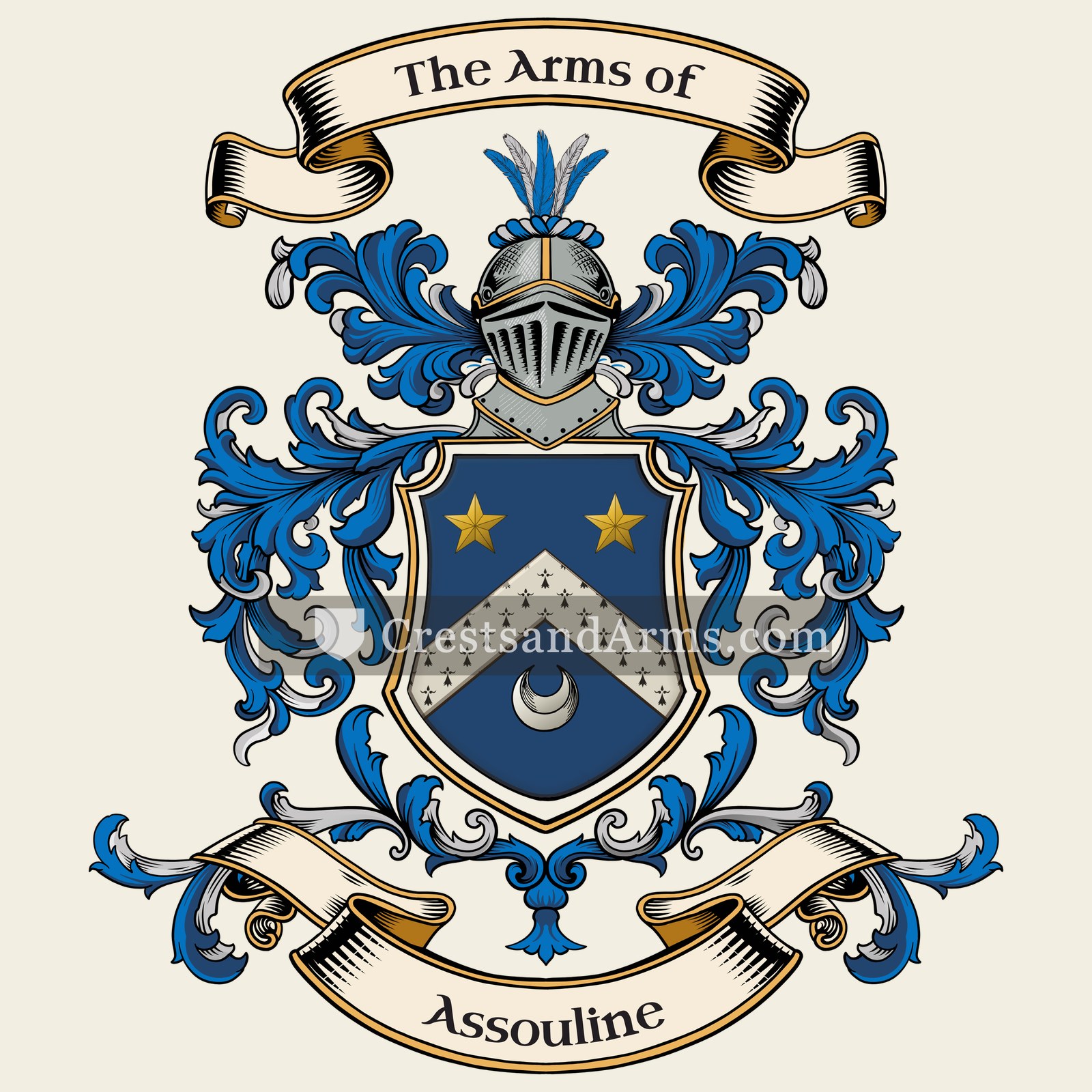
 chevronProtection, and faithful service completed
 mulletThe third son, and a divine quality from above
 crescentHonour by the sovereign, and the second son
 chevronProtection, and faithful service completed
 mulletThe third son, and a divine quality from above
 crescentHonour by the sovereign, and the second son