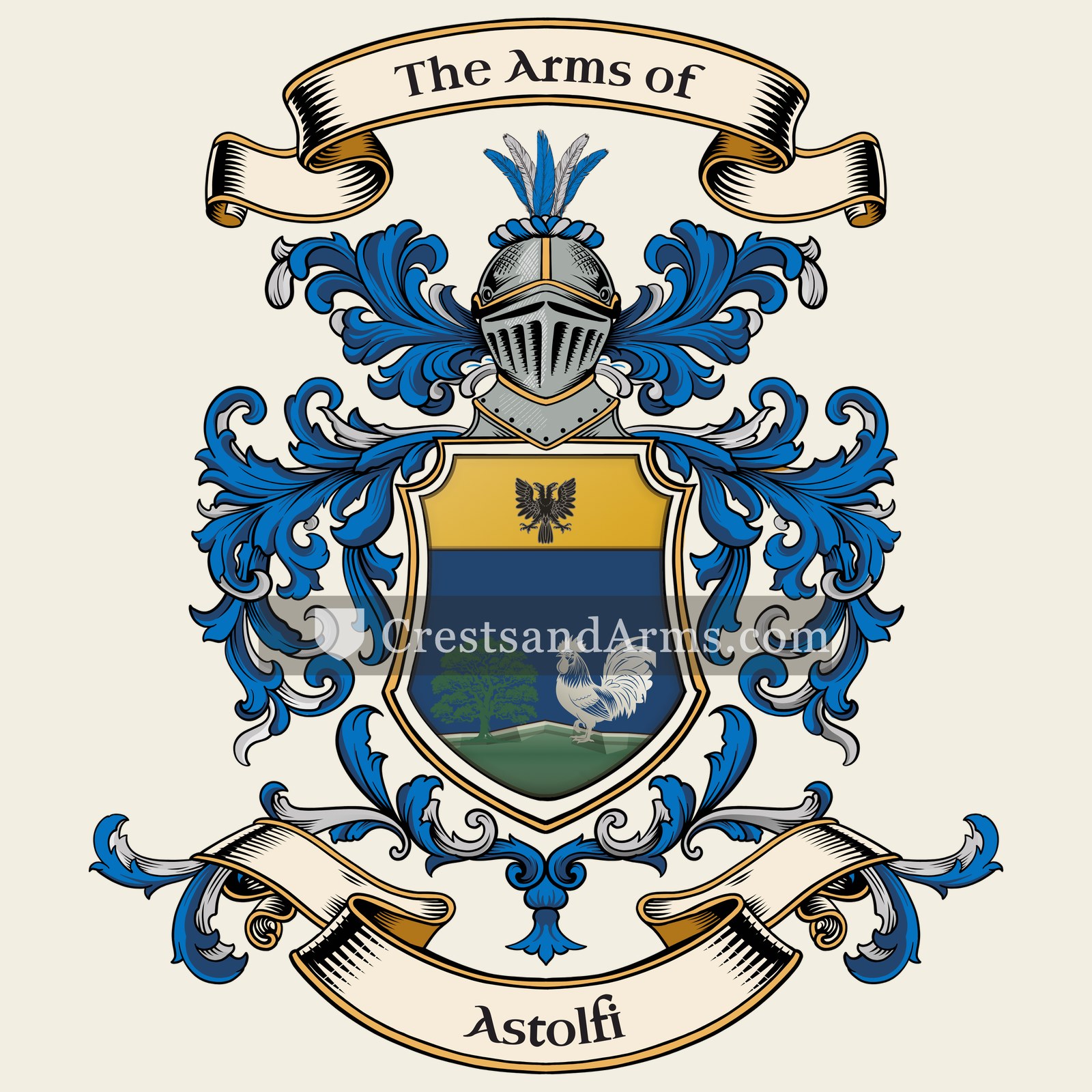
A record of documented arms, meaning and origin, researched for the Astolfi family of Italy.
Reg. 9889 · Italian, A–C
Coat of Arms & Family Crest Details
Symbols on this shield
mountThe ground held, and steadfastness upon it
chiefAuthority, wisdom and dominion
treeLife, endurance and deep roots
cockCourage, vigilance and readiness for battle
eagleNobility, strength and a keen mind
Colours
Blue (Azure)Means: Loyalty and truth
Gold (Or)Means: Generosity
Green (Vert)Means: Hope
Silver (Argent)Means: Peace and sincerity
Black (Sable)Means: Constancy
Historical info
Source
J. B. Rietstap, Armorial Général, Gouda: G. B. van Goor Zonen, 1884–87
Blazon (the actual original written record)
“D'azur à un arbre de sin., senestré d'un coq d'arg., crêté et barbé de gu.; le tout soutenu d'une terrasse de sin.; au chef d'or, ch. d'une aigle de sa.”
ItalyBologne, c. 1775
Digital archive packCoat of arms PNG, gold border print PDF, vector SVG and the certificate of authenticity. Sent to your email in minutes.
Map of Italy showing where the Astolfi arms are recorded
The Astolfi arms were recorded in Bologne, c. 1775.
This is where the arms were entered in the register. Families often moved to other parts of the country, so the same name can turn up in more than one region.
The body that granted and recorded arms in Italy in this period.
Alvise Giovanni Mocenigo
Sovereign of the period
Alvise Giovanni Mocenigo
1763–1778
Reigning in Italy when the Astolfi arms are first recorded.
How Arms Worked in Italy
In the Italian states, coats of arms were often used by noble families to show their status and history. These symbols were passed down through the generations to all legitimate male descendants. Younger branches of a family usually kept the original design but sometimes added small changes to distinguish their specific line from the main branch.
Granting authority
Various local rulers and city governments controlled the use of coats of arms across the different Italian states.
How they got arms
Families often assumed their own arms or received them as official grants from local lords, popes, or city councils.
Where arms were recorded
Arms were recorded in local city archives or private family books rather than in one single national register.
The family's standing
Recorded among the armigerous families of Italy.
Origin & History of the Astolfi Family in Italy
The family name Astolfi traces its roots to the Germanic name Astolfo, which combines the elements for "divine" and "wolf." This name became popular across Italy during the Middle Ages, largely due to the fame of King Aistulf, a powerful ruler of the Lombards who governed much of the Italian peninsula in the eighth century. By the time the family was firmly established in Bologna in 1775, they were part of a society deeply influenced by centuries of regional tradition and urban growth. Families with this name often settled in the fertile plains of the Emilia-Romagna region, where they participated in the local economy and civic life of the city. Because the name was tied to historical figures of high status, it carried a sense of long-standing prestige within the community. Over generations, the Astolfi family became a recognized part of the Bolognese social fabric, contributing to the development of the city through their professional and personal lives.
Astolfi Meaning & Related Branches
Root word
Astulf
Derived from the Germanic elements for divine god and wolf.
This name
AstolfiA patronymic form signifying descendant of the divine wolf.
also spelled
Astolfy
Astolfie
Astolfee
Documented Sources
J. B. Rietstap, Armorial Général, Gouda: G. B. van Goor Zonen, 1884–87
De Felice, Emidio. Dizionario dei cognomi italiani. 1978
Morolli, Angelo. Dizionario storico-blasonico delle famiglie nobili e notabili italiane estinte e fiorenti. 1886
Archivio di Stato di Bologna, Stato Civile della Restaurazione, Serie Matrimoni
Digital archive packCoat of arms PNG, gold border print PDF, vector SVG and the certificate of authenticity. Sent to your email in minutes.


 mountThe ground held, and steadfastness upon it
 chiefAuthority, wisdom and dominion
 treeLife, endurance and deep roots
 cockCourage, vigilance and readiness for battle
 eagleNobility, strength and a keen mind
 mountThe ground held, and steadfastness upon it
 chiefAuthority, wisdom and dominion
 treeLife, endurance and deep roots
 cockCourage, vigilance and readiness for battle
 eagleNobility, strength and a keen mind