A record of documented arms, meaning and origin, researched for the Aston family lines. Documented in 3 countries.
Reg. 0677 · Britain, A–C
Coat of Arms & Family Crest Details
Symbols on this shield
fessThe military belt, and readiness to serve
lozengeHonour and nobility, and the arms of a woman
Colours
Silver (Argent)Means: Peace and sincerity
Black (Sable)Means: Constancy
Historical info
Source
J. B. Rietstap, Armorial Général, Gouda: G. B. van Goor Zonen, 1884–87
Blazon (the actual original written record)
“D'arg. à la fasce de sa., acc. de trois los. du même, rangées en chef. C.: une tête et col de boeuf de sa. T.: deux guerriers romains, arm. de toutes pièces, le visage, les mains et les genoux de carn., tenant chacun un bouclier. D.: NUMINI ET PATRIÆ ASTO.”
Britainc. 1700
Digital archive packCoat of arms PNG, gold border print PDF, vector SVG and the certificate of authenticity. Sent to your email in minutes.
Map of Britain showing where the Aston arms are recorded
The Aston arms were recorded in Britain, c. 1700.
Arms such as these were typically recorded in Kent.
Kent sits between London and the short crossing to Europe, and the trade passing through made it wealthy. Merchant families bought land with that money, and it was landowners who took coats of arms.
This is where the arms were entered in the register. Families often moved to other parts of the country, so the same name can turn up in more than one region.
The body that granted and recorded arms in Britain in this period.
William III of England
Sovereign of the period
William III of England
1694–1702
Reigning in Britain when the Aston arms are first recorded.
How Arms Worked in Britain
English heraldry allowed arms to be shared by all legitimate descendants of the original owner. These symbols were treated as personal property that moved through the generations to all children. While the eldest son kept the original design, other family members could use the same shield without needing to change it or register their own unique versions.
Granting authority
The College of Arms in London has regulated the use of coats of arms throughout England and Wales since 1484.
How they got arms
Families typically obtained their coats of arms through a formal grant from the Crown or by proving their ancient right to them.
Where arms were recorded
All official coats of arms are recorded in the registers kept at the College of Arms, which date back to the fifteenth century.
The family's standing
Recorded among the armigerous families of Britain.
Origin & History of the Aston Family in Britain
The surname Aston is a classic example of a locative name, which means it was originally derived from a specific place rather than a trade or a personal characteristic. In Old English, the name translates literally to "east town," combining the words "east" and "tun." Because this was a common way to describe settlements located to the east of a larger town or manor, the name appeared independently in many different parts of Britain. By the time the family was firmly established in Kent in the early 1700s, the name had already been in use for centuries across various English counties. Families bearing this name were often tied to the land, working as farmers or local tradespeople who identified themselves by their home village. As the family grew and moved throughout the region, they carried this connection to their ancestral geography with them, eventually becoming a settled part of the local history in southeastern England.
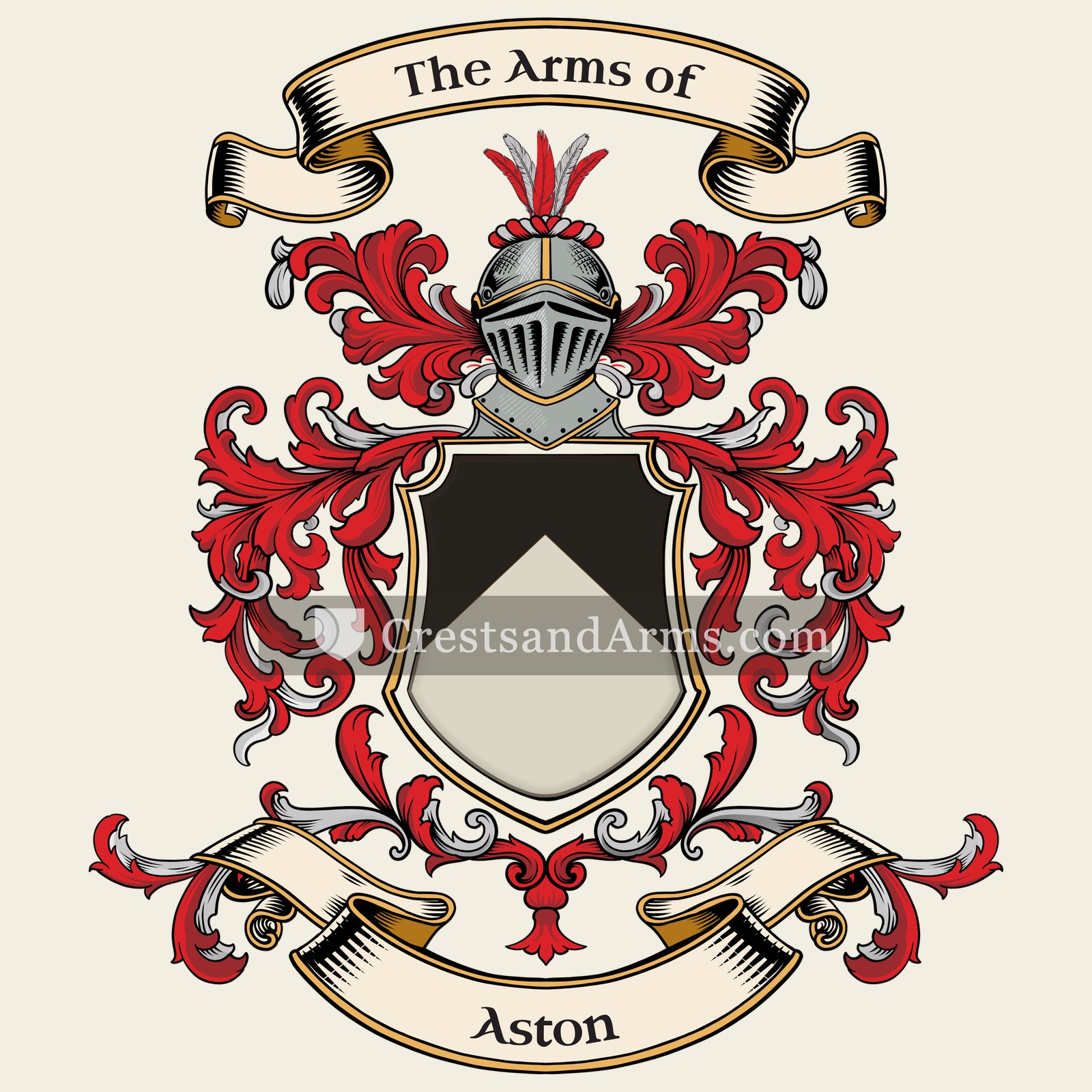
Coat of Arms & Family Crest Details
Colours
Black (Sable)Means: Constancy
Silver (Argent)Means: Peace and sincerity
Historical info
Source
Sir Bernard Burke, The General Armory of England, Scotland, Ireland and Wales, London: Harrison & Sons, 1884
Blazon (the actual original written record)
“Per chev. sa. and ar”
ChesterAston · Chester, c. 1620
Digital archive packCoat of arms PNG, gold border print PDF, vector SVG and the certificate of authenticity. Sent to your email in minutes.
Map of England showing where the Aston arms are recorded
The Aston arms were recorded in Chester, c. 1620.
Cheshire was governed apart from the rest of England for much of its history, with its own courts and its own gentry. That separateness bred a strong local landed class, and landed families carried arms.
This is where the arms were entered in the register. Families often moved to other parts of the country, so the same name can turn up in more than one region.
The body that granted and recorded arms in England in this period.
James VI and I
Sovereign of the period
James VI and I
1603–1625
Reigning in Britain when the Aston arms are first recorded.
How Arms Worked in England
English heraldry allowed arms to be shared by all legitimate descendants of the original owner. These symbols were treated as personal property that moved through the generations to all children. While the eldest son kept the original design, other family members could use the same shield without needing to change it or register their own unique versions.
Granting authority
The College of Arms in London has regulated the use of coats of arms throughout England and Wales since 1484.
How they got arms
Families typically obtained their coats of arms through a formal grant from the Crown or by proving their ancient right to them.
Where arms were recorded
All official coats of arms are recorded in the registers kept at the College of Arms, which date back to the fifteenth century.
The family's standing
Recorded among the armigerous families of Chester.
Origin & History of the Aston Family in England
The surname Aston is a locative name, meaning it originated from individuals who lived in or near a place called "East Town." In Old English, the name is derived from the words "east" and "tun," which referred to an eastern settlement or farmstead. Because many small villages across England shared this name, families named Aston emerged independently in several different counties rather than descending from a single ancestor. By the early 17th century, the name was well-established in the historic city of Chester. Records from 1620 confirm that members of the Aston family were active in this region, likely participating in the vibrant trade and civic life that defined the city during the Stuart period. As the family grew, they became part of the local social fabric, contributing to the development of the Cheshire area through their roles in business and community affairs.
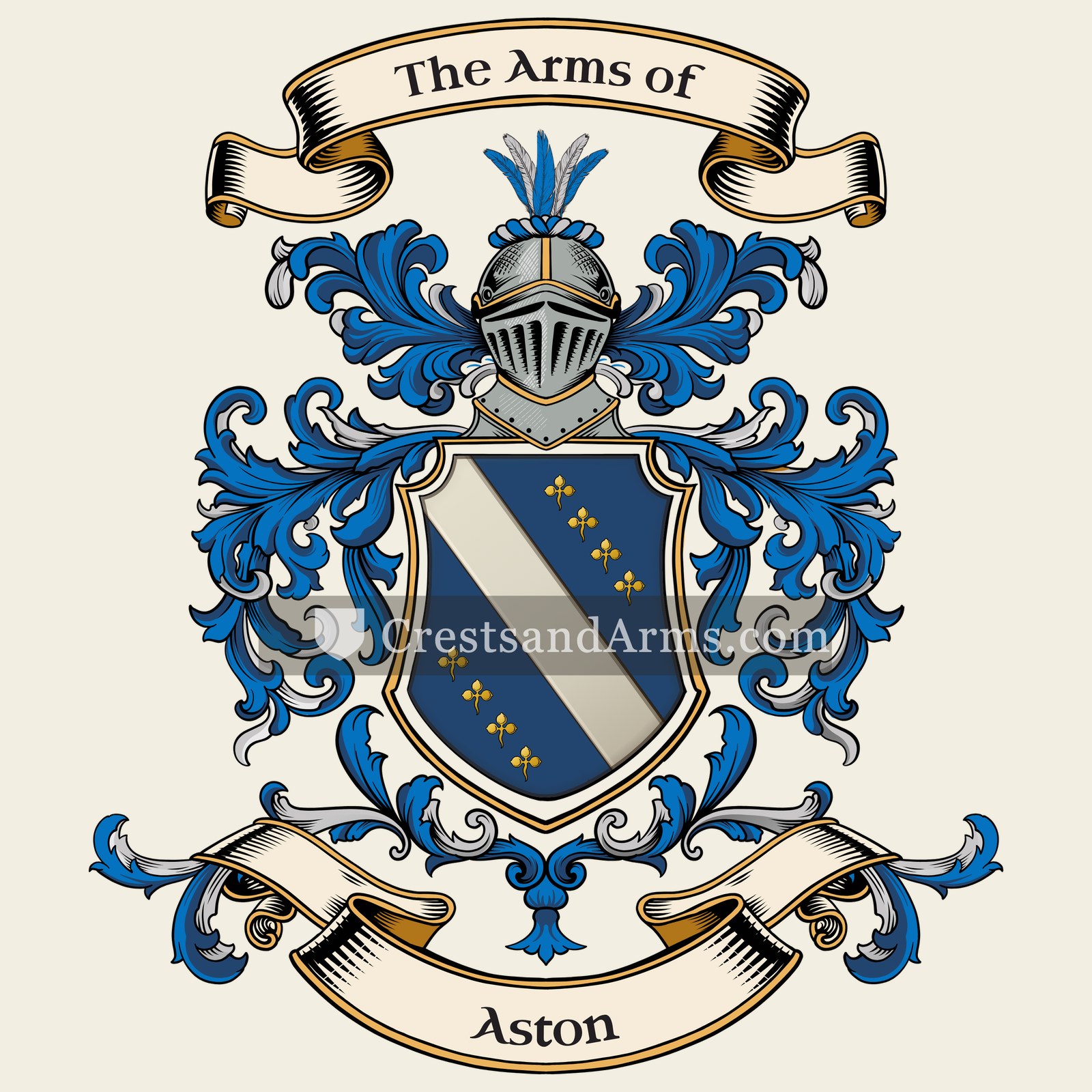
Coat of Arms & Family Crest Details
Symbols on this shield
bendDefence, and the scarf of a commander
trefoilPerpetuity, and the Trinity
Colours
Blue (Azure)Means: Loyalty and truth
Silver (Argent)Means: Peace and sincerity
Gold (Or)Means: Generosity
Historical info
Source
Sir Bernard Burke, The General Armory of England, Scotland, Ireland and Wales, London: Harrison & Sons, 1884
Blazon (the actual original written record)
“Az. a bend ar. cottised or, betw. eight trefoils of the last”
Irelandc. 1645
Digital archive packCoat of arms PNG, gold border print PDF, vector SVG and the certificate of authenticity. Sent to your email in minutes.
Map of Ireland showing where the Aston arms are recorded
The Aston arms were recorded in Ireland, c. 1645.
Arms such as these were typically recorded in Dublin.
Dublin was the seat of government in Ireland and the place where grants were sought and recorded. Families with business at the castle or the courts settled nearby, and settling there put their arms on record.
This is where the arms were entered in the register. Families often moved to other parts of the country, so the same name can turn up in more than one region.
The body that granted and recorded arms in Ireland in this period.
Charles I of England
Sovereign of the period
Charles I of England
1625–1649
Reigning in Britain when the Aston arms are first recorded.
How Arms Worked in Ireland
The Ulster King of Arms granted coats of arms to individuals who proved their social standing and good character. These symbols were typically inherited by all legitimate descendants of the original holder. If a family branch wanted a unique look, they could apply for a specific change to their design through the office to ensure their identity remained distinct.
Granting authority
The Ulster King of Arms acted as the official body that regulated and issued all coats of arms throughout Ireland.
How they got arms
Families obtained their arms through formal grants issued by the office after proving their eligibility and paying the required fees.
Where arms were recorded
All official grants were recorded in the registers held by the Ulster King of Arms starting from the year 1552.
The family's standing
Recorded among the armigerous families of Ireland.
Origin & History of the Aston Family in Ireland
The history of the Aston family in Ireland is deeply rooted in the political and social shifts of the seventeenth century. By 1645, members of the family were firmly established in Dublin, a city that served as the primary administrative and military hub for the English presence in Ireland at the time. During this period, the name was associated with individuals who held positions of influence within the city's growing merchant and administrative classes. These early settlers often arrived as part of the broader movement of people from England to Ireland, seeking new opportunities in trade and governance. As the family integrated into Dublin society, they became part of the complex urban fabric of a city navigating the turbulent conflicts of the mid-1600s. Their presence in the capital suggests they were well-positioned to participate in the economic life of the region, helping to shape the development of the city during a time of significant transition.
Aston Meaning & Related Branches
Root word
East-tun
Old English terms for east and an enclosed settlement or town.
This name
AstonRefers to a person who lived in a settlement located to the east.
also spelled
Astun
Astoun
Asttonne
Related arms
Asten, or Anstenvariant spelling
Astownevariant spelling
Documented Sources
J. B. Rietstap, Armorial Général, Gouda: G. B. van Goor Zonen, 1884–87
Reaney, P.H., A Dictionary of English Surnames, 1958
Ekwall, Eilert, The Concise Oxford Dictionary of English Place-names, 1960
Kent Archives, Parish Registers of Kent, 1700–1750
Digital archive packCoat of arms PNG, gold border print PDF, vector SVG and the certificate of authenticity. Sent to your email in minutes.


 fessThe military belt, and readiness to serve
 lozengeHonour and nobility, and the arms of a woman
 fessThe military belt, and readiness to serve
 lozengeHonour and nobility, and the arms of a woman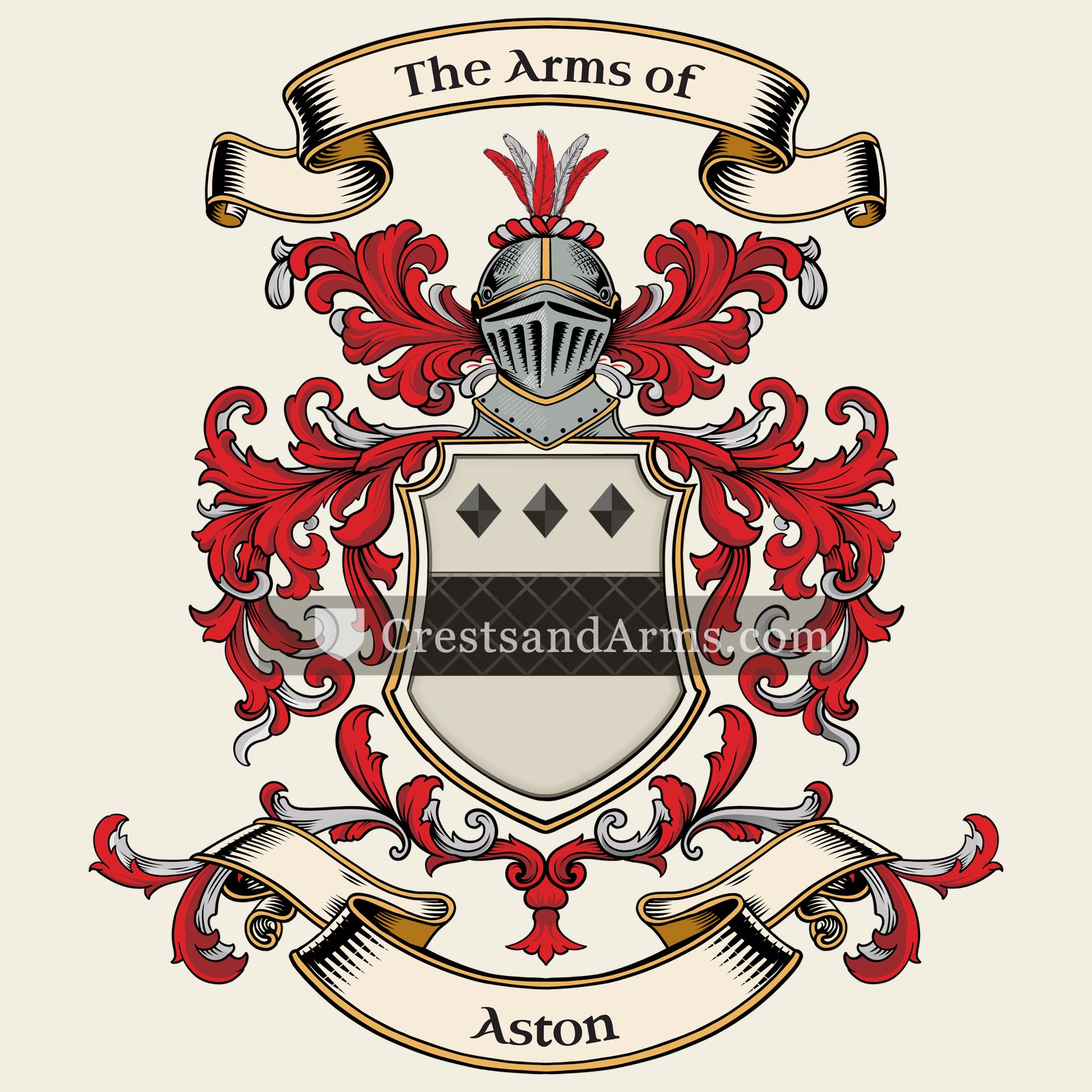



 bendDefence, and the scarf of a commander
 trefoilPerpetuity, and the Trinity