Map of Germany showing where the Atten arms are recorded
The Atten arms were recorded in Ostfrise, c. 1765.
This is where the arms were entered in the register. Families often moved to other parts of the country, so the same name can turn up in more than one region.
The body that granted and recorded arms in Germany in this period.
Francis I, Holy Roman Emperor
Sovereign of the period
Francis I, Holy Roman Emperor
1745–1765
Reigning in Germany when the Atten arms are first recorded.
How Arms Worked in Germany
In the Holy Roman Empire, coats of arms were often granted to individuals by the Emperor or his representatives. These arms were then passed down through the generations to all legitimate descendants of the original holder. Younger branches of a family usually kept the same shield design without needing to change it, as the arms belonged to the entire lineage.
Granting authority
The Holy Roman Emperor held the sole power to grant new coats of arms throughout his vast imperial territories.
How they got arms
Families typically obtained their coats of arms through a formal imperial grant or by proving their noble status to the authorities.
Where arms were recorded
These grants were officially recorded in the Imperial Chancery registers, which began keeping formal records of such honors during the Middle Ages.
The family's standing
Recorded among the armigerous families of Germany.
Origin & History of the Atten Family in Germany
The family name Atten finds its historical roots in the region of East Frisia, known locally as Ostfriesland, where records confirm members of the family were living by 1765. During this period, the area was characterized by a unique social structure where many families worked as independent farmers or skilled laborers within small, tight-knit coastal communities. The name itself likely evolved from the local Low German dialect, where it may have served as a descriptive identifier for a person’s origin or their specific place of residence within a village. Because East Frisia was a region defined by its flat marshlands and proximity to the North Sea, families often maintained strong ties to their local parishes. These early ancestors were part of a resilient population that navigated the challenges of living in a landscape shaped by constant water management and agricultural development. Over time, the name became a permanent marker of this family’s long-standing connection to the northern German countryside.
Atten Meaning & Related Branches
Root word
Adal
Old High German term meaning noble or of noble descent.
This name
AttenA patronymic or locative surname derived from noble ancestry or a settlement associated with noble families.
also spelled
Atena
Documented Sources
J. B. Rietstap, Armorial Général, Gouda: G. B. van Goor Zonen, 1884–87


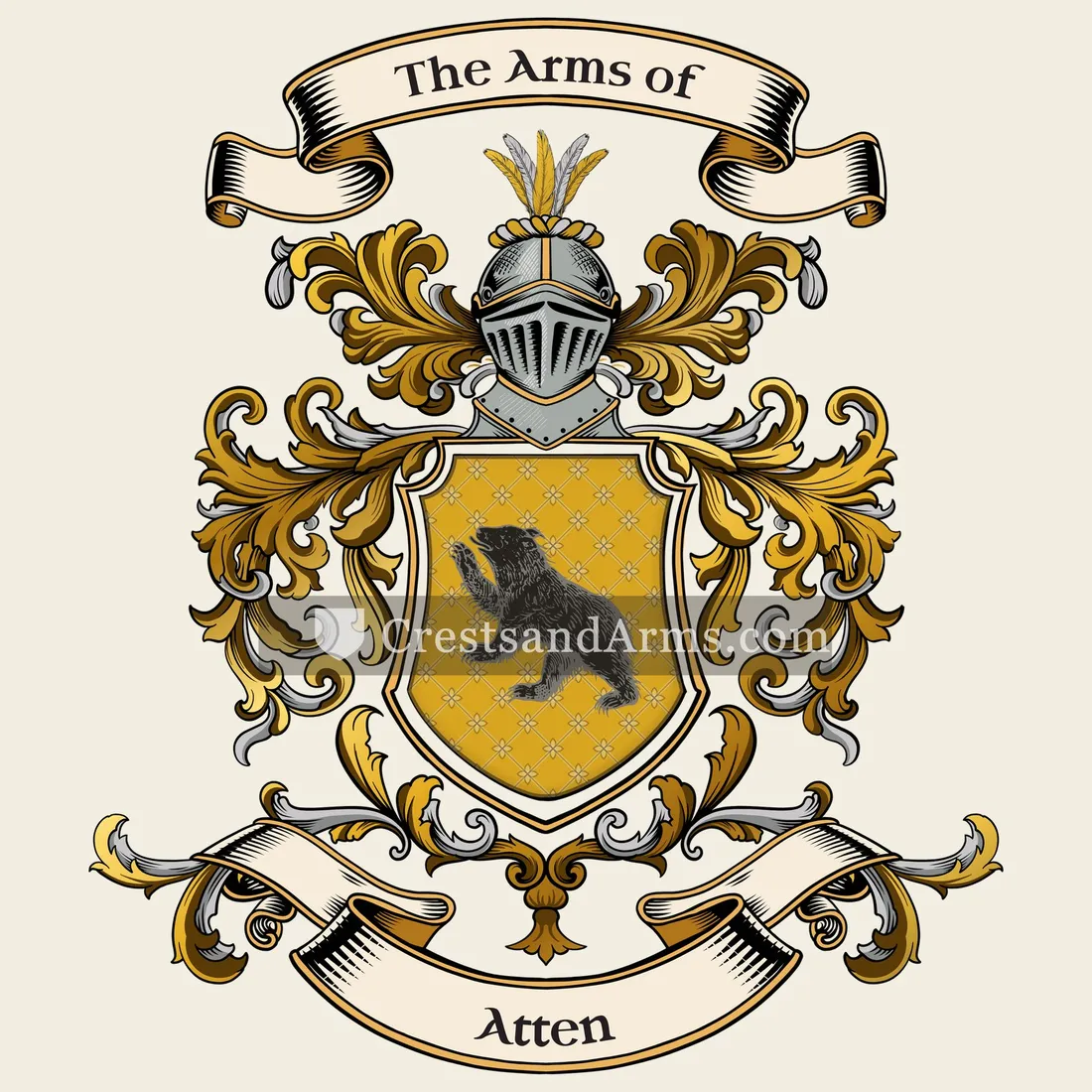
 bearStrength, cunning and protection of kin
 bearStrength, cunning and protection of kin