Map of France showing where the Aubert arms are recorded
The Aubert arms were recorded in Franche-Comte, c. 1630.
Franche-Comte sat between France and the Empire and changed hands more than once. Border families held their land under arms and expected to defend it, so a shield was a practical thing rather than an ornament.
This is where the arms were entered in the register. Families often moved to other parts of the country, so the same name can turn up in more than one region.
The body that granted and recorded arms in France in this period.
Louis XIII of France
Sovereign of the period
Louis XIII of France
1617–1643
Reigning in France when the Aubert arms are first recorded.
How Arms Worked in France
In France, a coat of arms was a mark of honor that passed down through the male line to all legitimate descendants. Families often used the same shield without changes to show their shared heritage. If a branch wanted to stand out, they could add a small mark to their shield to show their specific place in the family tree.
Granting authority
The Juge d'armes de France acted as the official authority that regulated and verified coats of arms across the country.
How they got arms
Families typically inherited their arms from ancestors, though they could also receive them through royal grants or by proving their noble status.
Where arms were recorded
Coats of arms were officially recorded in the Armorial Général de France, which began its main collection in the year 1696.
The family's standing
Recorded among the armigerous families of Franche-Comte.
Origin & History of the Aubert Family in France
The surname Aubert is a classic example of a name derived from ancient Germanic roots, specifically the name Adalbert, which combines the elements for noble and bright. As the name spread across France during the Middle Ages, it became a common choice for families living in various regions. By the year 1630, historical records confirm that members of the Aubert family were well-established in the Franche-Comté region. This area, located in eastern France near the border with Switzerland, was a place of significant cultural and political transition during the seventeenth century. Families like the Auberts often lived as farmers, artisans, or local officials who helped maintain the stability of their communities during this era. Their presence in Franche-Comté reflects the broader movement of families who settled in the provinces to build lives based on trade and land ownership. Over time, the name became deeply woven into the local history of the region as these early ancestors contributed to the growth of their towns and villages.
Coat of Arms & Family Crest Details
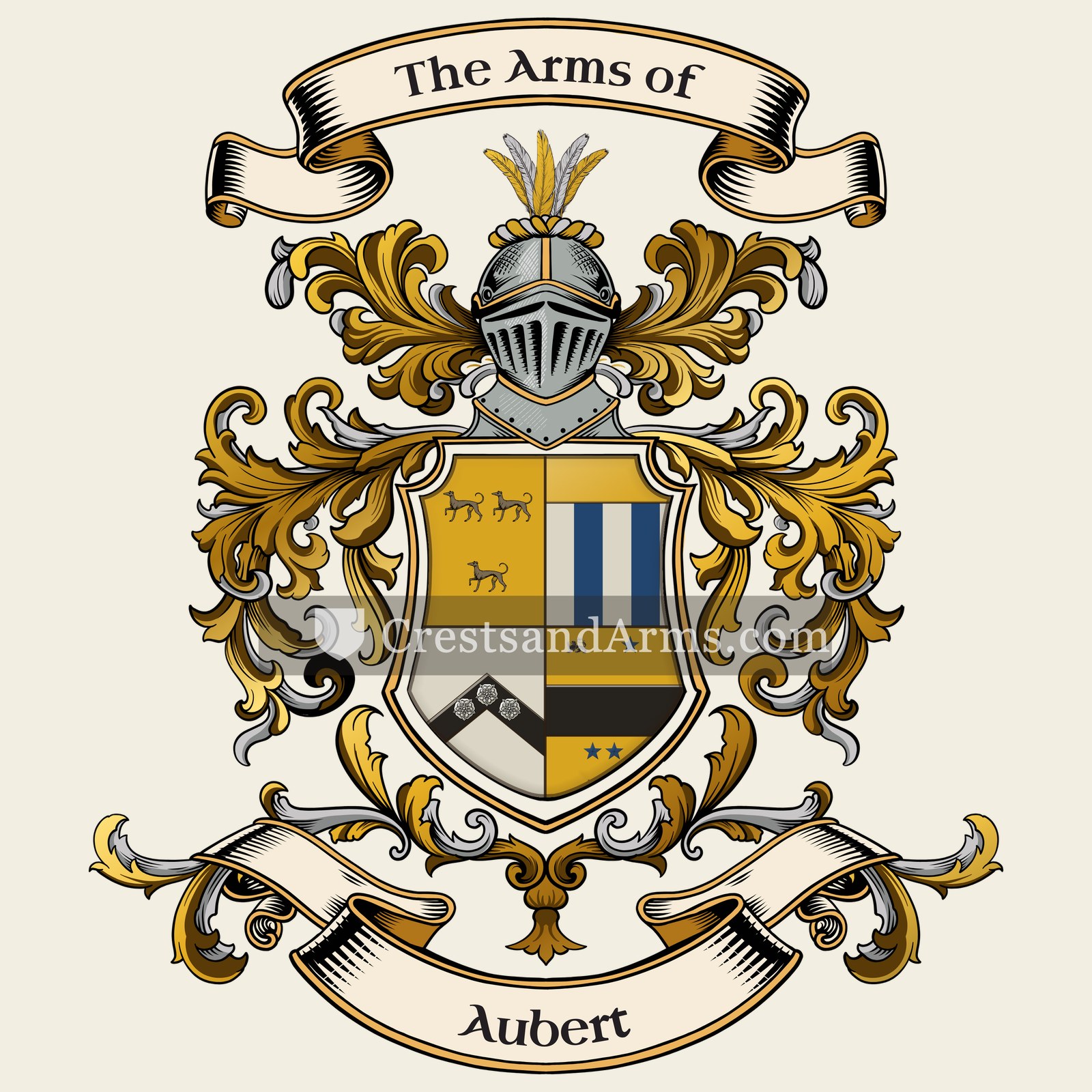
Symbols on this shield
paleMilitary strength, and a fortified defence
chiefAuthority, wisdom and dominion
chevronProtection, and faithful service completed
greyhoundCourage, vigilance and loyalty
roseThe seventh son, and beauty with grace
Colours
Gold (Or)Means: Generosity
Silver (Argent)Means: Peace and sincerity
Black (Sable)Means: Constancy
Blue (Azure)Means: Loyalty and truth
Historical info
Source
J. B. Rietstap, Armorial Général, Gouda: G. B. van Goor Zonen, 1884–87
Blazon (the actual original written record)
“Ec.: au 1 d'or à trois têtes de chien braque de sa. (Aubert); au 2 palé d'arg. et d'azur de six pièces; au chef d'or (Vesc-Beconne); au 3 d'arg. au chev. de sa., ch. de trois roses d'arg.; au 4 d'arg.”
BritainLondres, c. 1700
Digital archive packCoat of arms PNG, gold border print PDF, vector SVG and the certificate of authenticity. Sent to your email in minutes.
Map of Britain showing where the Aubert arms are recorded
The Aubert arms were recorded in Londres, c. 1700.
Arms such as these were typically recorded in Kent.
Kent sits between London and the short crossing to Europe, and the trade passing through made it wealthy. Merchant families bought land with that money, and it was landowners who took coats of arms.
This is where the arms were entered in the register. Families often moved to other parts of the country, so the same name can turn up in more than one region.
The body that granted and recorded arms in Britain in this period.
William III of England
Sovereign of the period
William III of England
1694–1702
Reigning in France when the Aubert arms are first recorded.
How Arms Worked in Britain
English heraldry allowed arms to be shared by all legitimate descendants of the original owner. These symbols were treated as personal property that moved through the generations to all children. While the eldest son kept the original design, other family members could use the same shield without needing to change it or register their own unique versions.
Granting authority
The College of Arms in London has regulated the use of coats of arms throughout England and Wales since 1484.
How they got arms
Families typically obtained their coats of arms through a formal grant from the Crown or by proving their ancient right to them.
Where arms were recorded
All official coats of arms are recorded in the registers kept at the College of Arms, which date back to the fifteenth century.
The family's standing
Recorded among the armigerous families of Britain.
Origin & History of the Aubert Family in Britain
The family name Aubert arrived in Britain as part of a broader movement of people fleeing religious persecution in continental Europe during the late seventeenth and early eighteenth centuries. By the year 1700, records indicate that members of the Aubert family had established themselves in the county of Kent. Many families with this name were part of the Huguenot community, which consisted of French Protestants seeking refuge from political and religious instability in their homeland. Upon settling in England, these individuals often integrated into the local economy by working as skilled artisans, merchants, or farmers. Their presence in Kent suggests that they were part of a wave of migration that brought new trades and cultural influences to the English countryside. Over time, the family name became firmly rooted in the region as these newcomers adapted to life in a new country while maintaining their distinct heritage.
Coat of Arms & Family Crest Details
Symbols on this shield
chiefAuthority, wisdom and dominion
chevronProtection, and faithful service completed
fessThe military belt, and readiness to serve
greyhoundCourage, vigilance and loyalty
roseThe seventh son, and beauty with grace
lionCourage, strength and royalty
mulletThe third son, and a divine quality from above
Colours
Gold (Or)Means: Generosity
Silver (Argent)Means: Peace and sincerity
Black (Sable)Means: Constancy
Blue (Azure)Means: Loyalty and truth
Historical info
Source
Sir Bernard Burke, The General Armory of England, Scotland, Ireland and Wales, London: Harrison & Sons, 1884
Blazon (the actual original written record)
“Quarterly, 1st, or, three talbots' heads erased at the neck ppr. ; 2nd, paly of six ar. and az. a chief or; 3rd, ar. on a chev. sa. three roses of the first; 4th, ar. a lion ramp. sa. debruised with a fesse gu. all betw. three mullets of six points az”
Englandc. 1620
Digital archive packCoat of arms PNG, gold border print PDF, vector SVG and the certificate of authenticity. Sent to your email in minutes.
Map of England showing where the Aubert arms are recorded
The Aubert arms were recorded in England, c. 1620.
Arms such as these were typically recorded in York.
Yorkshire is the largest of the English counties, and it held more gentry families than any other. Land there was split among a great many households rather than a few, so a great many of them carried arms.
This is where the arms were entered in the register. Families often moved to other parts of the country, so the same name can turn up in more than one region.
The body that granted and recorded arms in England in this period.
James VI and I
Sovereign of the period
James VI and I
1603–1625
Reigning in France when the Aubert arms are first recorded.
How Arms Worked in England
English heraldry allowed arms to be shared by all legitimate descendants of the original owner. These symbols were treated as personal property that moved through the generations to all children. While the eldest son kept the original design, other family members could use the same shield without needing to change it or register their own unique versions.
Granting authority
The College of Arms in London has regulated the use of coats of arms throughout England and Wales since 1484.
How they got arms
Families typically obtained their coats of arms through a formal grant from the Crown or by proving their ancient right to them.
Where arms were recorded
All official coats of arms are recorded in the registers kept at the College of Arms, which date back to the fifteenth century.
The family's standing
Recorded among the armigerous families of England.
Origin & History of the Aubert Family in England
The family name Aubert traces its roots to the Germanic name Albert, which combines the elements for noble and bright. While the name originated in continental Europe, it eventually migrated across the English Channel and became established in northern England. By the year 1620, records confirm that members of the Aubert family were living in the historic city of York. During this period, York was a bustling center of trade and religious importance, suggesting that these early settlers were likely involved in the local merchant class or skilled trades. The presence of the family in such a prominent northern hub indicates that they were well-integrated into the social fabric of seventeenth-century England. Over time, the name evolved alongside the English language, maintaining its distinct identity while adapting to the customs of their new home.
Aubert Meaning & Related Branches
Root word
Adalbert
Derived from Germanic elements meaning noble and bright or famous.
This name
AubertA French surname signifying a noble and illustrious individual.
also spelled
Auber
Auberts
Aubertt
Obert
Aubertin
Related arms
Aubrysame arms
Bonnelsimilar arms
Knyff (de) - Anvers, Bruxellessimilar arms
Aubervariant spelling
Documented Sources
J. B. Rietstap, Armorial Général, Gouda: G. B. van Goor Zonen, 1884–87
Dauzat, Albert. Dictionnaire étymologique des noms et prénoms de France. 1951
Archives départementales du Doubs. Série B: Cours et juridictions. 1630
Morlet, Marie-Thérèse. Dictionnaire étymologique des noms de famille. 1991
Digital archive packCoat of arms PNG, gold border print PDF, vector SVG and the certificate of authenticity. Sent to your email in minutes.


 lionCourage, strength and royalty
 lionCourage, strength and royalty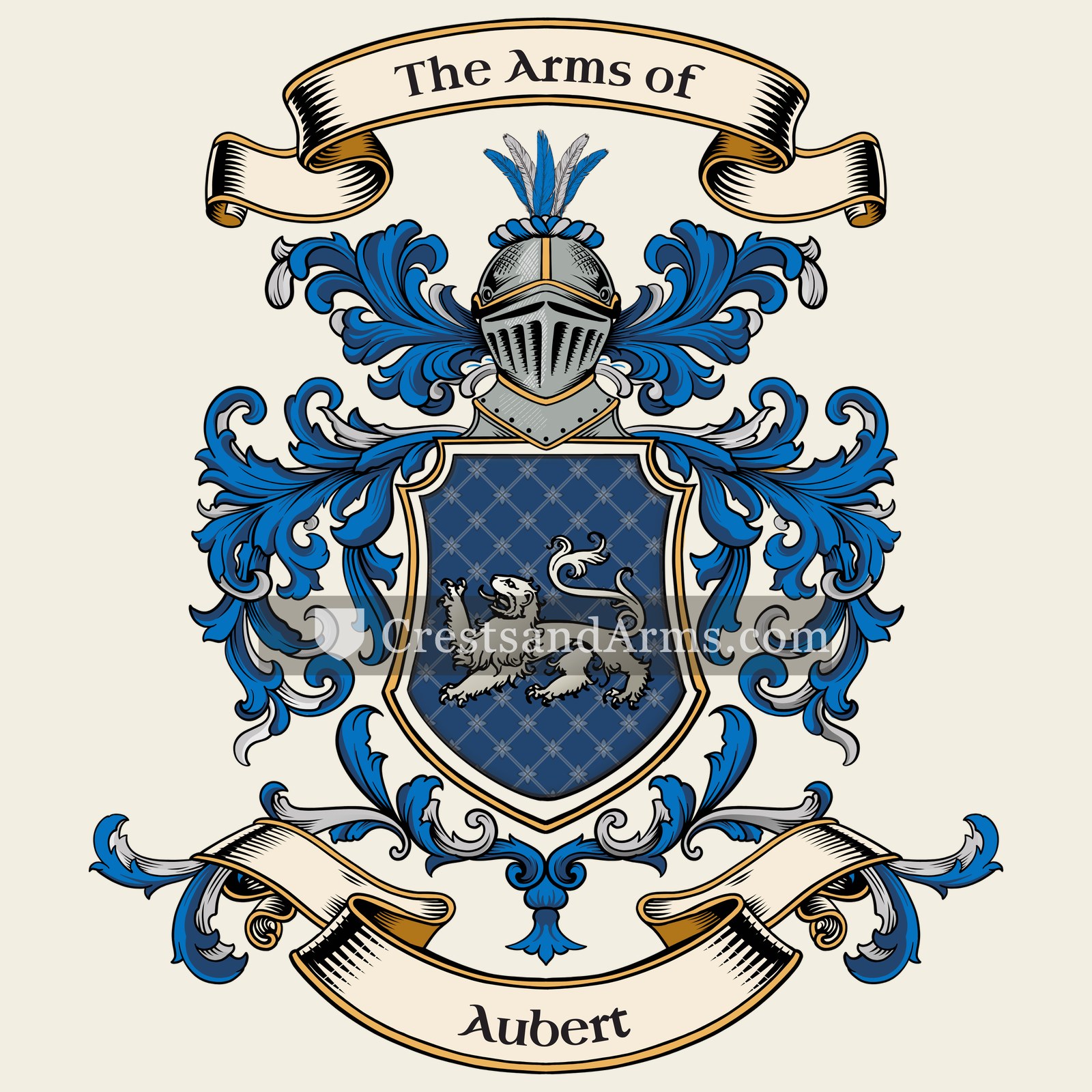


 paleMilitary strength, and a fortified defence
 chiefAuthority, wisdom and dominion
 chevronProtection, and faithful service completed
 greyhoundCourage, vigilance and loyalty
 roseThe seventh son, and beauty with grace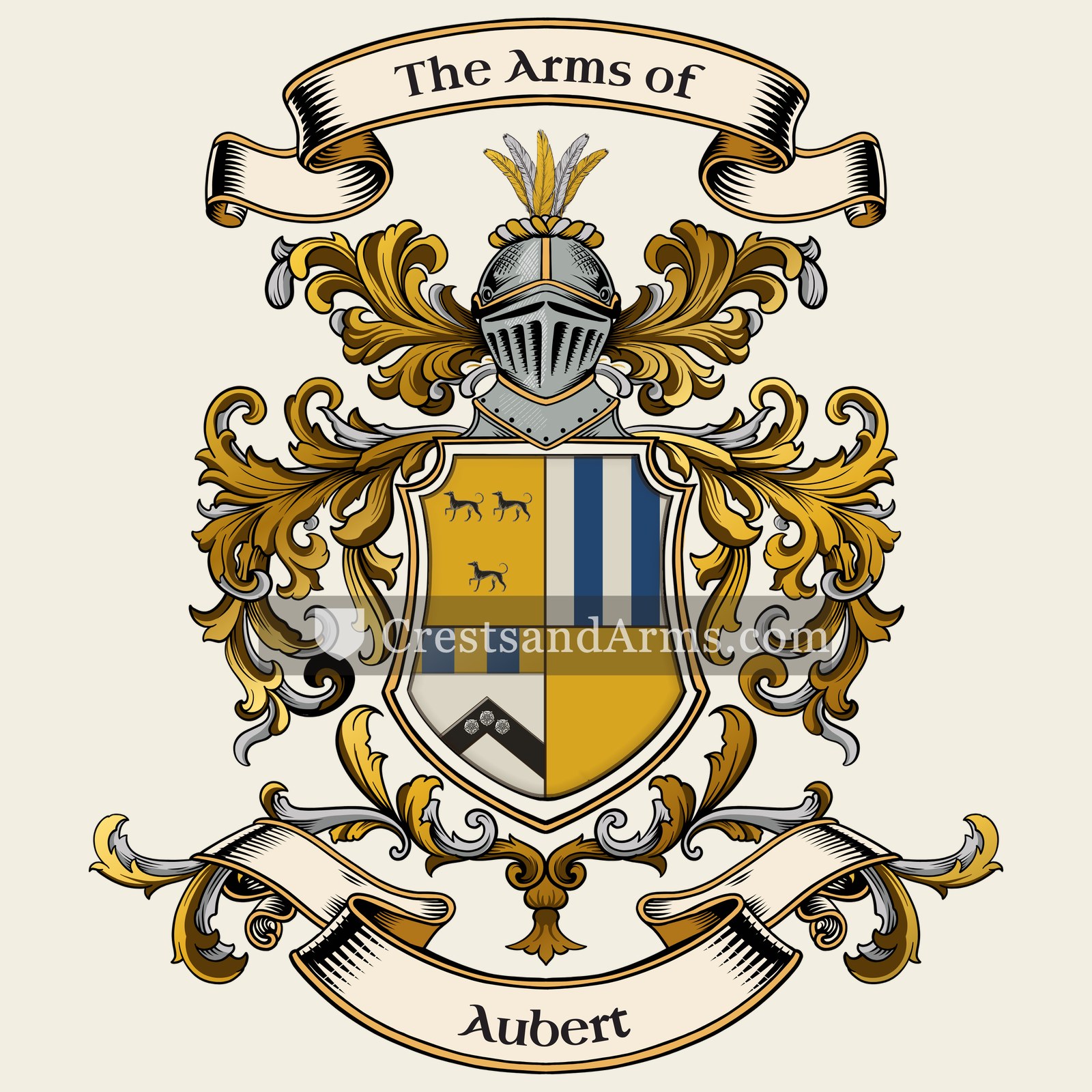


 fessThe military belt, and readiness to serve
 mulletThe third son, and a divine quality from above