A record of documented arms, meaning and origin, researched for the Augenstein family lines. Documented in 2 countries.
Reg. 7242 · German, A–C
Coat of Arms & Family Crest Details
Symbols on this shield
chevronProtection, and faithful service completed
fleur de lisPurity, light, and the sixth son
Colours
Red (Gules)Means: Military strength
Silver (Argent)Means: Peace and sincerity
Historical info
Source
J. B. Rietstap, Armorial Général, Gouda: G. B. van Goor Zonen, 1884–87
Blazon (the actual original written record)
“Ec.: aux 1 et 4 de gu. à une fleur-de-lis d'arg.; aux 2 et 3 d'arg. au chev. de gu. [A l'occasion de son mariage avec M. le comte Rossi, la célèbre cantatrice Henriette Sontag fut anoblie sous le nom de von Lauenstein, avec concession des armes ci-décrites.]”
Germanyc. 1765
Digital archive packCoat of arms PNG, gold border print PDF, vector SVG and the certificate of authenticity. Sent to your email in minutes.
Map of Germany showing where the Augenstein arms are recorded
The Augenstein arms were recorded in Germany, c. 1765.
Arms such as these were typically recorded in Bavaria.
Bavaria was a country of old landed families and walled market towns. Estates passed down the same line for centuries, and both the landowners and the leading townsmen kept arms, which is why so many Bavarian names sit in the registers.
This is where the arms were entered in the register. Families often moved to other parts of the country, so the same name can turn up in more than one region.
The body that granted and recorded arms in Germany in this period.
Francis I, Holy Roman Emperor
Sovereign of the period
Francis I, Holy Roman Emperor
1745–1765
Reigning in Germany when the Augenstein arms are first recorded.
How Arms Worked in Germany
In the Holy Roman Empire, coats of arms were often granted to individuals by the Emperor or his representatives. These arms were then passed down through the generations to all legitimate descendants of the original holder. Younger branches of a family usually kept the same shield design without needing to change it, as the arms belonged to the entire lineage.
Granting authority
The Holy Roman Emperor held the sole power to grant new coats of arms throughout his vast imperial territories.
How they got arms
Families typically obtained their coats of arms through a formal imperial grant or by proving their noble status to the authorities.
Where arms were recorded
These grants were officially recorded in the Imperial Chancery registers, which began keeping formal records of such honors during the Middle Ages.
The family's standing
Recorded among the armigerous families of Germany.
Origin & History of the Augenstein Family in Germany
The surname Augenstein is a topographical name that originated in the German-speaking regions of Central Europe. It is composed of the German words "Auge," meaning eye, and "Stein," meaning stone. Historians believe the name likely identified families who lived near a prominent rock formation or a landmark that resembled an eye. By the mid-18th century, records confirm that the Augenstein family was well-established in the Bavarian region. During this period, Bavaria was a collection of rural territories where families were often tied to the land through agriculture and local trade. Because the name is descriptive of the landscape, it suggests that the earliest ancestors were deeply connected to the specific geography of their home villages. These families lived through a time of significant social change in the Holy Roman Empire, eventually transitioning from local agrarian life into the broader historical narrative of southern Germany.
Coat of Arms & Family Crest Details
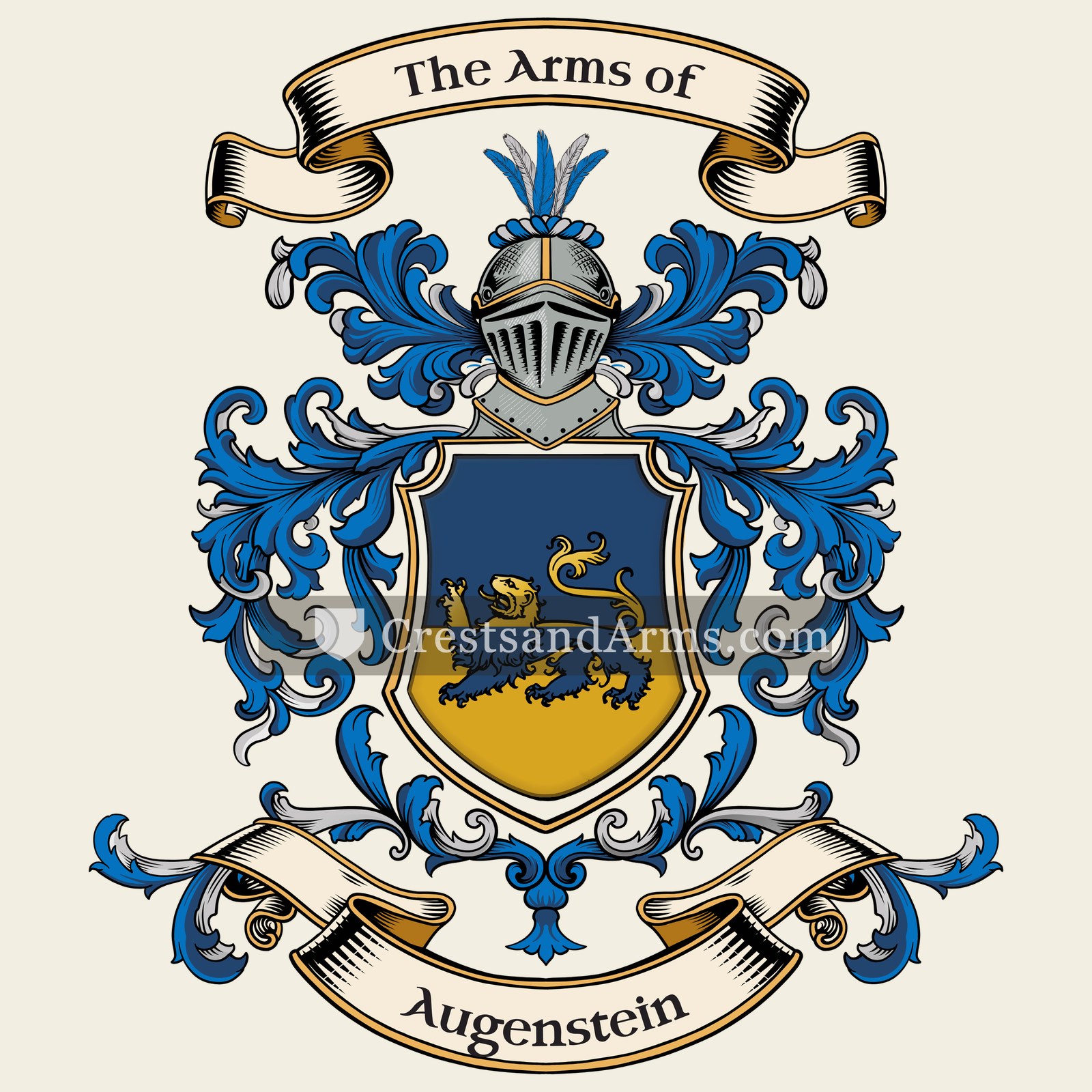
Symbols on this shield
lionCourage, strength and royalty
Colours
Blue (Azure)Means: Loyalty and truth
Gold (Or)Means: Generosity
Historical info
Source
J. B. Rietstap, Armorial Général, Gouda: G. B. van Goor Zonen, 1884–87
Blazon (the actual original written record)
“Coupé d'azur sur or; au lion de l'un en l'autre.”
SwitzerlandFribourg, c. 1745
Digital archive packCoat of arms PNG, gold border print PDF, vector SVG and the certificate of authenticity. Sent to your email in minutes.
Map of Switzerland showing where the Augenstein arms are recorded
The Augenstein arms were recorded in Fribourg, c. 1745.
This is where the arms were entered in the register. Families often moved to other parts of the country, so the same name can turn up in more than one region.
The body that granted and recorded arms in Switzerland in this period.
How Arms Worked in Switzerland
In Switzerland, coats of arms were not restricted to the nobility and were often adopted by common citizens and families. These symbols were passed down through generations to show family identity. When branches of a family grew, they often changed small details of the design to distinguish their own line from the original group.
Granting authority
Cantonal and civic authorities managed the use of coats of arms within their specific regions and local jurisdictions.
How they got arms
Families typically assumed their own coats of arms based on local custom rather than receiving them from a central monarch.
Where arms were recorded
Arms were recorded in various cantonal and civic registers starting from the fourteenth century throughout the Swiss region.
The family's standing
Recorded among the armigerous families of Switzerland.
Origin & History of the Augenstein Family in Switzerland
The surname Augenstein is deeply rooted in the historical landscape of Switzerland, where it emerged as a descriptive name likely linked to the physical appearance or character of its earliest bearers. By the middle of the eighteenth century, the family had established a documented presence in the canton of Fribourg, specifically appearing in official records by 1745. During this era, Fribourg served as a vital crossroads for trade and cultural exchange between German and French-speaking regions. Families like the Augensteins often integrated into the local agrarian or artisan economy, contributing to the steady development of the Swiss cantonal system. While the name itself suggests a connection to the German language, the family’s survival and growth within the complex social structure of Fribourg highlight their adaptability and long-standing role in the community. Their presence in these early records provides a clear window into the migration and settlement patterns that defined the Swiss population during the eighteenth century.
Related Branches & Arms
Root word
Auge and Stein
Eye and stone, referring to a precious gem or eye-shaped stone.
This name
AugensteinA topographic or occupational name for someone living near a prominent eye-shaped stone or a jeweler.
also spelled
Lauensteyn
Lauenstine
Lowenstein
Documented Sources
J. B. Rietstap, Armorial Général, Gouda: G. B. van Goor Zonen, 1884–87
Bahlow, Hans, Deutsches Namenlexikon: Familien- und Vornamen nach Ursprung und Sinn erklärt, 1967
Heintze, Albert, Die deutschen Familien-Namen: geschichtlich, geographisch, sprachlich, 1903
Bayerisches Hauptstaatsarchiv, Kurbayern Hofkammer: Steuer- und Katasterwesen
Digital archive packCoat of arms PNG, gold border print PDF, vector SVG and the certificate of authenticity. Sent to your email in minutes.


 chevronProtection, and faithful service completed
 fleur de lisPurity, light, and the sixth son
 chevronProtection, and faithful service completed
 fleur de lisPurity, light, and the sixth son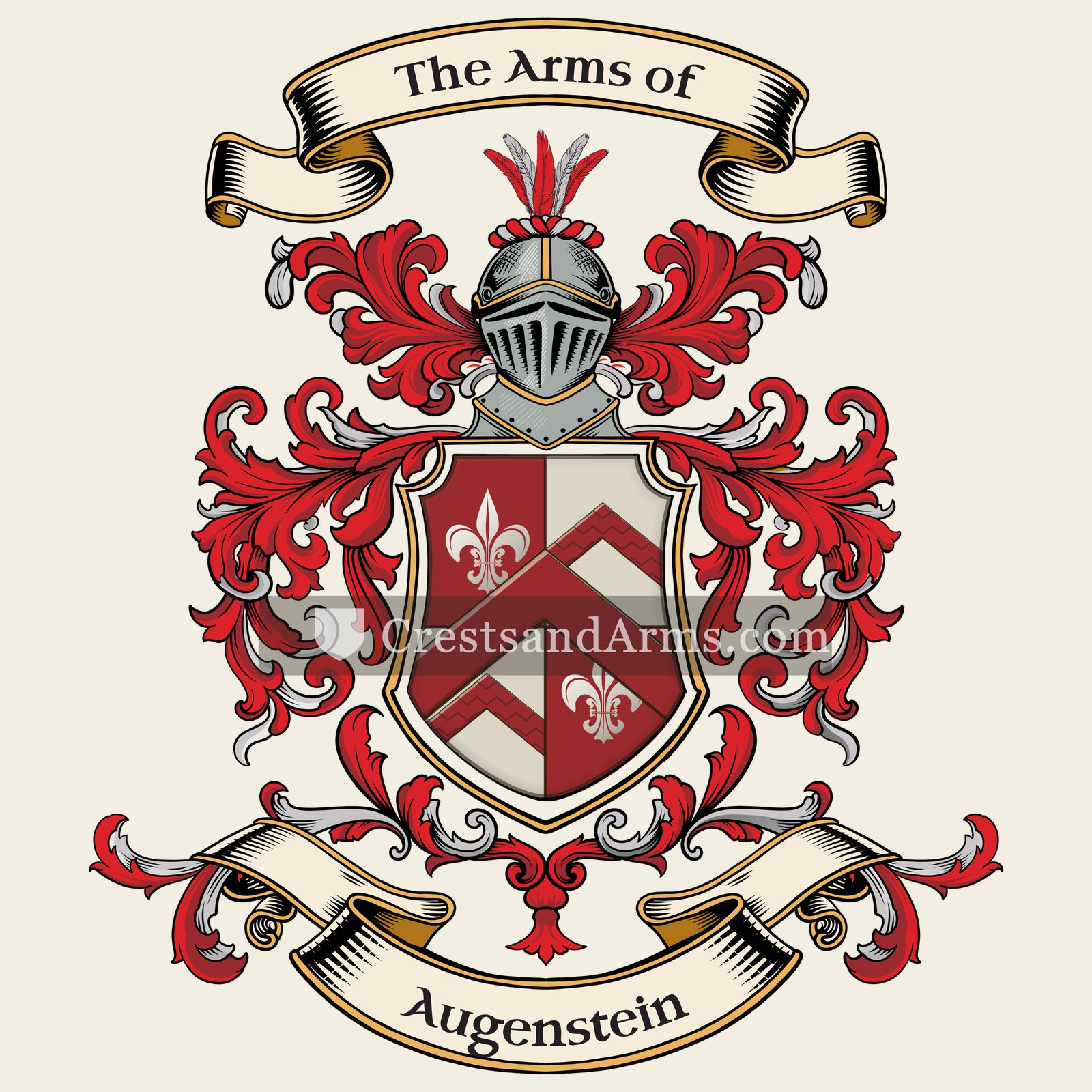


 lionCourage, strength and royalty