Map of Switzerland showing where the Avallon arms are recorded
The Avallon arms were recorded in Genevois, c. 1745.
Genevois was Alpine country south of Geneva, held in small estates by families who stayed put. Land there passed down the same line for centuries, and long tenure counted for more than wealth.
This is where the arms were entered in the register. Families often moved to other parts of the country, so the same name can turn up in more than one region.
The body that granted and recorded arms in Switzerland in this period.
How Arms Worked in Switzerland
In Switzerland, coats of arms were not restricted to the nobility and were often adopted by common citizens and families. These symbols were passed down through generations to show family identity. When branches of a family grew, they often changed small details of the design to distinguish their own line from the original group.
Granting authority
Cantonal and civic authorities managed the use of coats of arms within their specific regions and local jurisdictions.
How they got arms
Families typically assumed their own coats of arms based on local custom rather than receiving them from a central monarch.
Where arms were recorded
Arms were recorded in various cantonal and civic registers starting from the fourteenth century throughout the Swiss region.
The family's standing
Recorded among the armigerous families of Genevois.
Origin & History of the Avallon Family in Switzerland
The family name Avallon finds its historical roots in the scenic region of Genevois, a territory that historically bridged the cultural influences of France and Savoy. By the year 1745, records confirm that members of the family were well-established within this area, living amidst a landscape defined by the Alps and the proximity of Lake Geneva. During the eighteenth century, the people of Genevois were primarily engaged in agriculture and local trade, navigating a period of significant political transition as the region shifted between various regional powers. The name itself likely evolved from local geographic markers or ancient place names, reflecting a deep connection to the specific valleys and mountain passes of the territory. As residents of this crossroads, the early Avallon family members were part of a resilient community that maintained strong social ties and local traditions throughout the turbulent decades of the mid-1700s.
Avallon Meaning & Related Branches
Root word
Aval
A Celtic term referring to an apple or apple orchard.
This name
AvallonDerived from the mythical Isle of Avalon, signifying a place of apples or paradise.
also spelled
Avalon
Documented Sources
J. B. Rietstap, Armorial Général, Gouda: G. B. van Goor Zonen, 1884–87
Archives départementales de la Haute-Savoie, État civil de la province du Genevois, 1745
Besson, Joseph, Mémoires pour servir à l'histoire ecclésiastique des diocèses de Genève, Tarantaise, Aoste et Maurienne, 1759
Spon, Jacob, Histoire de la ville et de l'estat de Genève, 1680
Digital archive packCoat of arms PNG, gold border print PDF, vector SVG and the certificate of authenticity. Sent to your email in minutes.


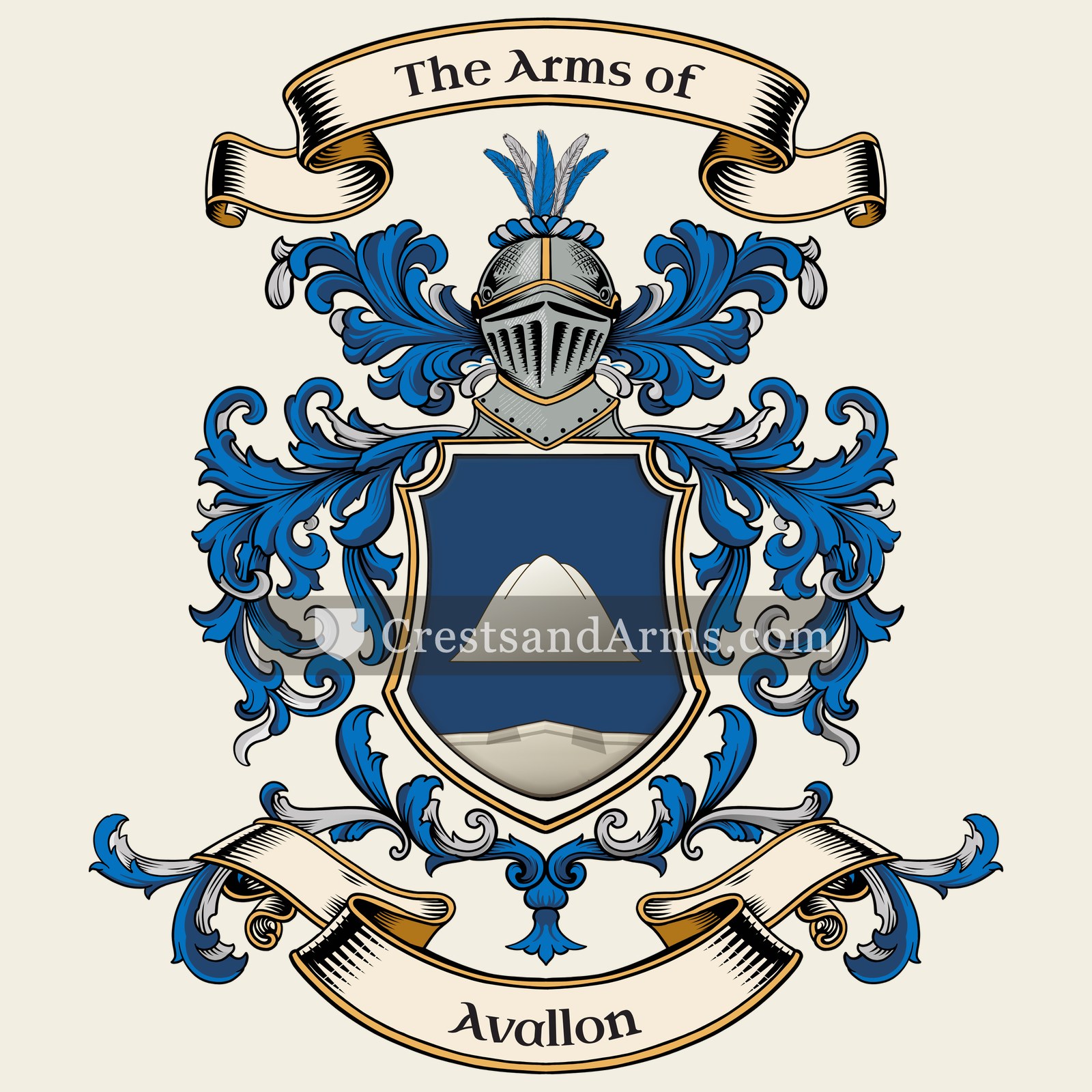
 mountThe ground held, and steadfastness upon it
 mountThe ground held, and steadfastness upon it