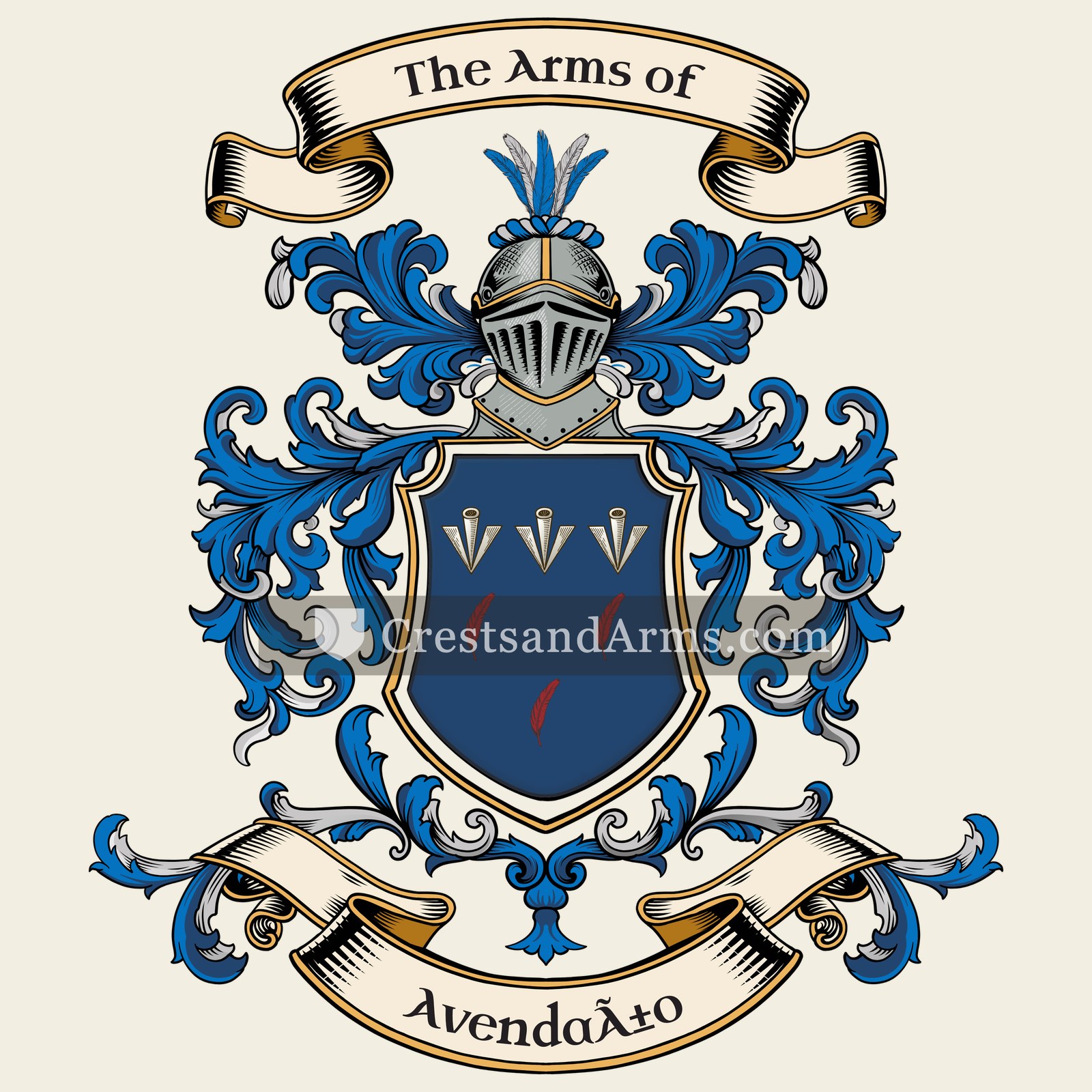
A record of documented arms, meaning and origin, researched for the Avendaño family of Spain.
Reg. 7111 · Spanish, A–C
Coat of Arms & Family Crest Details
Symbols on this shield
arrowReadiness for battle, and affliction endured
feathersWilling obedience and serenity
Colours
Blue (Azure)Means: Loyalty and truth
Silver (Argent)Means: Peace and sincerity
Red (Gules)Means: Military strength
Historical info
Source
J. B. Rietstap, Armorial Général, Gouda: G. B. van Goor Zonen, 1884–87
Blazon (the actual original written record)
“D'azur à une chemise d'arg., percée de trois flèches du même, empennées de gu., les endroits où elles se sont enfoncées ensanglantés, 2 à dextre, l'une sur l'autre, et 1 à sen.”
SpainBiscaye, c. 1722
Digital archive packCoat of arms PNG, gold border print PDF, vector SVG and the certificate of authenticity. Sent to your email in minutes.
Map of Spain showing where the Avendaño arms are recorded
The Avendaño arms were recorded in Biscaye, c. 1722.
This is where the arms were entered in the register. Families often moved to other parts of the country, so the same name can turn up in more than one region.
The body that granted and recorded arms in Spain in this period.
Philip V of Spain
Sovereign of the period
Philip V of Spain
1714–1724
Reigning in Spain when the Avendaño arms are first recorded.
How Arms Worked in Spain
In Spain, a coat of arms was considered a form of property that belonged to the entire family line. These arms were passed down from a father to all his children equally. Younger branches of the family usually kept the original design without needing to add any special marks to distinguish their specific line.
Granting authority
The Cronista Rey de Armas was the official body that regulated and granted coats of arms throughout Spain.
How they got arms
Families often obtained their arms through royal grants or by proving their noble status to the official heraldic authority.
Where arms were recorded
Coats of arms were officially recorded in the registers of the Cronista Rey de Armas starting in 1496.
The family's standing
Recorded among the armigerous families of Spain.
Origin & History of the Avendaño Family in Spain
The family name Avendaño has deep roots in the Basque region of northern Spain, particularly within the province of Biscay. By the early 18th century, the family was well-established in this area, where they were deeply connected to the local landscape and social structures. The name itself is thought to be topographic, likely originating from a place known for its abundance of hazelnut trees, as the Basque word "avenda" relates to these plants. During the 1700s, families like the Avendaños often held roles as landowners or local administrators, playing an active part in the governance and agricultural life of their mountain communities. Their presence in Biscay in 1722 reflects a long history of settlement in the rugged terrain of the Basque Country, where families frequently identified themselves through their ancestral lands and local parish ties.
Avendaño Meaning & Related Branches
Root word
avena
Latin term referring to the oat plant or wild oats.
This name
AvendañoA topographic surname for someone who lived near a field of oats.
also spelled
Avendanyo
Avendane
Documented Sources
J. B. Rietstap, Armorial Général, Gouda: G. B. van Goor Zonen, 1884–87
Mikel Belasko, Diccionario etimológico de los nombres de los pueblos, villas y ciudades de Navarra, 1999
Endika de Mogrobejo, Diccionario hispanoamericano de heráldica, onomástica y genealogía, 1995
Archivo Histórico Eclesiástico de Bizkaia, Libros Sacramentales (Bautismos, Casamientos y Defunciones)
Archivo de la Real Chancillería de Valladolid, Sala de Hijosdalgo
Digital archive packCoat of arms PNG, gold border print PDF, vector SVG and the certificate of authenticity. Sent to your email in minutes.


 arrowReadiness for battle, and affliction endured
 feathersWilling obedience and serenity
 arrowReadiness for battle, and affliction endured
 feathersWilling obedience and serenity