Map of Ireland showing where the Aylmer arms are recorded
The Aylmer arms were recorded in Kildare, c. 1645.
Kildare was flat grazing country close to Dublin, taken early by Norman families. Being near the seat of government meant being near where arms were recorded, which is why so many Kildare names appear.
This is where the arms were entered in the register. Families often moved to other parts of the country, so the same name can turn up in more than one region.
The body that granted and recorded arms in Ireland in this period.
Charles I of England
Sovereign of the period
Charles I of England
1625–1649
Reigning in Ireland when the Aylmer arms are first recorded.
How Arms Worked in Ireland
The Ulster King of Arms granted coats of arms to individuals who proved their social standing and good character. These symbols were typically inherited by all legitimate descendants of the original holder. If a family branch wanted a unique look, they could apply for a specific change to their design through the office to ensure their identity remained distinct.
Granting authority
The Ulster King of Arms acted as the official body that regulated and issued all coats of arms throughout Ireland.
How they got arms
Families obtained their arms through formal grants issued by the office after proving their eligibility and paying the required fees.
Where arms were recorded
All official grants were recorded in the registers held by the Ulster King of Arms starting from the year 1552.
The family's standing
Recorded among the armigerous families of Kildare.
Origin & History of the Aylmer Family in Ireland
The Aylmer family established themselves as a prominent force in County Kildare long before the mid-seventeenth century. While records confirm their significant presence in the region by 1645, the family actually arrived in Ireland much earlier, likely during the Anglo-Norman expansion in the late twelfth or thirteenth century. Over the following generations, they integrated deeply into the social and political landscape of the Pale, which was the area of Ireland under direct English control. By the time of the mid-1600s, the Aylmers had become major landowners and influential figures in local administration. Their history is closely tied to the shifting power dynamics of the era, as they often held roles that required them to navigate the complex relationship between the Irish gentry and the English crown. Through their long tenure in Kildare, the family maintained a lasting impact on the development of the local community and the regional economy.
Coat of Arms & Family Crest Details
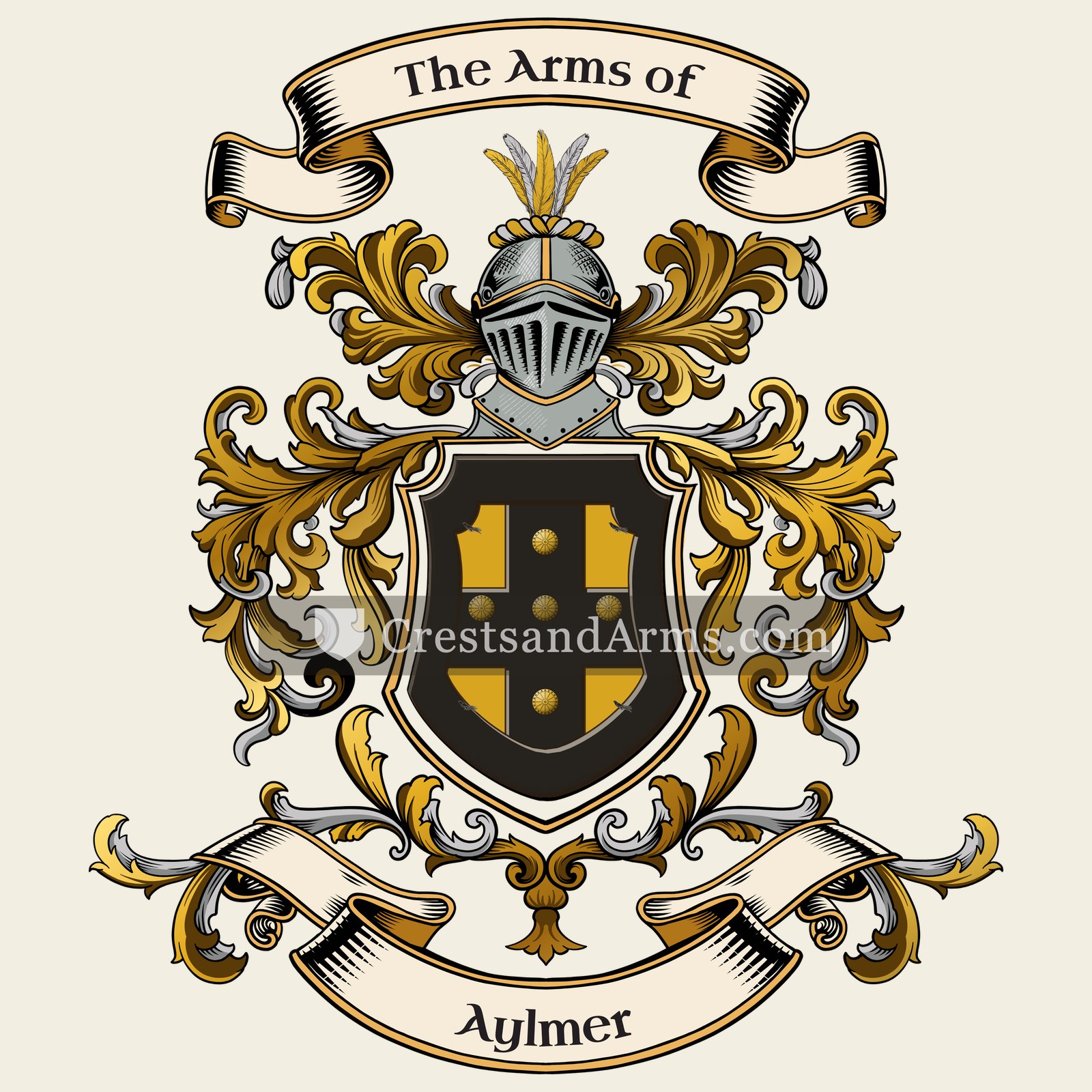
Symbols on this shield
cross symbolChristian faith and service
bordureA difference between branches of one family
martletA younger son, who must win his own land
roundelA coin, and one who has been to the crusades
Colours
Gold (Or)Means: Generosity
Black (Sable)Means: Constancy
Historical info
Source
Sir Bernard Burke, The General Armory of England, Scotland, Ireland and Wales, London: Harrison & Sons, 1884
Blazon (the actual original written record)
“Or, on a cross engr. betw. four martlets sa. five bezants within a bordure gobonated purp. and ar”
EnglandLondon, c. 1620
Digital archive packCoat of arms PNG, gold border print PDF, vector SVG and the certificate of authenticity. Sent to your email in minutes.
Map of England showing where the Aylmer arms are recorded
The Aylmer arms were recorded in London, c. 1620.
This is where the arms were entered in the register. Families often moved to other parts of the country, so the same name can turn up in more than one region.
The body that granted and recorded arms in England in this period.
James VI and I
Sovereign of the period
James VI and I
1603–1625
Reigning in Ireland when the Aylmer arms are first recorded.
How Arms Worked in England
English heraldry allowed arms to be shared by all legitimate descendants of the original owner. These symbols were treated as personal property that moved through the generations to all children. While the eldest son kept the original design, other family members could use the same shield without needing to change it or register their own unique versions.
Granting authority
The College of Arms in London has regulated the use of coats of arms throughout England and Wales since 1484.
How they got arms
Families typically obtained their coats of arms through a formal grant from the Crown or by proving their ancient right to them.
Where arms were recorded
All official coats of arms are recorded in the registers kept at the College of Arms, which date back to the fifteenth century.
The family's standing
Recorded among the armigerous families of England.
Origin & History of the Aylmer Family in England
The surname Aylmer originates from the Old English given name Æthelmar, which translates to noble and famous. Before it became a hereditary family name, it was used as a personal name by various Anglo-Saxon figures, including bishops and landowners. By the time the name began to stabilize as a surname, families bearing it were well-established in different parts of England. Records confirm that members of the Aylmer family were active in London by 1620, a period when the city was a bustling center of trade and social mobility. These early residents were part of the growing urban middle class, participating in the economic and civic life of the capital during the early seventeenth century. Over time, the name evolved from its ancient roots to become a distinct identifier for families who contributed to the development of English society through their roles in commerce, religion, and local government.
Aylmer Meaning & Related Branches
Root word
Aethelmaer
Derived from Old English elements meaning noble and famous.
This name
AylmerAn Anglo-Norman surname brought to Ireland, signifying a person of noble and illustrious fame.
also spelled
Ailmer
Aylmar
Aylemer
Related arms
Aylemervariant spelling
Documented Sources
Sir Bernard Burke, The General Armory of England, Scotland, Ireland and Wales, London: Harrison & Sons, 1884
FitzGerald, Walter. Journal of the County Kildare Archaeological Society and Surrounding Districts. 1895
O'Byrne, Emmett. War, Politics and the Irish of Leinster 1156-1606. 2003
National Archives of Ireland, Aylmer Family Papers
National Library of Ireland, Genealogical Office Manuscripts
Digital archive packCoat of arms PNG, gold border print PDF, vector SVG and the certificate of authenticity. Sent to your email in minutes.


 cross symbolChristian faith and service
 martletA younger son, who must win his own land
 cross symbolChristian faith and service
 martletA younger son, who must win his own land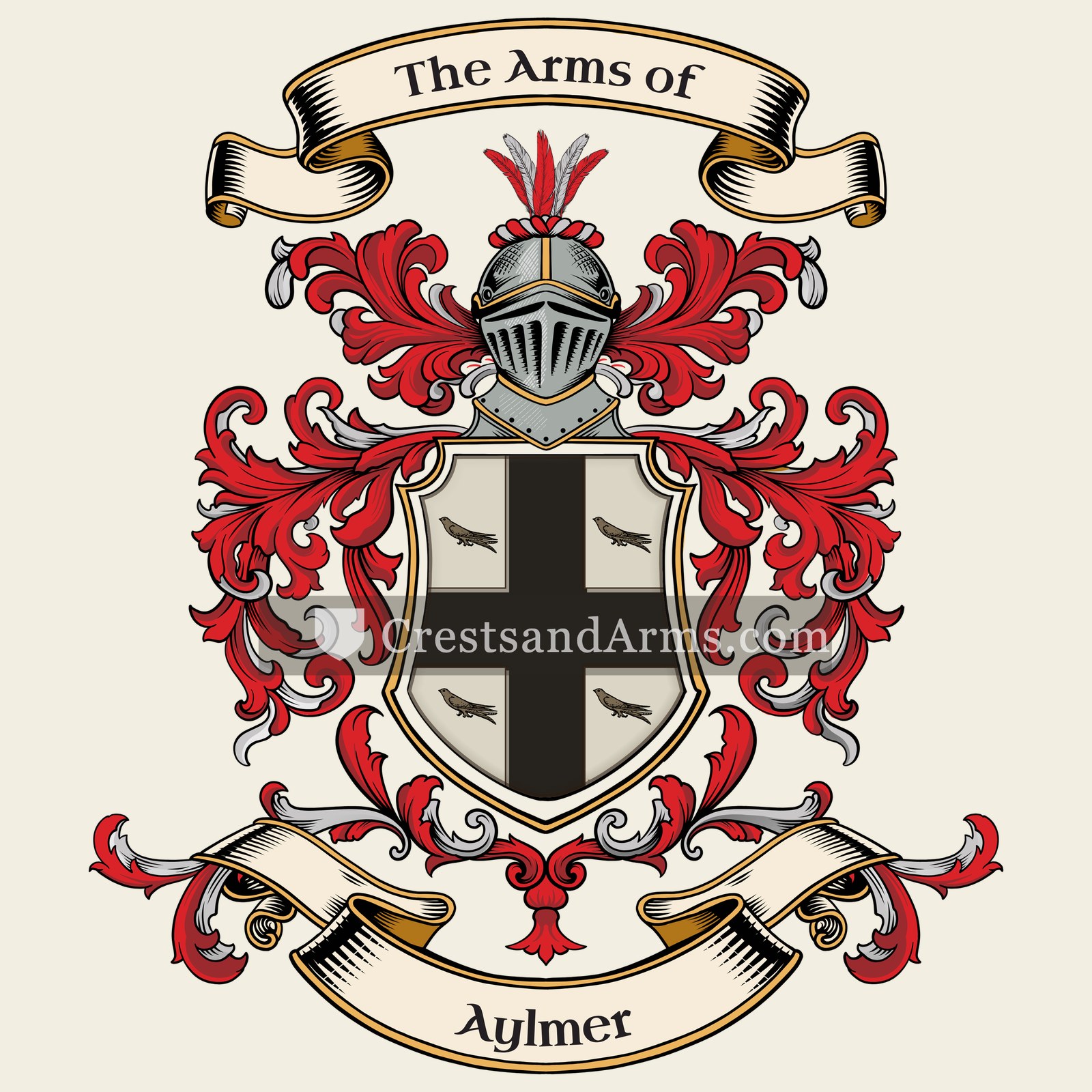


 bordureA difference between branches of one family
 roundelA coin, and one who has been to the crusades