Map of France showing where the Aymé arms are recorded
The Aymé arms were recorded in Paris, c. 1663.
This is where the arms were entered in the register. Families often moved to other parts of the country, so the same name can turn up in more than one region.
The body that granted and recorded arms in France in this period.
Louis XIV of France
Sovereign of the period
Louis XIV of France
1643–1715
Reigning in France when the Aymé arms are first recorded.
How Arms Worked in France
In France, a coat of arms was a mark of honor that passed down through the male line to all legitimate descendants. Families often used the same shield without changes to show their shared heritage. If a branch wanted to stand out, they could add a small mark to their shield to show their specific place in the family tree.
Granting authority
The Juge d'armes de France acted as the official authority that regulated and verified coats of arms across the country.
How they got arms
Families typically inherited their arms from ancestors, though they could also receive them through royal grants or by proving their noble status.
Where arms were recorded
Coats of arms were officially recorded in the Armorial Général de France, which began its main collection in the year 1696.
The family's standing
Recorded among the armigerous families of France.
Origin & History of the Aymé Family in France
The name Aymé finds its roots in the medieval period as a variation of the French given name Aimé, which translates to beloved. During the seventeenth century, the family established a notable presence in Paris, with records confirming their residence in the city by 1663. At this time, Paris was a bustling center of trade and intellectual growth, and families like the Aymés were often integrated into the professional or merchant classes that kept the city running. Because the name originated as a term of endearment, it likely began as a nickname for a well-liked individual before eventually becoming a permanent family surname passed down through generations. By the mid-1600s, the Aymé family was already part of the complex social fabric of the French capital, living through a transformative era of history just as the reign of King Louis XIV began to shape the future of France.
Aymé Meaning & Related Branches
Root word
Amatus
Latin for beloved or dear one.
This name
AyméDerived from the past participle of the verb aimer, signifying someone who is loved.
also spelled
Aime
Aymay
Documented Sources
J. B. Rietstap, Armorial Général, Gouda: G. B. van Goor Zonen, 1884–87
Dauzat, Albert. Dictionnaire étymologique des noms de famille et prénoms de France. 1951
Moreri, Louis. Le Grand Dictionnaire historique, ou le mélange curieux de l'histoire sacrée et profane. 1759
Digital archive packCoat of arms PNG, gold border print PDF, vector SVG and the certificate of authenticity. Sent to your email in minutes.


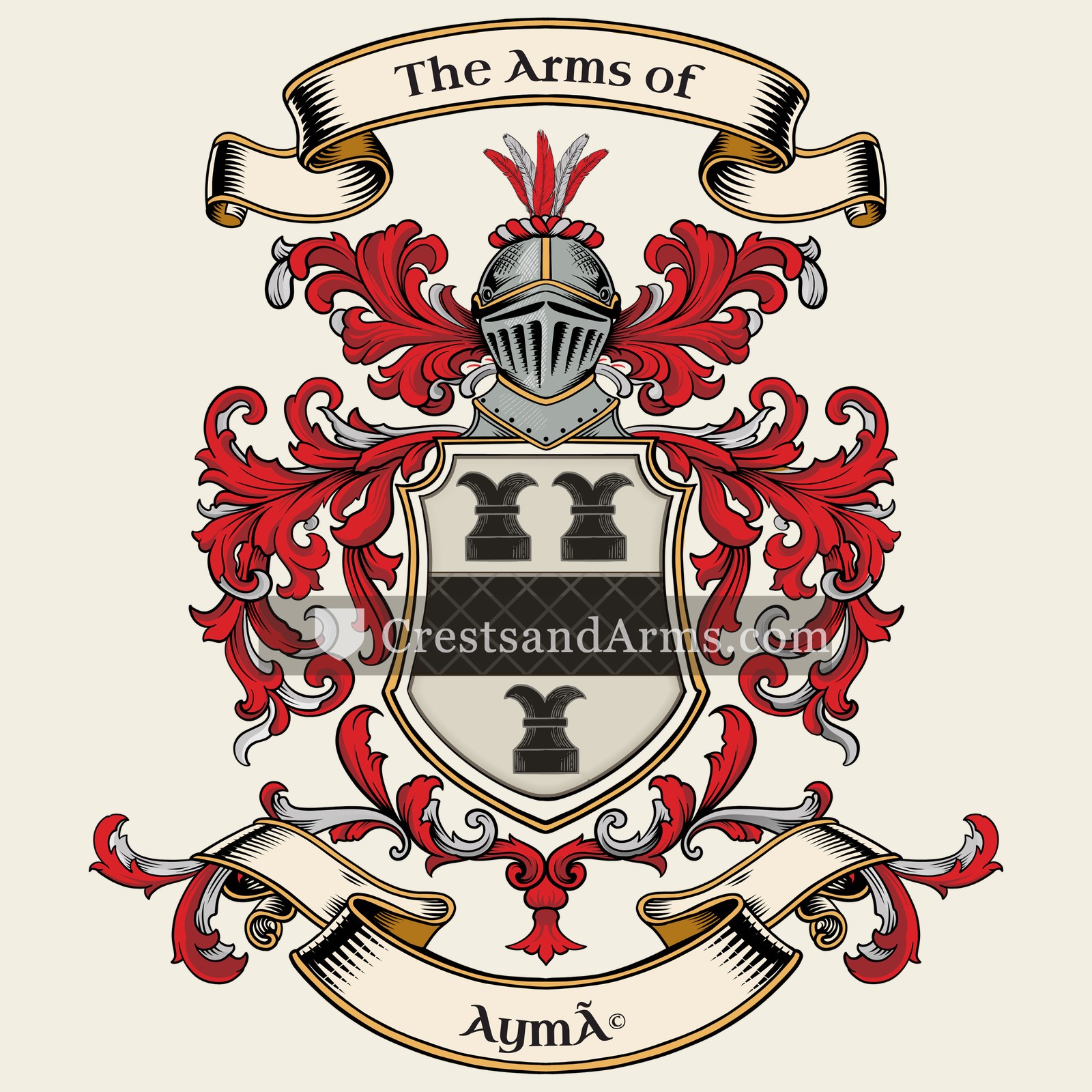
 fessThe military belt, and readiness to serve
 chess rookStrategy, and the defence of a position
 fessThe military belt, and readiness to serve
 chess rookStrategy, and the defence of a position