Map of England showing where the Ayscue arms are recorded
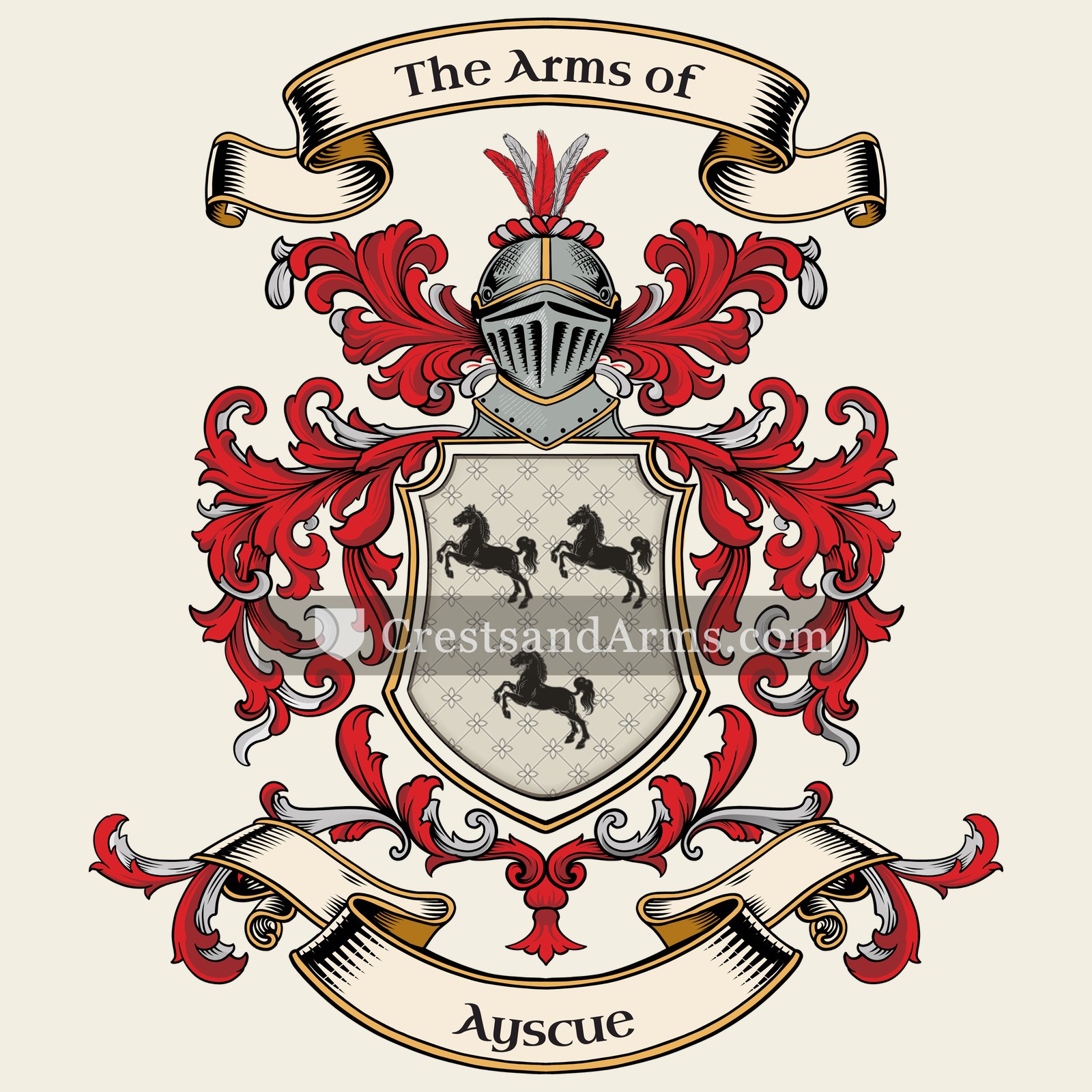
The Ayscue arms were recorded in Lincolnshire, c. 1620.
This is where the arms were entered in the register. Families often moved to other parts of the country, so the same name can turn up in more than one region.
The body that granted and recorded arms in England in this period.
James VI and I
Sovereign of the period
James VI and I
1603–1625
Reigning in England when the Ayscue arms are first recorded.
How Arms Worked in England
English heraldry allowed arms to be shared by all legitimate descendants of the original owner. These symbols were treated as personal property that moved through the generations to all children. While the eldest son kept the original design, other family members could use the same shield without needing to change it or register their own unique versions.
Granting authority
The College of Arms in London has regulated the use of coats of arms throughout England and Wales since 1484.
How they got arms
Families typically obtained their coats of arms through a formal grant from the Crown or by proving their ancient right to them.
Where arms were recorded
All official coats of arms are recorded in the registers kept at the College of Arms, which date back to the fifteenth century.
The family's standing
Recorded among the armigerous families of Lincolnshire.
Origin & History of the Ayscue Family in England
The Ayscue family name is deeply rooted in the history of Lincolnshire, England, where the family established a strong presence by the early 17th century. The name is a variation of the older surname Ayscough, which originated as a topographic name for people living near a specific type of valley or ridge. During the 1600s, the family became well-established in the region, with members often serving in local government or as landowners who influenced the development of their rural communities. As the name evolved through different spellings, it remained tied to the social and economic life of the English countryside. By 1620, the Ayscues were active participants in the local legal and agricultural systems of Lincolnshire, helping to shape the identity of the families who held land in the area during that era.
Ayscue Meaning & Related Branches
Root word
Eskr
Old Norse term for an ash tree.
This name
AyscueDerived from a location name referring to a ridge or clearing where ash trees grew.
also spelled
Ayscough
Askew
Related arms
Aiscough, or Ayscoghevariant spelling
Ascuevariant spelling
Askewvariant spelling
Ayscoughvariant spelling
Documented Sources
Sir Bernard Burke, The General Armory of England, Scotland, Ireland and Wales, London: Harrison & Sons, 1884
Maddison, Arthur Roland, Lincolnshire Pedigrees, 1902
The National Archives, Prerogative Court of Canterbury wills and other probate records, PROB 11


 horseReadiness to serve king and country
 horseReadiness to serve king and country