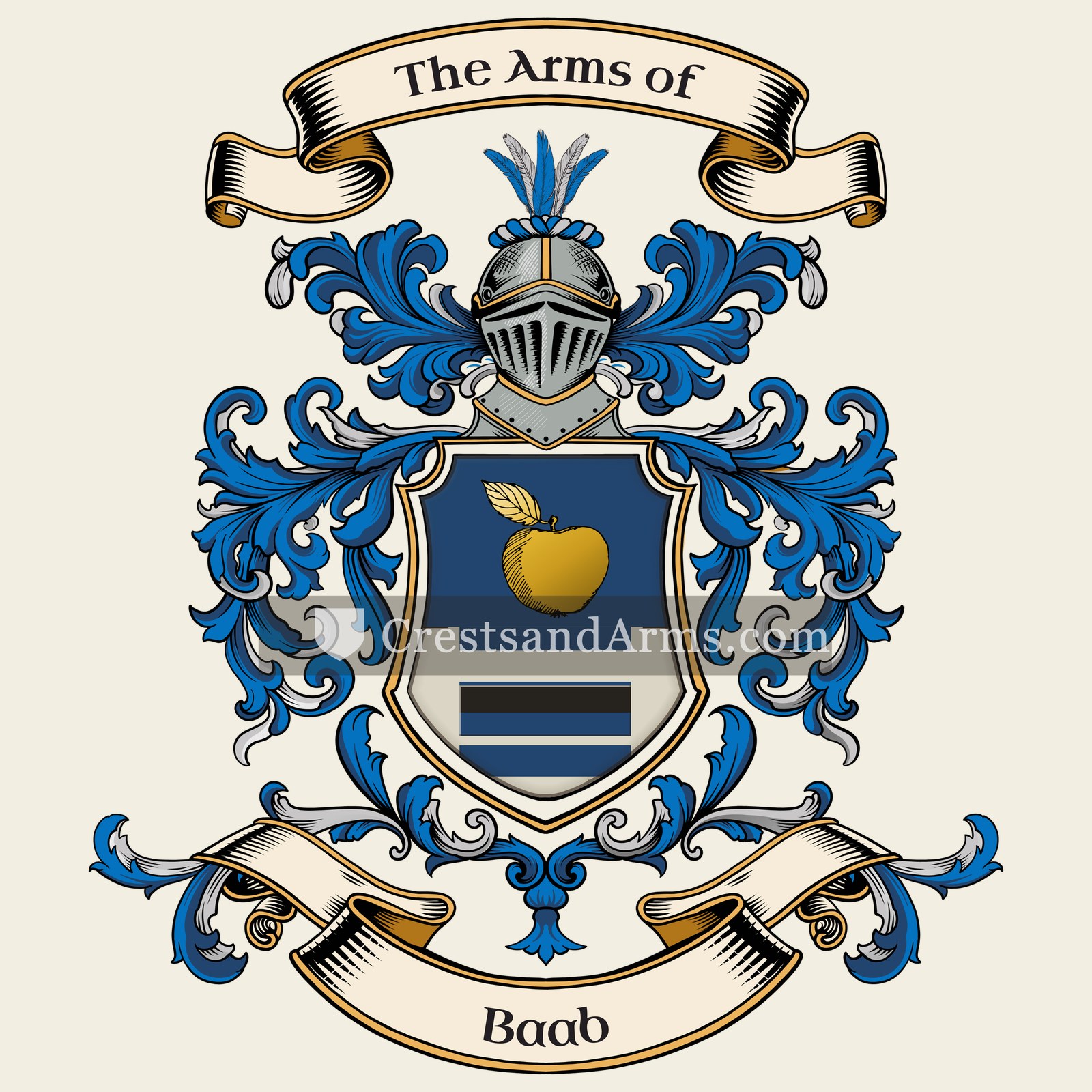
A record of documented arms, meaning and origin, researched for the Baab family of Germany.
Reg. 8490 · German, A–C
Coat of Arms & Family Crest Details
Symbols on this shield
fessThe military belt, and readiness to serve
applePeace, plenty and long-standing settlement
Colours
Blue (Azure)Means: Loyalty and truth
Silver (Argent)Means: Peace and sincerity
Gold (Or)Means: Generosity
Historical info
Source
J. B. Rietstap, Armorial Général, Gouda: G. B. van Goor Zonen, 1884–87
Blazon (the actual original written record)
“Coupé: au 1 d'azur à une grenade d'or, tigée et feuillée de sin.; au 2 fascé d'arg. et d'azur, de quatre pièces. C.: la grenade du 1, entre un vol du 2. L. d'or et d'azur.”
Germanyc. 1772
Where the Baab Arms Were Recorded
Bavaria
Map of Germany showing where the Baab arms are recorded
The Baab arms were recorded in Germany, c. 1772.
Arms such as these were typically recorded in Bavaria.
Bavaria was a country of old landed families and walled market towns. Estates passed down the same line for centuries, and both the landowners and the leading townsmen kept arms, which is why so many Bavarian names sit in the registers.
This is where the arms were entered in the register. Families often moved to other parts of the country, so the same name can turn up in more than one region.
The body that granted and recorded arms in Germany in this period.
Joseph II, Holy Roman Emperor
Sovereign of the period
Joseph II, Holy Roman Emperor
1765–1790
Reigning in Germany when the Baab arms are first recorded.
How Arms Worked in Germany
In the Holy Roman Empire, coats of arms were often granted to individuals by the Emperor or his representatives. These arms were then passed down through the generations to all legitimate descendants of the original holder. Younger branches of a family usually kept the same shield design without needing to change it, as the arms belonged to the entire lineage.
Granting authority
The Holy Roman Emperor held the sole power to grant new coats of arms throughout his vast imperial territories.
How they got arms
Families typically obtained their coats of arms through a formal imperial grant or by proving their noble status to the authorities.
Where arms were recorded
These grants were officially recorded in the Imperial Chancery registers, which began keeping formal records of such honors during the Middle Ages.
The family's standing
Recorded among the armigerous families of Germany.
Origin & History of the Baab Family in Germany
The family name Baab has deep roots in the historical region of Bavaria, where records confirm members of the family were established by 1772. During the eighteenth century, Bavaria was a collection of territories undergoing significant social and agricultural changes. Families with this surname were likely part of the rural or artisan classes who lived in small village communities. The name itself is thought to be a variation of older Germanic terms, possibly linked to local nicknames or specific occupations common in the southern German states. As the family grew, they likely participated in the local traditions and religious life of the Bavarian countryside, contributing to the development of their community over many generations. By the late 1700s, the Baab family was firmly integrated into the regional fabric, living through a period of transition that saw the eventual rise of the modern Bavarian state.
Related Branches & Arms
Root word
Babbe
A diminutive form of the Germanic personal name Babo.
This name
BaabA patronymic surname derived from a short form of ancient Germanic names starting with Bab-.
also spelled
Bab
Documented Sources
J. B. Rietstap, Armorial Général, Gouda: G. B. van Goor Zonen, 1884–87


 fessThe military belt, and readiness to serve
 applePeace, plenty and long-standing settlement
 fessThe military belt, and readiness to serve
 applePeace, plenty and long-standing settlement