A record of documented arms, meaning and origin, researched for the Baader family lines. Documented in 2 countries.
Reg. 5844 · Swiss, A–C
Coat of Arms & Family Crest Details
Symbols on this shield
chevronProtection, and faithful service completed
eagleNobility, strength and a keen mind
Colours
Silver (Argent)Means: Peace and sincerity
Red (Gules)Means: Military strength
Gold (Or)Means: Generosity
Black (Sable)Means: Constancy
Historical info
Source
J. B. Rietstap, Armorial Général, Gouda: G. B. van Goor Zonen, 1884–87
Blazon (the actual original written record)
“Coupé: au 1 d'arg. à l'aigle naiss. de sa., bq. d'or, mouv. du coupé; au 2 de gu. au chev. d'or. C.: deux prob. coupées, à dextre de sa. sur arg., à sen. de gu. sur or. L. conformes aux émaux des prob.”
SwitzerlandBâle, c. 1745
Digital archive packCoat of arms PNG, gold border print PDF, vector SVG and the certificate of authenticity. Sent to your email in minutes.
Map of Switzerland showing where the Baader arms are recorded
The Baader arms were recorded in Bâle, c. 1745.
This is where the arms were entered in the register. Families often moved to other parts of the country, so the same name can turn up in more than one region.
The body that granted and recorded arms in Switzerland in this period.
How Arms Worked in Switzerland
In Switzerland, coats of arms were not restricted to the nobility and were often adopted by common citizens and families. These symbols were passed down through generations to show family identity. When branches of a family grew, they often changed small details of the design to distinguish their own line from the original group.
Granting authority
Cantonal and civic authorities managed the use of coats of arms within their specific regions and local jurisdictions.
How they got arms
Families typically assumed their own coats of arms based on local custom rather than receiving them from a central monarch.
Where arms were recorded
Arms were recorded in various cantonal and civic registers starting from the fourteenth century throughout the Swiss region.
The family's standing
Recorded among the armigerous families of Switzerland.
Origin & History of the Baader Family in Switzerland
The family name Baader has deep roots in the German-speaking regions of Europe, with historical records confirming their presence in the city of Basel, Switzerland, as early as 1745. The name itself is occupational in origin, derived from the Middle High German word "bader," which referred to a person who operated a public bathhouse. In the eighteenth century, these bathhouses were essential social hubs where citizens gathered for hygiene, medical treatments, and community news. By the time the family was established in Basel, the role of the bathhouse keeper had evolved from a simple service provider into a respected trade that often involved basic surgical procedures and barbering. Settling in a major trade hub like Basel allowed the family to integrate into the urban middle class, where they likely contributed to the city's vibrant guild system and local commerce during a period of significant economic growth.
Coat of Arms & Family Crest Details
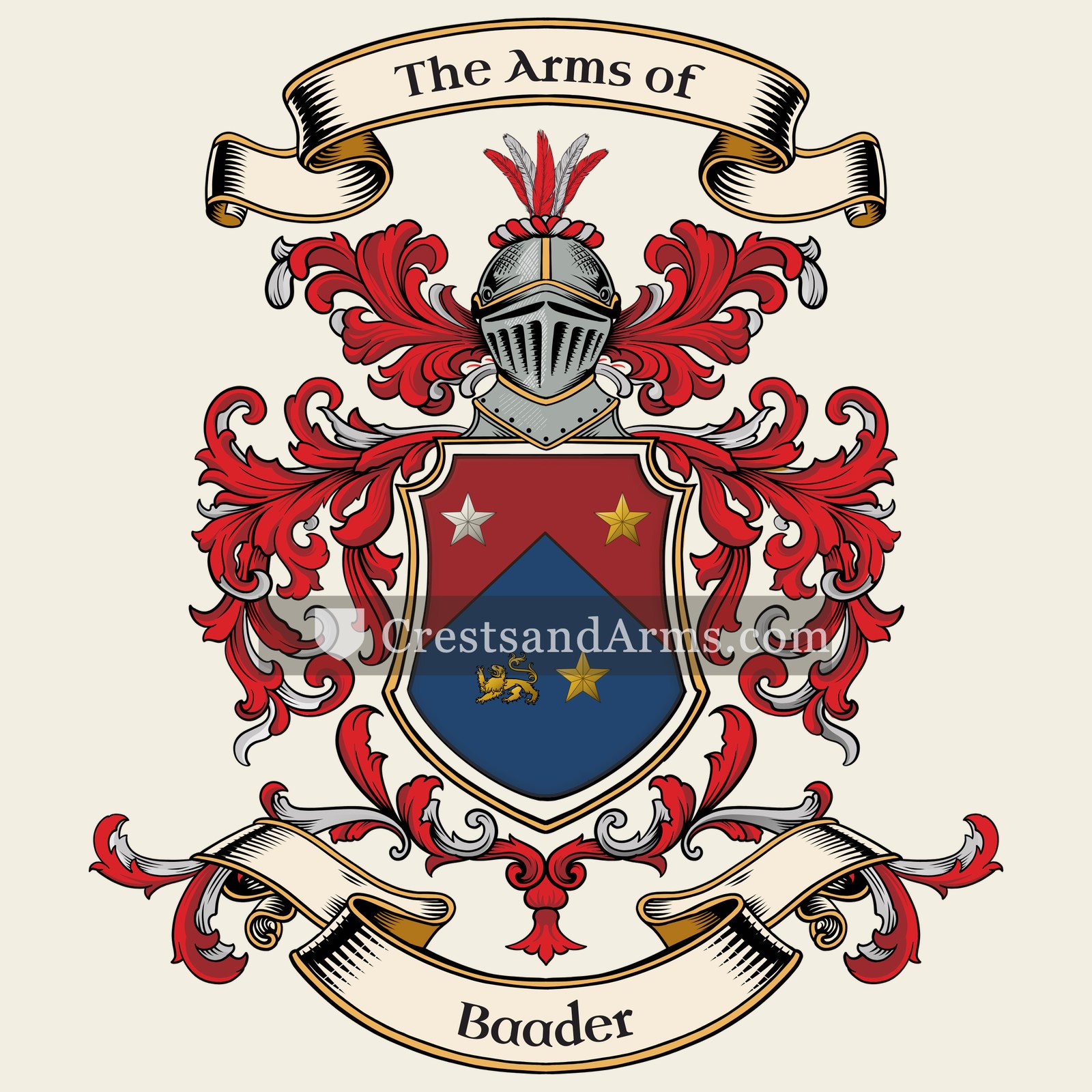
Symbols on this shield
lionCourage, strength and royalty
mulletThe third son, and a divine quality from above
Colours
Red (Gules)Means: Military strength
Blue (Azure)Means: Loyalty and truth
Gold (Or)Means: Generosity
Silver (Argent)Means: Peace and sincerity
Historical info
Source
J. B. Rietstap, Armorial Général, Gouda: G. B. van Goor Zonen, 1884–87
Blazon (the actual original written record)
“De gu. au lion d'or, supp. de sa patte dextre une étoile d'arg.; le champ chapé-ployé d'azur, à deux étoiles d'or. Deux cq., le 2 cour. C.: 1° trois pl. d'aut., une d'arg. entre deux d'azur, surm. d'une étoile d'or; 2° le lion, iss. L.: de gu. et d'azur.”
BavariaBavaria, c. 1778
Digital archive packCoat of arms PNG, gold border print PDF, vector SVG and the certificate of authenticity. Sent to your email in minutes.
Map of Germany showing where the Baader arms are recorded
The Baader arms were recorded in Bavaria, c. 1778.
Bavaria was a country of old landed families and walled market towns. Estates passed down the same line for centuries, and both the landowners and the leading townsmen kept arms, which is why so many Bavarian names sit in the registers.
This is where the arms were entered in the register. Families often moved to other parts of the country, so the same name can turn up in more than one region.
The body that granted and recorded arms in Germany in this period.
Joseph II, Holy Roman Emperor
Sovereign of the period
Joseph II, Holy Roman Emperor
1765–1790
Reigning in Switzerland when the Baader arms are first recorded.
How Arms Worked in Germany
In the Holy Roman Empire, coats of arms were often granted to individuals by the Emperor or his representatives. These arms were then passed down through the generations to all legitimate descendants of the original holder. Younger branches of a family usually kept the same shield design without needing to change it, as the arms belonged to the entire lineage.
Granting authority
The Holy Roman Emperor held the sole power to grant new coats of arms throughout his vast imperial territories.
How they got arms
Families typically obtained their coats of arms through a formal imperial grant or by proving their noble status to the authorities.
Where arms were recorded
These grants were officially recorded in the Imperial Chancery registers, which began keeping formal records of such honors during the Middle Ages.
The family's standing
Recorded among the armigerous families of Bavaria.
Origin & History of the Baader Family in Germany
The surname Baader originated in the German-speaking regions as a professional designation, specifically identifying individuals who worked as bathhouse keepers or barbers. During the medieval and early modern periods, these figures played an essential role in community health by managing public steam baths and performing minor medical procedures like bloodletting or wound dressing. By the time historical records confirm the presence of the Baader family in Bavaria in 1778, the name had long transitioned from a job title to a hereditary family name. This evolution reflects the broader social history of southern Germany, where trade-based surnames became fixed identifiers as families settled in specific towns and villages. The Baader name serves as a linguistic link to a time when the local bathhouse was a central hub for social interaction and basic hygiene in Bavarian society.
Baader Meaning & Related Branches
Root word
Bader
A person who operates a public bathhouse or barber-surgeon.
This name
BaaderAn occupational surname for a bath attendant or someone who provided medical services.
also spelled
Bader
Related arms
Madalenasimilar arms
Badervariant spelling
Documented Sources
J. B. Rietstap, Armorial Général, Gouda: G. B. van Goor Zonen, 1884–87
Brechenmacher, Josef Karlmann. Etymologisches Wörterbuch der deutschen Familiennamen. 1957
Heintze, Albert. Die deutschen Familiennamen: geschichtlich, geographisch, sprachlich. 1903
Staatsarchiv Basel-Stadt, Bürgerrechtsakten
Staatsarchiv Basel-Stadt, Kirchenbücher der Stadt Basel
Digital archive packCoat of arms PNG, gold border print PDF, vector SVG and the certificate of authenticity. Sent to your email in minutes.


 chevronProtection, and faithful service completed
 eagleNobility, strength and a keen mind
 chevronProtection, and faithful service completed
 eagleNobility, strength and a keen mind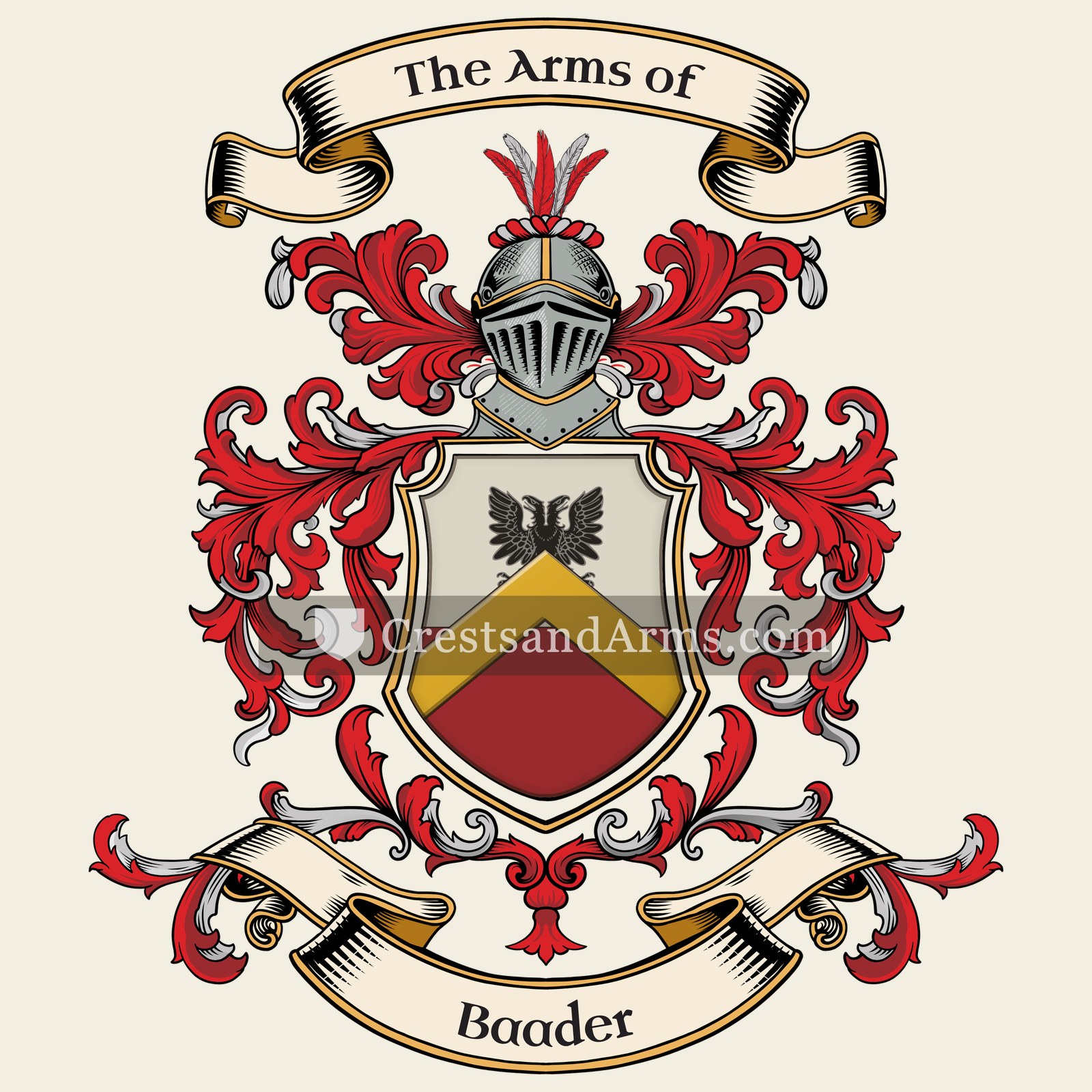

 lionCourage, strength and royalty
 mulletThe third son, and a divine quality from above