Map of Ireland showing where the Babaei arms are recorded
The Babaei arms were recorded in Louth, c. 1645.
Louth is the smallest Irish county but sat on the road north from Dublin. Norman families took it early, held it under arms, and stayed, which is what put their shields on record.
This is where the arms were entered in the register. Families often moved to other parts of the country, so the same name can turn up in more than one region.
The body that granted and recorded arms in Ireland in this period.
Charles I of England
Sovereign of the period
Charles I of England
1625–1649
Reigning in Ireland when the Babaei arms are first recorded.
How Arms Worked in Ireland
The Ulster King of Arms granted coats of arms to individuals who proved their social standing and good character. These symbols were typically inherited by all legitimate descendants of the original holder. If a family branch wanted a unique look, they could apply for a specific change to their design through the office to ensure their identity remained distinct.
Granting authority
The Ulster King of Arms acted as the official body that regulated and issued all coats of arms throughout Ireland.
How they got arms
Families obtained their arms through formal grants issued by the office after proving their eligibility and paying the required fees.
Where arms were recorded
All official grants were recorded in the registers held by the Ulster King of Arms starting from the year 1552.
The family's standing
Recorded among the armigerous families of Louth.
Origin & History of the Babaei Family in Ireland
The surname Babaei carries a rich history that traces back to the Persian term "baba," which serves as a respectful title for a father, grandfather, or a wise elder. While the name is deeply rooted in Middle Eastern linguistic traditions, historical records confirm that members of the family were present in Louth, Ireland, as early as 1645. This suggests that the family was part of a small but significant group of travelers or merchants who moved between distant regions during the seventeenth century. By settling in this coastal area, these early family members integrated their unique cultural heritage into the local landscape of the time. Their presence in Louth highlights the long history of global movement and the way that names can travel across vast distances to become part of new communities.
Babaei Meaning & Related Branches
Root word
Baba
A term of endearment for a father or grandfather.
This name
BabaeiA patronymic surname meaning son of the father or grandfather.
also spelled
Baab
Documented Sources
Sir Bernard Burke, The General Armory of England, Scotland, Ireland and Wales, London: Harrison & Sons, 1884
National Archives of Ireland, Civil Survey of County Louth (1654–1656)


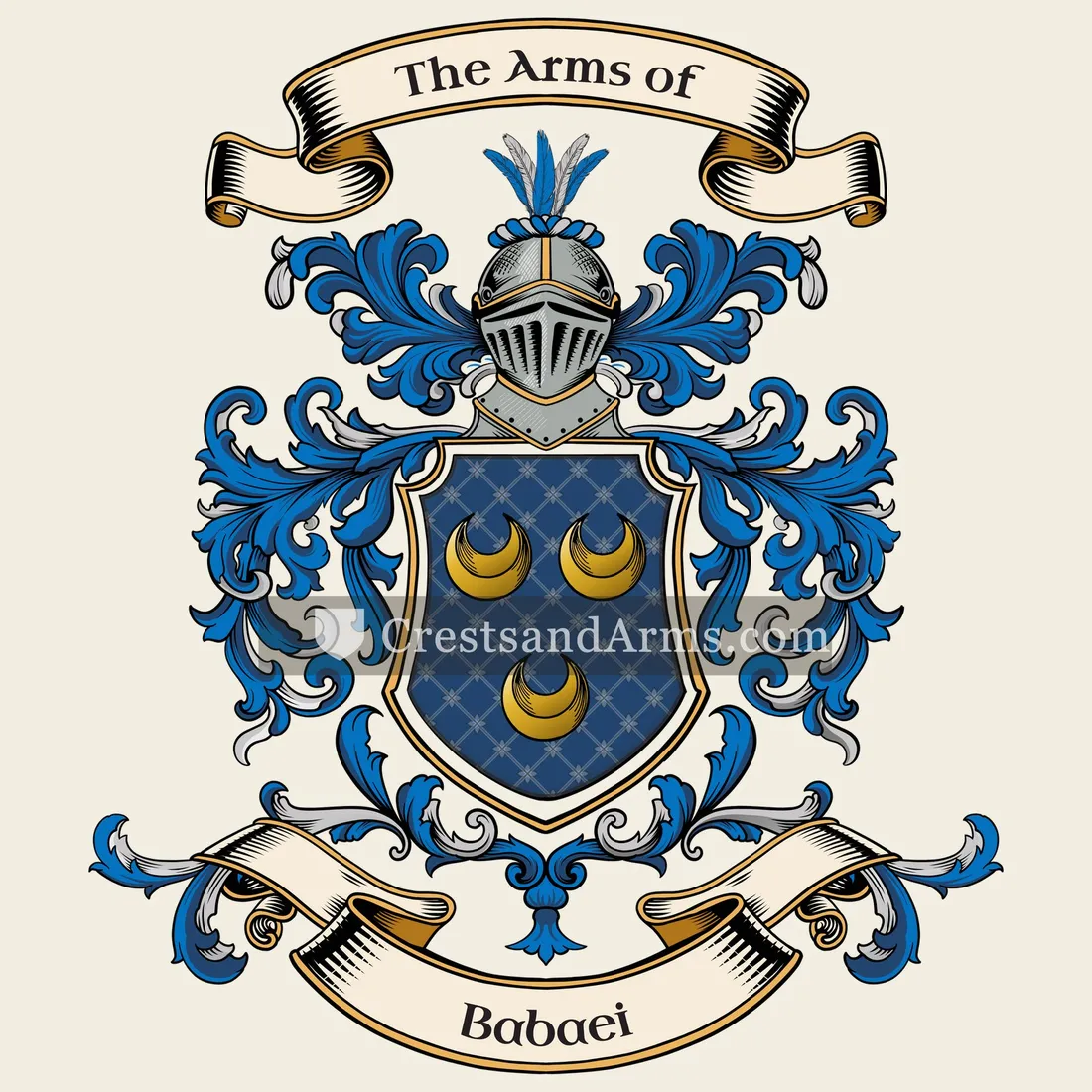
 crescentHonour by the sovereign, and the second son
 crescentHonour by the sovereign, and the second son