Map of Germany showing where the Babra arms are recorded
The Babra arms were recorded in Saxony, c. 1698.
Saxony had mines, trade and old landed families all at once. Silver made some fortunes and land held others, and both sorts of family kept arms, which is why Saxon names appear so often in the registers.
This is where the arms were entered in the register. Families often moved to other parts of the country, so the same name can turn up in more than one region.
The body that granted and recorded arms in Germany in this period.
Leopold I, Holy Roman Emperor
Sovereign of the period
Leopold I, Holy Roman Emperor
1658–1705
Reigning in Germany when the Babra arms are first recorded.
How Arms Worked in Germany
In the Holy Roman Empire, coats of arms were often granted to individuals by the Emperor or his representatives. These arms were then passed down through the generations to all legitimate descendants of the original holder. Younger branches of a family usually kept the same shield design without needing to change it, as the arms belonged to the entire lineage.
Granting authority
The Holy Roman Emperor held the sole power to grant new coats of arms throughout his vast imperial territories.
How they got arms
Families typically obtained their coats of arms through a formal imperial grant or by proving their noble status to the authorities.
Where arms were recorded
These grants were officially recorded in the Imperial Chancery registers, which began keeping formal records of such honors during the Middle Ages.
The family's standing
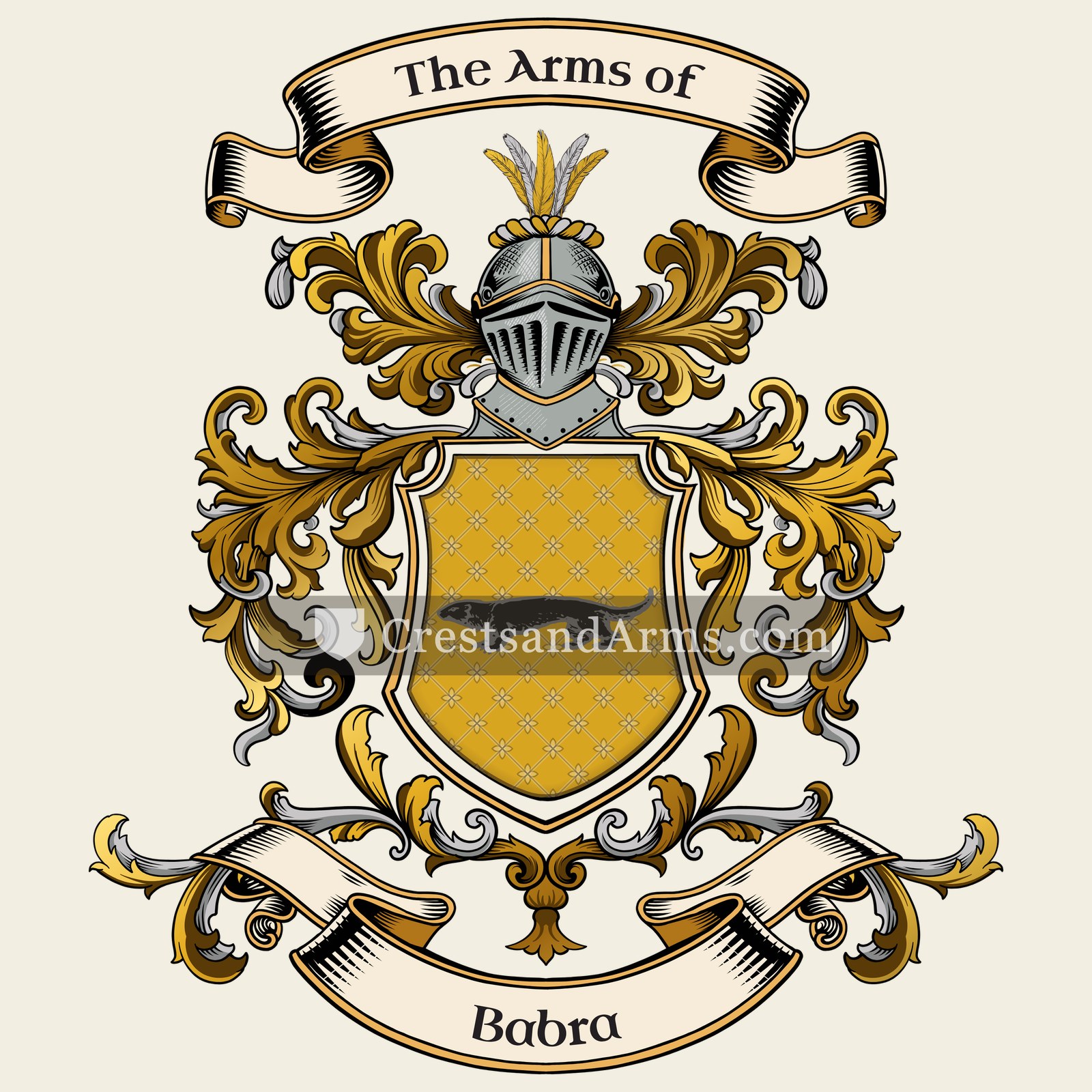
Recorded among the armigerous families of Saxony.
Origin & History of the Babra Family in Germany
The history of the Babra family name is deeply rooted in the cultural landscape of Saxony, where records confirm the presence of family members as early as 1698. During this period, the region was a center of significant social and economic transition within the Holy Roman Empire. Families with this name were likely integrated into the local agrarian or trade communities that defined Saxon life at the turn of the 18th century. As the name appears in regional documentation, it suggests that the family was part of the established population that navigated the complex administrative and religious shifts of the era. Over time, the name persisted through generations, reflecting the resilience and stability of families living in the heart of central Europe during a time of great historical change.
Related Branches & Arms
Root word
Barbarus
Latin term for a foreigner or someone who speaks a different language.
This name
BabraA locative or descriptive surname likely referring to an individual of foreign origin or non-Germanic descent.
also spelled
Bybra
Documented Sources
J. B. Rietstap, Armorial Général, Gouda: G. B. van Goor Zonen, 1884–87
Blaschke, Karlheinz, Bevölkerungsgeschichte von Sachsen bis zur industriellen Revolution, 1967
Sächsisches Staatsarchiv, Kirchenbücher der evangelisch-lutherischen Landeskirche Sachsens, 1698
Digital archive packCoat of arms PNG, gold border print PDF, vector SVG and the certificate of authenticity. Sent to your email in minutes.


 otterOne who lives life to the full
 otterOne who lives life to the full