A record of documented arms, meaning and origin, researched for the Bacha family lines. Documented in 3 countries.
Reg. 1022 · German, A–C
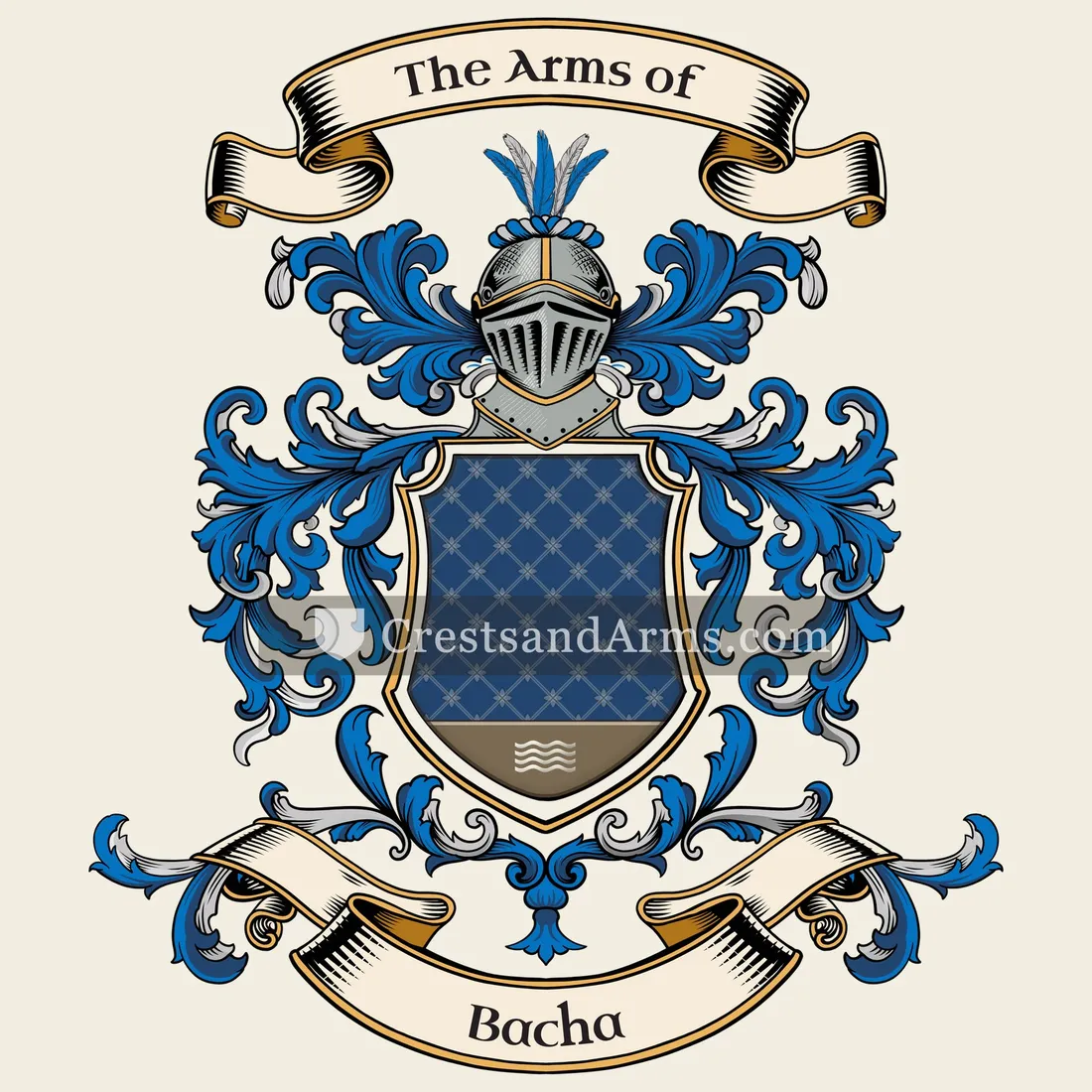
Meaning of the Bacha family crest colors & symbols
Symbols on this shield
riverThe bounds of a land, and life carried through it
Colours
Blue (Azure)Means: Loyalty and truth
Historical info
Source
J. B. Rietstap, Armorial Général, Gouda: G. B. van Goor Zonen, 1884–87
Blazon (the actual original written record)
“D'azur à une mer au nat., en p., surm. de trois mâcles d'or, rangées en fasce. Cq. cour. C.: une mâcle d'or, entre un vol d'azur. L. d'arg. et d'azur [La branche d'Oldenbourg porte en cimier un vol à l'antique, l'aile de devant d'azur, celle de derrière d'arg.]”
WurttembergOldenbourg · Wurttemberg, c. 1703
Digital archive packCoat of arms PNG, gold border print PDF, vector SVG and the certificate of authenticity. Sent to your email in minutes.
Map of Germany showing where the Bacha arms are recorded
The Bacha arms were recorded in Wurttemberg, c. 1703.
Wurttemberg was southern German country of small estates and well-off market towns. Both landowners and leading townsmen kept arms there, so the region carries far more names than its size suggests.
This is where the arms were entered in the register. Families often moved to other parts of the country, so the same name can turn up in more than one region.
The body that granted and recorded arms in Germany in this period.
Leopold I, Holy Roman Emperor
Sovereign of the period
Leopold I, Holy Roman Emperor
1658–1705
Reigning in Germany when the Bacha arms are first recorded.
How Arms Worked in Germany
In the Holy Roman Empire, coats of arms were often granted to individuals by the Emperor or his representatives. These arms were then passed down through the generations to all legitimate descendants of the original holder. Younger branches of a family usually kept the same shield design without needing to change it, as the arms belonged to the entire lineage.
Granting authority
The Holy Roman Emperor held the sole power to grant new coats of arms throughout his vast imperial territories.
How they got arms
Families typically obtained their coats of arms through a formal imperial grant or by proving their noble status to the authorities.
Where arms were recorded
These grants were officially recorded in the Imperial Chancery registers, which began keeping formal records of such honors during the Middle Ages.
The family's standing
Recorded among the armigerous families of Wurttemberg.
Origin & History of the Bacha Family in Germany
The family name Bacha has deep roots in the southwestern region of Germany, specifically within the historical territory of Württemberg. By the year 1703, records confirm that members of the family were already established in this area, which was known for its dense forests and complex agricultural society. During this period, the name likely emerged as a descriptive identifier linked to the local Swabian dialect or as a reference to a specific geographic feature near where the family lived. Life in Württemberg at the turn of the 18th century was defined by the transition from the aftermath of major European conflicts to a period of modest economic rebuilding. As members of the Bacha family settled into these rural communities, they participated in the traditional village life that shaped the social fabric of the region. Their presence in the official church and tax registers of the time suggests they were integrated into the local peasantry or skilled trades, contributing to the steady development of the Württemberg landscape long before the modern era.
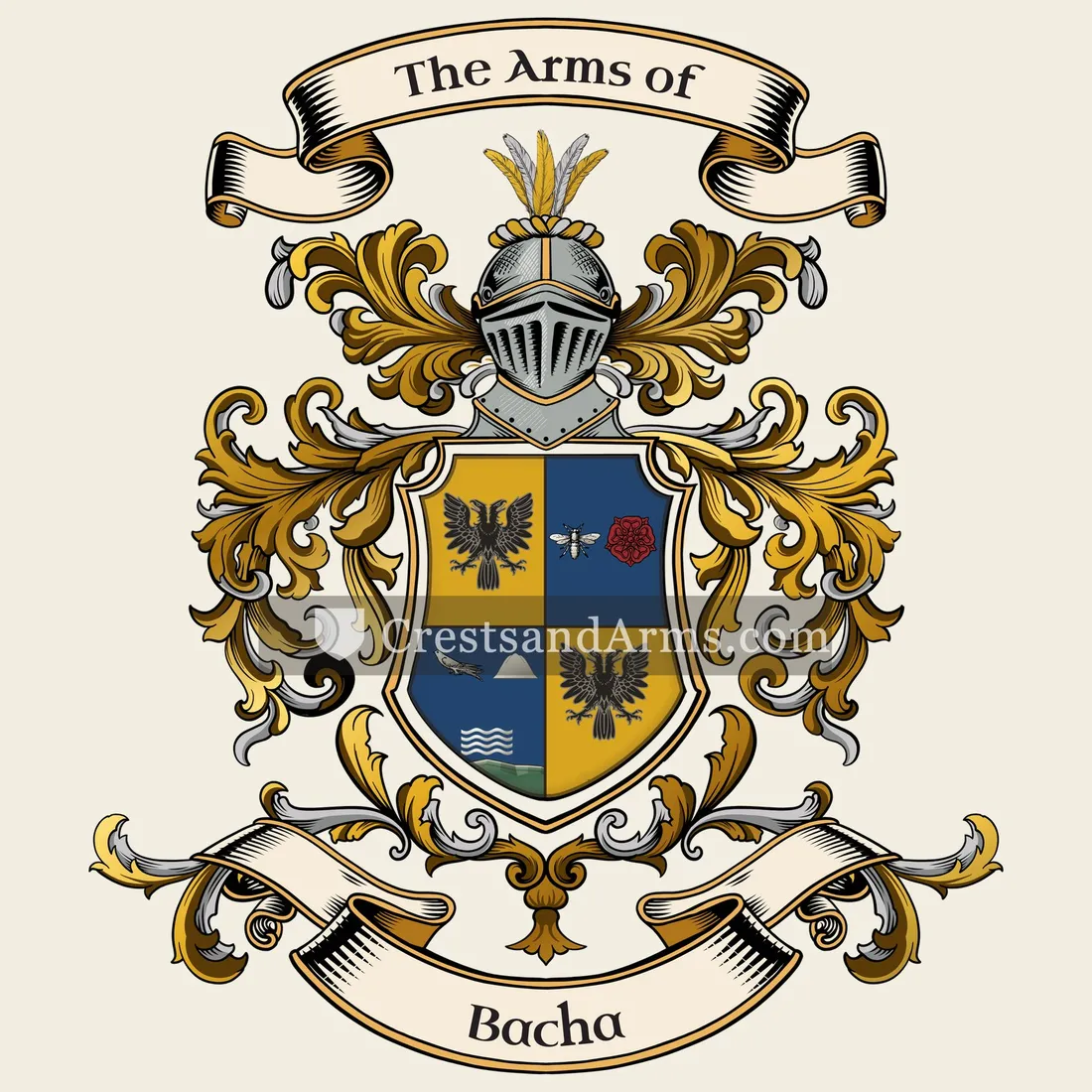
Meaning of the Bacha family crest colors & symbols
Symbols on this shield
mountThe ground held, and steadfastness upon it
eagleNobility, strength and a keen mind
beeIndustry, order and tireless work
roseThe seventh son, and beauty with grace
martletA younger son, who must win his own land
riverThe bounds of a land, and life carried through it
Colours
Gold (Or)Means: Generosity
Blue (Azure)Means: Loyalty and truth
Green (Vert)Means: Hope
Black (Sable)Means: Constancy
Red (Gules)Means: Military strength
Historical info
Source
J. B. Rietstap, Armorial Général, Gouda: G. B. van Goor Zonen, 1884–87
Blazon (the actual original written record)
“Ec.: aux 1 et 4 d'or à l'aigle de sa.; au 2 coupé: a. d'azur à une ruche au nat., entourée d'abeilles; b. d'arg. à une rose de gu., tigée et feuillée de sin.; au 3 coupé: a. d'azur à un oiseau au nat.; b. d'arg. à une terrasse rocheuse, dans laquelle coule un ruisseau, en bande.”
Austriac. 1784
Digital archive packCoat of arms PNG, gold border print PDF, vector SVG and the certificate of authenticity. Sent to your email in minutes.
Map of Austria showing where the Bacha arms are recorded
The Bacha arms were recorded in Austria, c. 1784.
Arms such as these were typically recorded in Tyrol.
Tyrol was mountain country in western Austria, where the valleys were held by families who had been there a very long time. Old tenure counted for more than money, and old families carried arms.
This is where the arms were entered in the register. Families often moved to other parts of the country, so the same name can turn up in more than one region.
Region
Tyrol
First recorded
1784
Granting Authority for the Bacha Arms
Imperial and Royal chancery
Sodacan · CC BY-SA 3.0
The body that granted and recorded arms in Austria in this period.
Joseph II, Holy Roman Emperor
Sovereign of the period
Joseph II, Holy Roman Emperor
1765–1790
Reigning in Germany when the Bacha arms are first recorded.
How Arms Worked in Austria
Austrian coats of arms were often linked directly to noble titles granted by the Emperor. These symbols belonged to the entire family line rather than just one individual. When a family grew, new branches kept the original design without needing to change it. This system allowed all members of a noble house to share the same identity across many generations.
Granting authority
The Imperial and Royal chancery managed all heraldic matters and controlled the official granting of arms throughout the Austrian lands.
How they got arms
Families typically received their arms through a formal imperial decree that often accompanied the elevation of a person to noble status.
Where arms were recorded
Official records of these grants were kept in the Imperial Register of Nobility which began its formal documentation process in 1453.
The family's standing
Recorded among the armigerous families of Austria.
Origin & History of the Bacha Family in Austria
The history of the Bacha family in Austria is deeply rooted in the rugged landscape of the Tyrol region, where records confirm their presence as early as 1784. During this period, the name was closely tied to the alpine lifestyle and the social structures of the Habsburg Empire. Families in this mountainous area often lived in small, tight-knit communities where they relied on agriculture and local trade to survive. Because the Tyrol served as a vital crossroads for travel and commerce between northern and southern Europe, the Bacha family likely experienced the cultural shifts brought by changing borders and regional governance. By settling in this area, the family became part of a long tradition of mountain dwellers who maintained strong ties to their local parishes and village life. These early ancestors helped shape the identity of the region through their labor and their participation in the daily rhythms of Tyrolean society.
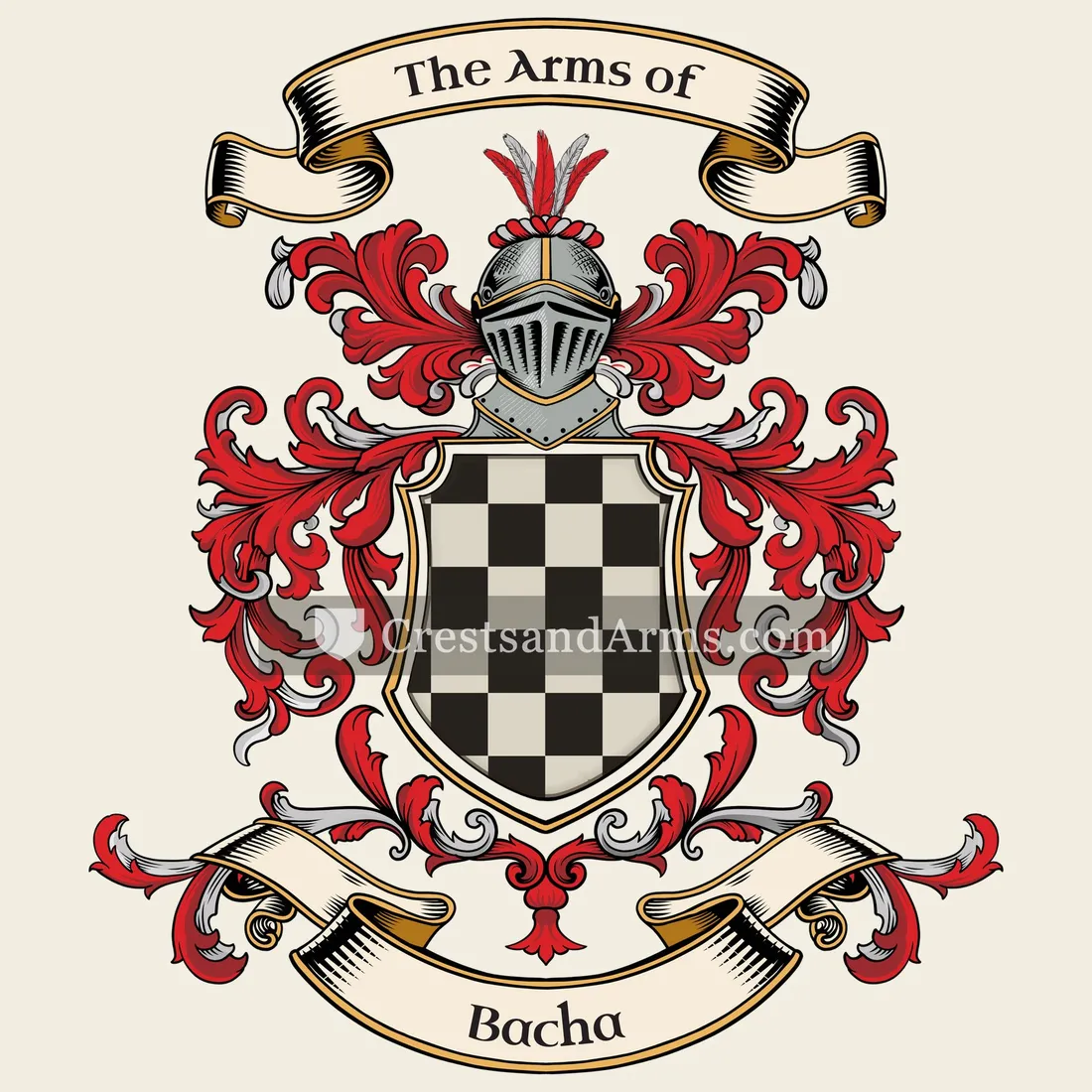
Meaning of the Bacha family crest colors & symbols
Symbols on this shield
chequyConstancy, and the counting-board
Colours
Black (Sable)Means: Constancy
Silver (Argent)Means: Peace and sincerity
Historical info
Source
J. B. Rietstap, Armorial Général, Gouda: G. B. van Goor Zonen, 1884–87
Blazon (the actual original written record)
“Echiq. de sa. et d'arg. C.: un vol, aux armes de l'écu.”
Switzerlandc. 1745
Digital archive packCoat of arms PNG, gold border print PDF, vector SVG and the certificate of authenticity. Sent to your email in minutes.
Map of Switzerland showing where the Bacha arms are recorded
The Bacha arms were recorded in Switzerland, c. 1745.
Arms such as these were typically recorded in Bern.
Bern was the largest of the Swiss cantons and ran itself, with its own council and its own courts. Its governing families held office for generations, and office of that kind carried a shield with it.
This is where the arms were entered in the register. Families often moved to other parts of the country, so the same name can turn up in more than one region.
The body that granted and recorded arms in Switzerland in this period.
How Arms Worked in Switzerland
In Switzerland, coats of arms were not restricted to the nobility and were often adopted by common citizens and families. These symbols were passed down through generations to show family identity. When branches of a family grew, they often changed small details of the design to distinguish their own line from the original group.
Granting authority
Cantonal and civic authorities managed the use of coats of arms within their specific regions and local jurisdictions.
How they got arms
Families typically assumed their own coats of arms based on local custom rather than receiving them from a central monarch.
Where arms were recorded
Arms were recorded in various cantonal and civic registers starting from the fourteenth century throughout the Swiss region.
The family's standing
Recorded among the armigerous families of Switzerland.
Origin & History of the Bacha Family in Switzerland
The family name Bacha has deep roots in the Swiss canton of Bern, where records confirm members of the family were established by 1745. During this period, Bern was a powerful city-state governed by a strict social hierarchy, and families like the Bachas were often integrated into the local agricultural or artisan communities that formed the backbone of the region. Life in eighteenth-century Switzerland was shaped by the transition from feudal traditions to more structured civic life, and families in the Bernese highlands or surrounding valleys typically focused on land cultivation and local trade. Because the name appears in official registers during the mid-1700s, it suggests that the family was part of the settled population that contributed to the stability of the Swiss Confederation. These early ancestors likely navigated the complex religious and political shifts of the time while maintaining their identity within the German-speaking culture of the Bernese territory.
Bacha Meaning & Related Branches
Root word
Bach
A German term referring to a brook, stream, or small creek.
This name
BachaA topographic name for someone who lived near a small stream or brook.
also spelled
Back
Bek
Documented Sources
J. B. Rietstap, Armorial Général, Gouda: G. B. van Goor Zonen, 1884–87
Brechenmacher, Josef Karlmann. Etymologisches Wörterbuch der deutschen Familiennamen. 1957
Kohl, Wilhelm. Die Geschichte der deutschen Familiennamen. 1998
Digital archive packCoat of arms PNG, gold border print PDF, vector SVG and the certificate of authenticity. Sent to your email in minutes.


 riverThe bounds of a land, and life carried through it
 riverThe bounds of a land, and life carried through it


 mountThe ground held, and steadfastness upon it
 eagleNobility, strength and a keen mind
 beeIndustry, order and tireless work
 roseThe seventh son, and beauty with grace
 martletA younger son, who must win his own land


 chequyConstancy, and the counting-board