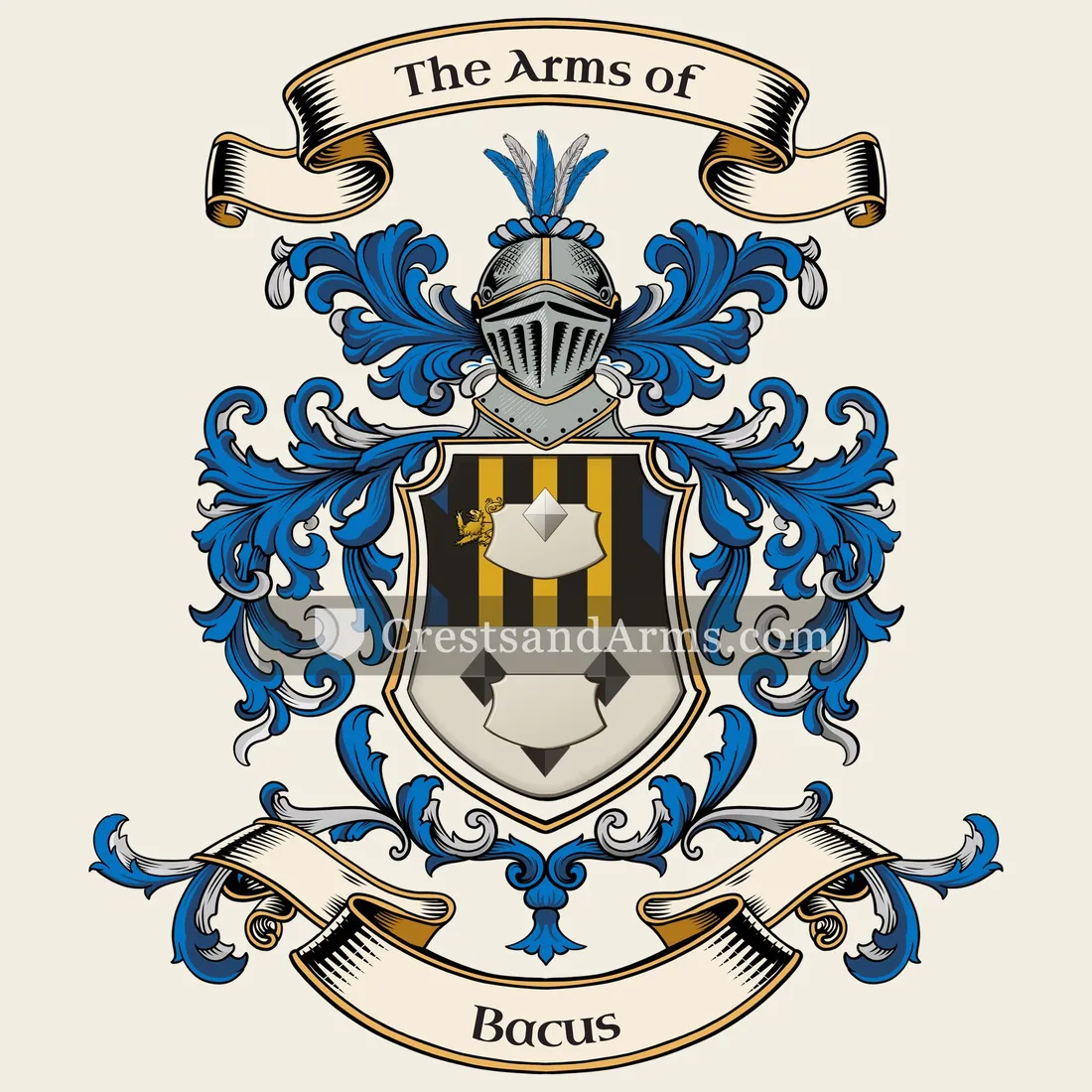
A record of documented arms, meaning and origin, researched for the Bacus family of Netherlands.
Reg. 8525 · Dutch, A–C
Meaning of the Bacus family crest colors & symbols
Symbols on this shield
paleMilitary strength, and a fortified defence
lozengeHonour and nobility, and the arms of a woman
lionCourage, strength and royalty
Colours
Black (Sable)Means: Constancy
Silver (Argent)Means: Peace and sincerity
Gold (Or)Means: Generosity
Blue (Azure)Means: Loyalty and truth
Historical info
Source
J. B. Rietstap, Armorial Général, Gouda: G. B. van Goor Zonen, 1884–87
Blazon (the actual original written record)
“Coupé: au 1 parti: a. de sa. au lion d'or; b. d'azur à trois pals d'or; au 2 d'arg. à trois los. de sa. Sur le tout fuselé en barre d'arg. et d'azur. Cq. cour. C.: un lion iss. d'or.”
NetherlandsDordrecht, c. 1815
Digital archive packCoat of arms PNG, gold border print PDF, vector SVG and the certificate of authenticity. Sent to your email in minutes.
Map of Netherlands showing where the Bacus arms are recorded
The Bacus arms were recorded in Dordrecht, c. 1815.
This is where the arms were entered in the register. Families often moved to other parts of the country, so the same name can turn up in more than one region.
Region
Dordrecht
Town
Dordrecht
First recorded
1815
Granting Authority for the Bacus Arms
Hoge Raad van Adel
Photograph made by me · CC BY-SA 3.0
The body that granted and recorded arms in Netherlands in this period.
William I of the Netherlands
Sovereign of the period
William I of the Netherlands
1815–1840
Reigning in Netherlands when the Bacus arms are first recorded.
How Arms Worked in Netherlands
In the Netherlands, coats of arms were often used by noble families and those who held specific public offices. These arms were passed down through the generations to legitimate descendants. Younger branches of a family usually kept the original design without needing to add special marks. This system ensured that the family identity remained clear and consistent over many years.
Granting authority
The Hoge Raad van Adel is the official body that regulates and manages noble titles and coats of arms in the Netherlands.
How they got arms
Families typically obtained their coats of arms through official royal grants or by proving their long-standing historical use of the symbols.
Where arms were recorded
Coats of arms are officially recorded in the registers held by the Hoge Raad van Adel, which began its work in 1814.
The family's standing
Recorded among the armigerous families of Netherlands.
Origin & History of the Bacus Family in Netherlands
The surname Bacus has deep roots in the Netherlands, with historical records confirming that members of the family were established in the city of Dordrecht by 1815. During this period, Dordrecht served as a vital hub for trade and shipping, which likely influenced the lives and occupations of early family members. The name itself is thought to be a variation of older regional naming patterns, possibly linked to local geographic features or occupational titles common in the South Holland province. As the family settled into the urban landscape of Dordrecht, they became part of a growing community that navigated the transition from the Napoleonic era into the establishment of the United Kingdom of the Netherlands. By tracing these early records, we see a family that was well-integrated into the social and economic fabric of one of the oldest cities in the region.
Bacus Meaning & Related Branches
Root word
Bacchus
The Roman god of wine and vegetation.
This name
BacusA habitational or occupational name derived from the Roman deity, often associated with wine merchants or vineyard workers.
also spelled
Backes
Documented Sources
J. B. Rietstap, Armorial Général, Gouda: G. B. van Goor Zonen, 1884–87


 paleMilitary strength, and a fortified defence
 lozengeHonour and nobility, and the arms of a woman
 lionCourage, strength and royalty
 paleMilitary strength, and a fortified defence
 lozengeHonour and nobility, and the arms of a woman
 lionCourage, strength and royalty