Map of England showing where the Badd arms are recorded
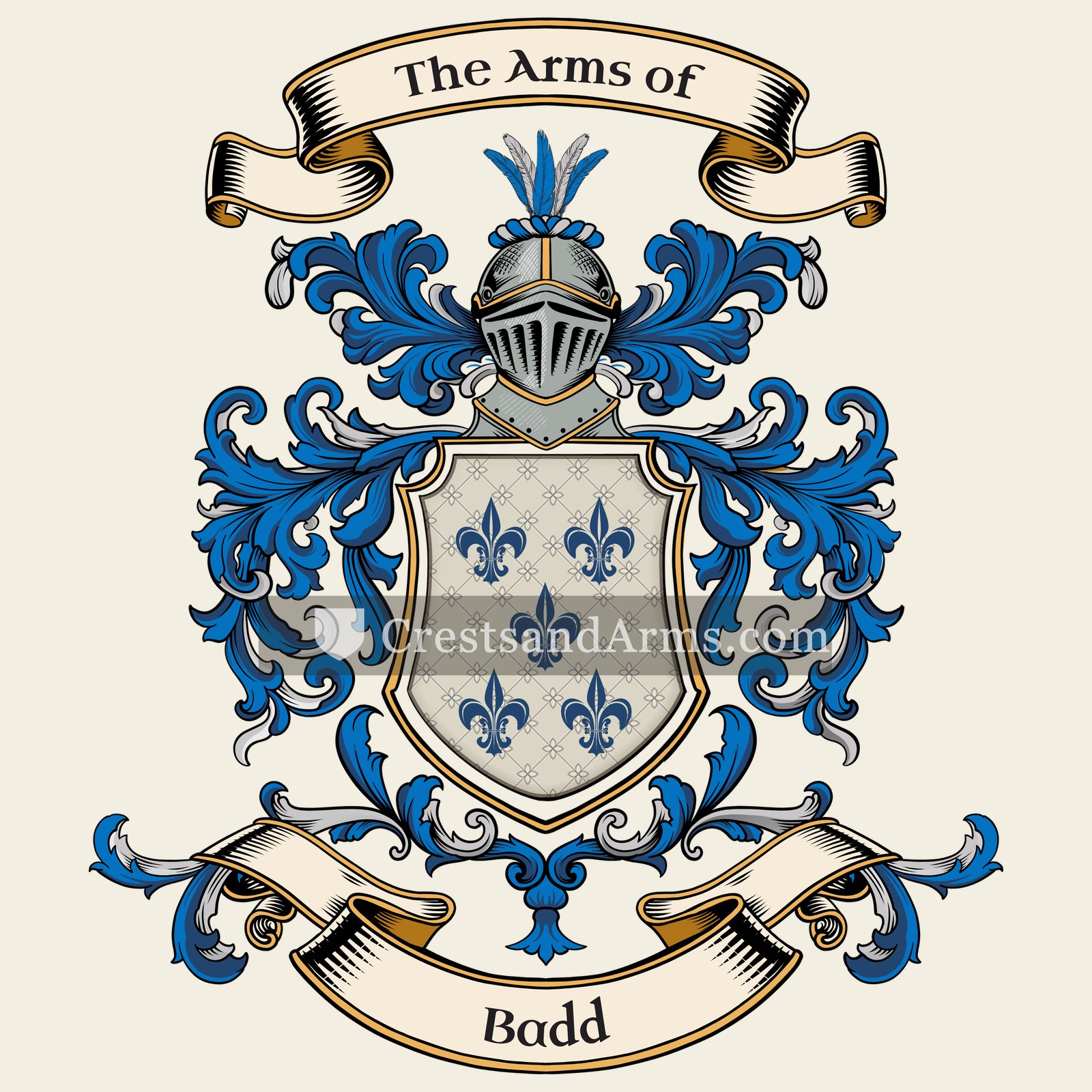
The Badd arms were recorded in Hants, c. 1620.
Hampshire had the naval dockyards at Portsmouth on one side and good farmland on the other. Sea money and land money both bought estates, and an estate was what brought a family its coat of arms.
This is where the arms were entered in the register. Families often moved to other parts of the country, so the same name can turn up in more than one region.
The body that granted and recorded arms in England in this period.
James VI and I
Sovereign of the period
James VI and I
1603–1625
Reigning in England when the Badd arms are first recorded.
How Arms Worked in England
English heraldry allowed arms to be shared by all legitimate descendants of the original owner. These symbols were treated as personal property that moved through the generations to all children. While the eldest son kept the original design, other family members could use the same shield without needing to change it or register their own unique versions.
Granting authority
The College of Arms in London has regulated the use of coats of arms throughout England and Wales since 1484.
How they got arms
Families typically obtained their coats of arms through a formal grant from the Crown or by proving their ancient right to them.
Where arms were recorded
All official coats of arms are recorded in the registers kept at the College of Arms, which date back to the fifteenth century.
The family's standing
Recorded among the armigerous families of Hants.
Origin & History of the Badd Family in England
The surname Badd is a rare and distinct name with deep roots in the English county of Hampshire. Historical records confirm that members of the family were well-established in this region by the year 1620. During this period, the name was often associated with families living in rural parishes where they worked as farmers or tradespeople. Because the name is short and phonetically simple, it likely originated as a descriptive nickname or a variation of an older occupational title. Over the centuries, the Badd family remained closely tied to the landscape of southern England, gradually spreading from their early Hampshire base into neighboring counties. While the family never sought great fame or political power, their presence in local parish registers provides a clear window into the lives of ordinary people who helped shape the history of their community.
Badd Meaning & Related Branches
Root word
Badda
An Old English personal name derived from the word for bold.
This name
BaddA patronymic surname indicating descent from a person known for their courageous or bold nature.
also spelled
Bade
Baed
Related arms
Badevariant spelling
Benettrecorded with Badd, same area
Documented Sources
Sir Bernard Burke, The General Armory of England, Scotland, Ireland and Wales, London: Harrison & Sons, 1884


 fleur de lisPurity, light, and the sixth son
 fleur de lisPurity, light, and the sixth son