Map of Denmark showing where the Baden arms are recorded
The Baden arms were recorded in Denmark, c. 1722.
Arms such as these were typically recorded in Sjaælland.
Zealand held the Danish court, the crown's offices and Copenhagen itself. Families who served the king kept estates within reach of it, and royal service was the ordinary route to a coat of arms.
This is where the arms were entered in the register. Families often moved to other parts of the country, so the same name can turn up in more than one region.
The body that granted and recorded arms in Denmark in this period.
Frederik IV of Denmark
Sovereign of the period
Frederik IV of Denmark
1699–1730
Reigning in Denmark when the Baden arms are first recorded.
How Arms Worked in Denmark
Danish heraldry during this period was closely tied to noble status and royal favor rather than being open to all citizens. Arms were typically granted by the monarch to individuals, and these symbols were then shared by all members of the noble house. If a family line died out, the right to use those specific arms ended with them.
Granting authority
The Danish royal chancery held the power to issue and regulate official coats of arms for the kingdom.
How they got arms
Families usually received their arms through a formal royal grant that confirmed their noble status and rights.
Where arms were recorded
These grants were officially recorded in the Danish Royal Chancery records starting in the sixteenth century.
The family's standing
Recorded among the armigerous families of Denmark.
Origin & History of the Baden Family in Denmark
The history of the Baden family in Denmark is rooted in the island of Sjælland, where records confirm their presence by 1722. During this period, the family established themselves as part of the growing professional class in a society transitioning toward modern administration. The name itself reflects a common naming tradition of the era, often linked to geographical origins or specific ancestral occupations in Northern Europe. As the family settled into Danish life, they became integrated into the local social fabric, eventually producing notable figures in academia and the arts. By maintaining a consistent presence in the region, the Baden family evolved from early settlers into a recognized lineage that contributed to the cultural development of Denmark throughout the eighteenth and nineteenth centuries.
Coat of Arms & Family Crest Details
Colours
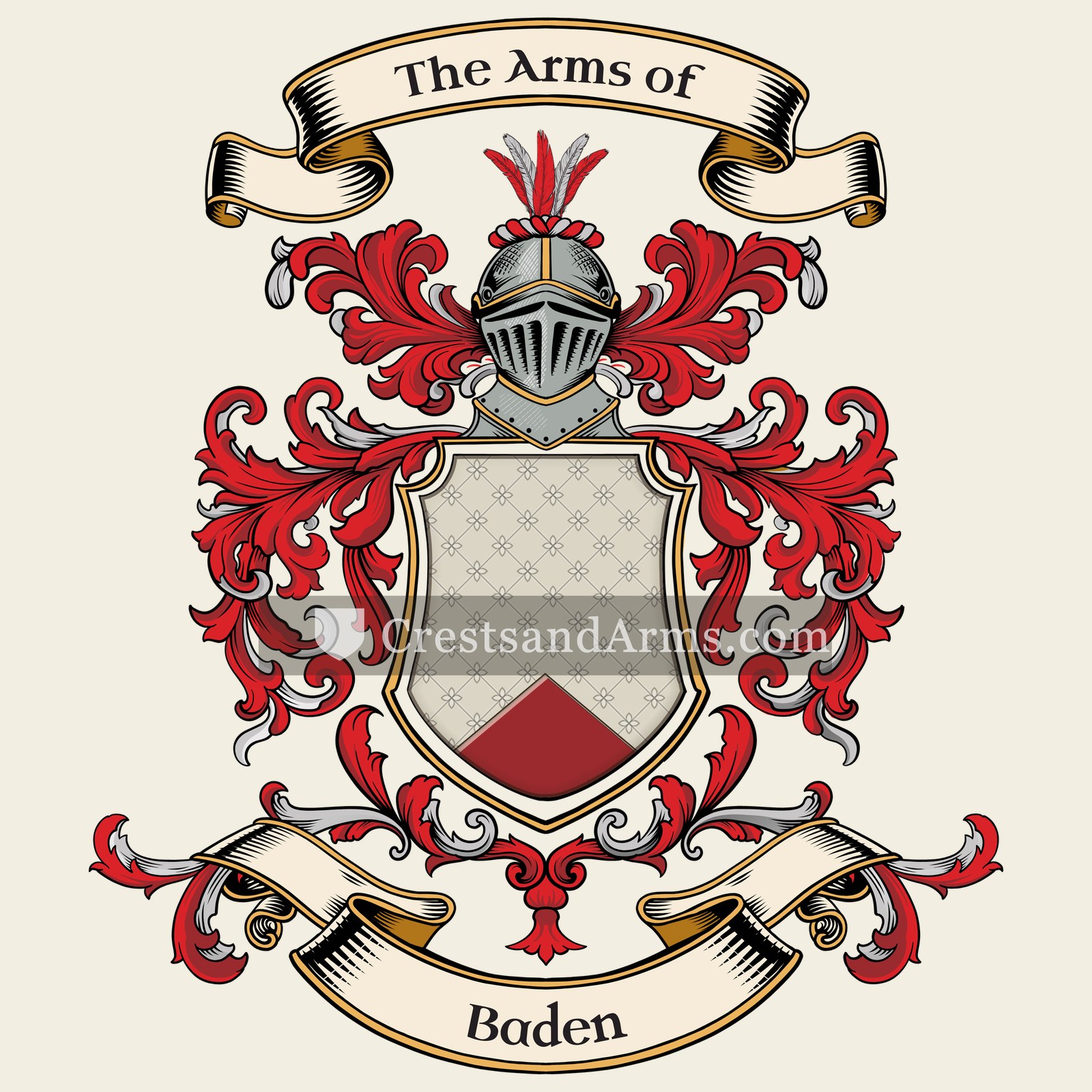
Silver (Argent)Means: Peace and sincerity
Red (Gules)Means: Military strength
Historical info
Source
J. B. Rietstap, Armorial Général, Gouda: G. B. van Goor Zonen, 1884–87
Blazon (the actual original written record)
“D'arg. à une pointe de gu., posée en bande, mouv. du canton sen. de la p. de l'écu. C.: un cor-de-chasse de gu., lié d'or; ou: un chapeau pyramidal de gu., retr. d'arg., sommé d'une boule d'or ornée d'une touffe de plumes de coq d'arg.”
Switzerlandc. 1745
Digital archive packCoat of arms PNG, gold border print PDF, vector SVG and the certificate of authenticity. Sent to your email in minutes.
Map of Switzerland showing where the Baden arms are recorded
The Baden arms were recorded in Switzerland, c. 1745.
Arms such as these were typically recorded in Bern.
Bern was the largest of the Swiss cantons and ran itself, with its own council and its own courts. Its governing families held office for generations, and office of that kind carried a shield with it.
This is where the arms were entered in the register. Families often moved to other parts of the country, so the same name can turn up in more than one region.
The body that granted and recorded arms in Switzerland in this period.
How Arms Worked in Switzerland
In Switzerland, coats of arms were not restricted to the nobility and were often adopted by common citizens and families. These symbols were passed down through generations to show family identity. When branches of a family grew, they often changed small details of the design to distinguish their own line from the original group.
Granting authority
Cantonal and civic authorities managed the use of coats of arms within their specific regions and local jurisdictions.
How they got arms
Families typically assumed their own coats of arms based on local custom rather than receiving them from a central monarch.
Where arms were recorded
Arms were recorded in various cantonal and civic registers starting from the fourteenth century throughout the Swiss region.
The family's standing
Recorded among the armigerous families of Switzerland.
Origin & History of the Baden Family in Switzerland
The family name Baden is deeply tied to the geography and social structure of the Swiss Confederation. While the name itself likely originated as a topographic descriptor for people living near thermal springs, its presence in the city of Bern by 1745 places the family within the heart of a powerful urban center during the Old Swiss Confederacy. At that time, Bern was a dominant city-state governed by a strict patrician class, and families established there were often integrated into the complex guild systems that controlled trade and local politics. Members of the Baden family in this era would have navigated a society defined by rigid social hierarchies and the transition toward the modern Swiss state. By settling in Bern, the family became part of a historical narrative involving the growth of Swiss administrative power and the development of urban citizenship long before the country became the unified nation it is today.
Coat of Arms & Family Crest Details
Symbols on this shield
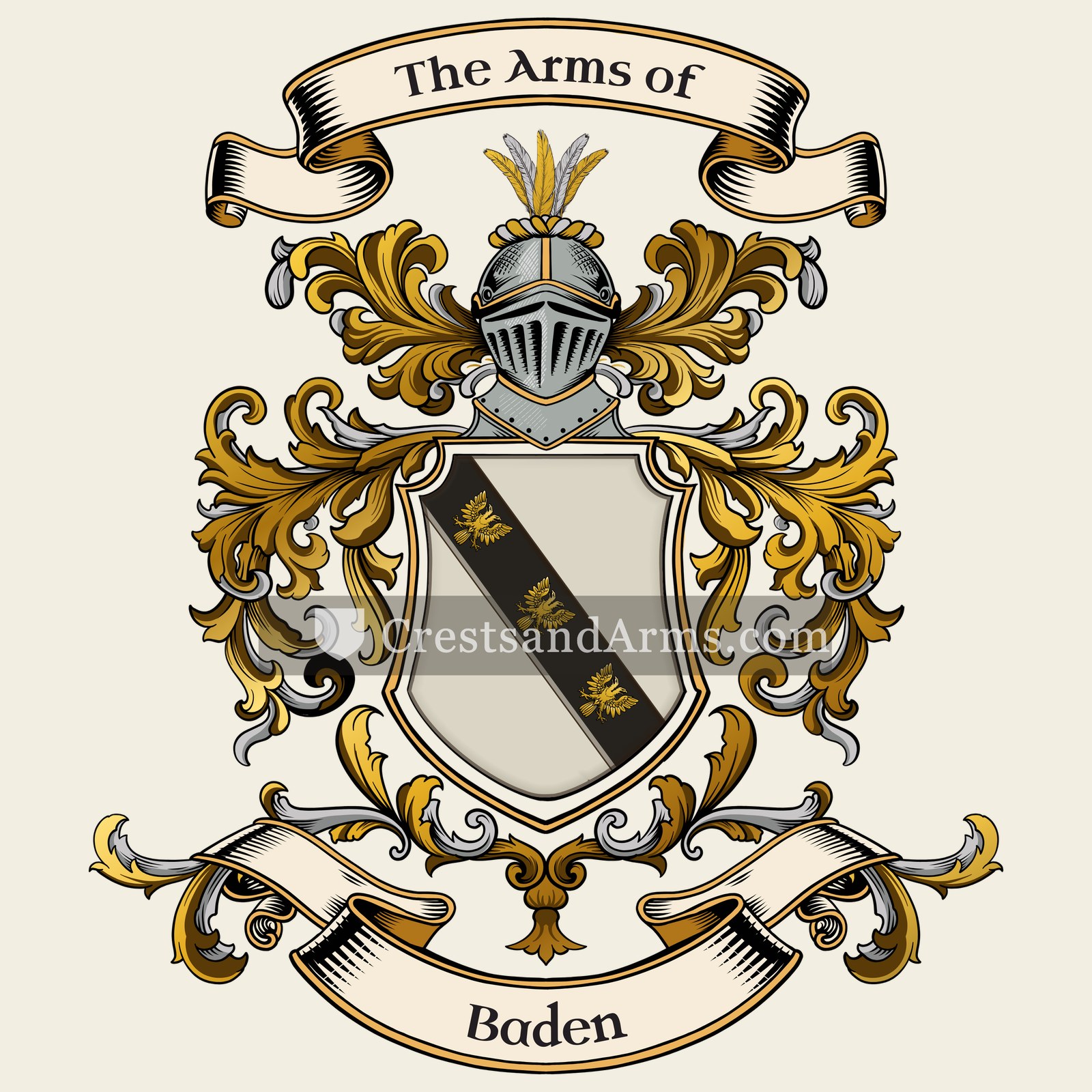
bendDefence, and the scarf of a commander
eagleNobility, strength and a keen mind
Colours
Silver (Argent)Means: Peace and sincerity
Black (Sable)Means: Constancy
Gold (Or)Means: Generosity
Historical info
Source
Sir Bernard Burke, The General Armory of England, Scotland, Ireland and Wales, London: Harrison & Sons, 1884
Blazon (the actual original written record)
“Ar. on a bend double cottised sa. three eagles displ. or”
Germanyc. 1765
Digital archive packCoat of arms PNG, gold border print PDF, vector SVG and the certificate of authenticity. Sent to your email in minutes.
Map of Germany showing where the Baden arms are recorded
The Baden arms were recorded in Germany, c. 1765.
Arms such as these were typically recorded in Bavaria.
Bavaria was a country of old landed families and walled market towns. Estates passed down the same line for centuries, and both the landowners and the leading townsmen kept arms, which is why so many Bavarian names sit in the registers.
This is where the arms were entered in the register. Families often moved to other parts of the country, so the same name can turn up in more than one region.
The body that granted and recorded arms in Germany in this period.
Francis I, Holy Roman Emperor
Sovereign of the period
Francis I, Holy Roman Emperor
1745–1765
Reigning in Denmark when the Baden arms are first recorded.
How Arms Worked in Germany
In the Holy Roman Empire, coats of arms were often granted to individuals by the Emperor or his representatives. These arms were then passed down through the generations to all legitimate descendants of the original holder. Younger branches of a family usually kept the same shield design without needing to change it, as the arms belonged to the entire lineage.
Granting authority
The Holy Roman Emperor held the sole power to grant new coats of arms throughout his vast imperial territories.
How they got arms
Families typically obtained their coats of arms through a formal imperial grant or by proving their noble status to the authorities.
Where arms were recorded
These grants were officially recorded in the Imperial Chancery registers, which began keeping formal records of such honors during the Middle Ages.
The family's standing
Recorded among the armigerous families of Germany.
Origin & History of the Baden Family in Germany
The name Baden originates from the German word for baths, which historically referred to locations with natural hot springs. In the German-speaking regions, families often adopted this name because they lived near these thermal sites or managed them as a trade. By the middle of the eighteenth century, the family had established a documented presence in Bavaria. During this era, Bavaria was a region defined by strict social hierarchies and agricultural traditions. Families like the Badens were typically integrated into the local village structures where they worked as farmers or skilled laborers. Life in 1765 Bavaria required individuals to maintain strong ties to their local parish and community to ensure economic stability. Over time, the name became a permanent marker of the family’s geographic roots and their connection to the specific landscapes of southern Germany.
Baden Meaning & Related Branches
Root word
Bad
Old Germanic term referring to a bath or bathing place.
This name
BadenA topographic name for someone who lived near a public bathhouse.
also spelled
Badenne
Baaden
Baddan
Badin
Badon
Related arms
Jernskiegsame arms
Argausimilar arms
Baydenvariant spelling
Holsteinrecorded with Baden, same area
Documented Sources
J. B. Rietstap, Armorial Général, Gouda: G. B. van Goor Zonen, 1884–87
Hiort-Lorenzen, H. R. and Thiset, A., Danmarks Adels Aarbog, 1893
Wegener, C. F., Personalhistoriske Bidrag til Danmarks Historie, 1850
Rigsarkivet (Danish National Archives), Kirkebøger for Sjællands Stift (Parish registers for the Diocese of Sjælland)
Rigsarkivet (Danish National Archives), Folketællinger (Census records)
Digital archive packCoat of arms PNG, gold border print PDF, vector SVG and the certificate of authenticity. Sent to your email in minutes.


 paleMilitary strength, and a fortified defence
 chiefAuthority, wisdom and dominion
 paleMilitary strength, and a fortified defence
 chiefAuthority, wisdom and dominion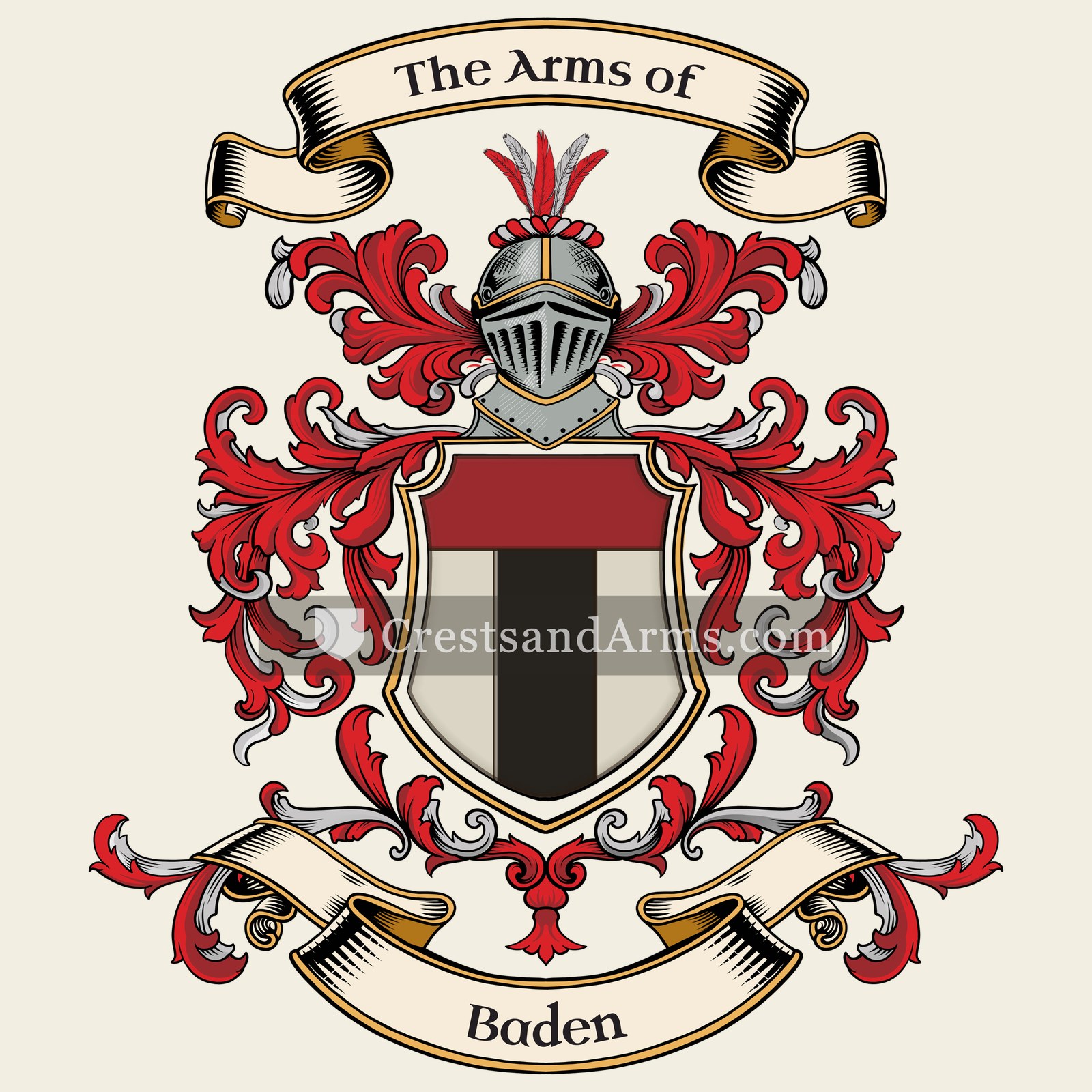



 bendDefence, and the scarf of a commander
 eagleNobility, strength and a keen mind