Map of Denmark showing where the Bader arms are recorded
The Bader arms were recorded in Denmark, c. 1722.
Arms such as these were typically recorded in Sjaælland.
Zealand held the Danish court, the crown's offices and Copenhagen itself. Families who served the king kept estates within reach of it, and royal service was the ordinary route to a coat of arms.
This is where the arms were entered in the register. Families often moved to other parts of the country, so the same name can turn up in more than one region.
The body that granted and recorded arms in Denmark in this period.
Frederik IV of Denmark
Sovereign of the period
Frederik IV of Denmark
1699–1730
Reigning in Denmark when the Bader arms are first recorded.
How Arms Worked in Denmark
Danish heraldry during this period was closely tied to noble status and royal favor rather than being open to all citizens. Arms were typically granted by the monarch to individuals, and these symbols were then shared by all members of the noble house. If a family line died out, the right to use those specific arms ended with them.
Granting authority
The Danish royal chancery held the power to issue and regulate official coats of arms for the kingdom.
How they got arms
Families usually received their arms through a formal royal grant that confirmed their noble status and rights.
Where arms were recorded
These grants were officially recorded in the Danish Royal Chancery records starting in the sixteenth century.
The family's standing
Recorded among the armigerous families of Denmark.
Origin & History of the Bader Family in Denmark
The family name Bader has deep roots in the Danish landscape, with documented evidence placing members of the family in the region of Sjælland as early as 1722. During this period, the name was often associated with individuals who held specific roles within their local communities, as surnames were frequently derived from a person’s occupation or their place of origin. In the context of eighteenth-century Denmark, the name Bader likely evolved from the German term for a bathhouse keeper or a barber-surgeon, reflecting a profession that provided essential health and hygiene services to the public. As these families settled into the rural and growing urban areas of Sjælland, they became part of the steady social fabric of the Danish kingdom. Their presence in official records from the early 1700s highlights a history of stability and integration within the local parish systems, where they lived and worked alongside other families during a time of significant agricultural and social change in Denmark.
Coat of Arms & Family Crest Details
Symbols on this shield
palm treeVictory, and righteousness that flourishes
Colours
Silver (Argent)Means: Peace and sincerity
Green (Vert)Means: Hope
Historical info
Source
J. B. Rietstap, Armorial Général, Gouda: G. B. van Goor Zonen, 1884–87
Blazon (the actual original written record)
“D'arg. au palmier de sin.,”
GermanyFrancfort s, c. 1765
Digital archive packCoat of arms PNG, gold border print PDF, vector SVG and the certificate of authenticity. Sent to your email in minutes.
Map of Germany showing where the Bader arms are recorded
The Bader arms were recorded in Francfort s, c. 1765.
This is where the arms were entered in the register. Families often moved to other parts of the country, so the same name can turn up in more than one region.
The body that granted and recorded arms in Germany in this period.
Francis I, Holy Roman Emperor
Sovereign of the period
Francis I, Holy Roman Emperor
1745–1765
Reigning in Denmark when the Bader arms are first recorded.
How Arms Worked in Germany
In the Holy Roman Empire, coats of arms were often granted to individuals by the Emperor or his representatives. These arms were then passed down through the generations to all legitimate descendants of the original holder. Younger branches of a family usually kept the same shield design without needing to change it, as the arms belonged to the entire lineage.
Granting authority
The Holy Roman Emperor held the sole power to grant new coats of arms throughout his vast imperial territories.
How they got arms
Families typically obtained their coats of arms through a formal imperial grant or by proving their noble status to the authorities.
Where arms were recorded
These grants were officially recorded in the Imperial Chancery registers, which began keeping formal records of such honors during the Middle Ages.
The family's standing
Recorded among the armigerous families of Germany.
Origin & History of the Bader Family in Germany
The surname Bader is an occupational name that originated in medieval Germany. It comes from the German word *Bader*, which refers to a person who operated a public bathhouse. During the Middle Ages, these bathhouses were essential social hubs where people went to bathe, receive medical treatments, and even get haircuts or minor surgeries. Because these bathhouse owners held a respected and necessary role in their communities, the name became common across many German-speaking regions. By the time members of the family were documented in Frankfurt in 1765, the name had been established for centuries as a reflection of this traditional trade. As society modernized and the role of the bathhouse keeper evolved, the name remained a permanent link to the professional lives of ancestors who served the public health needs of their towns.
Coat of Arms & Family Crest Details
Symbols on this shield
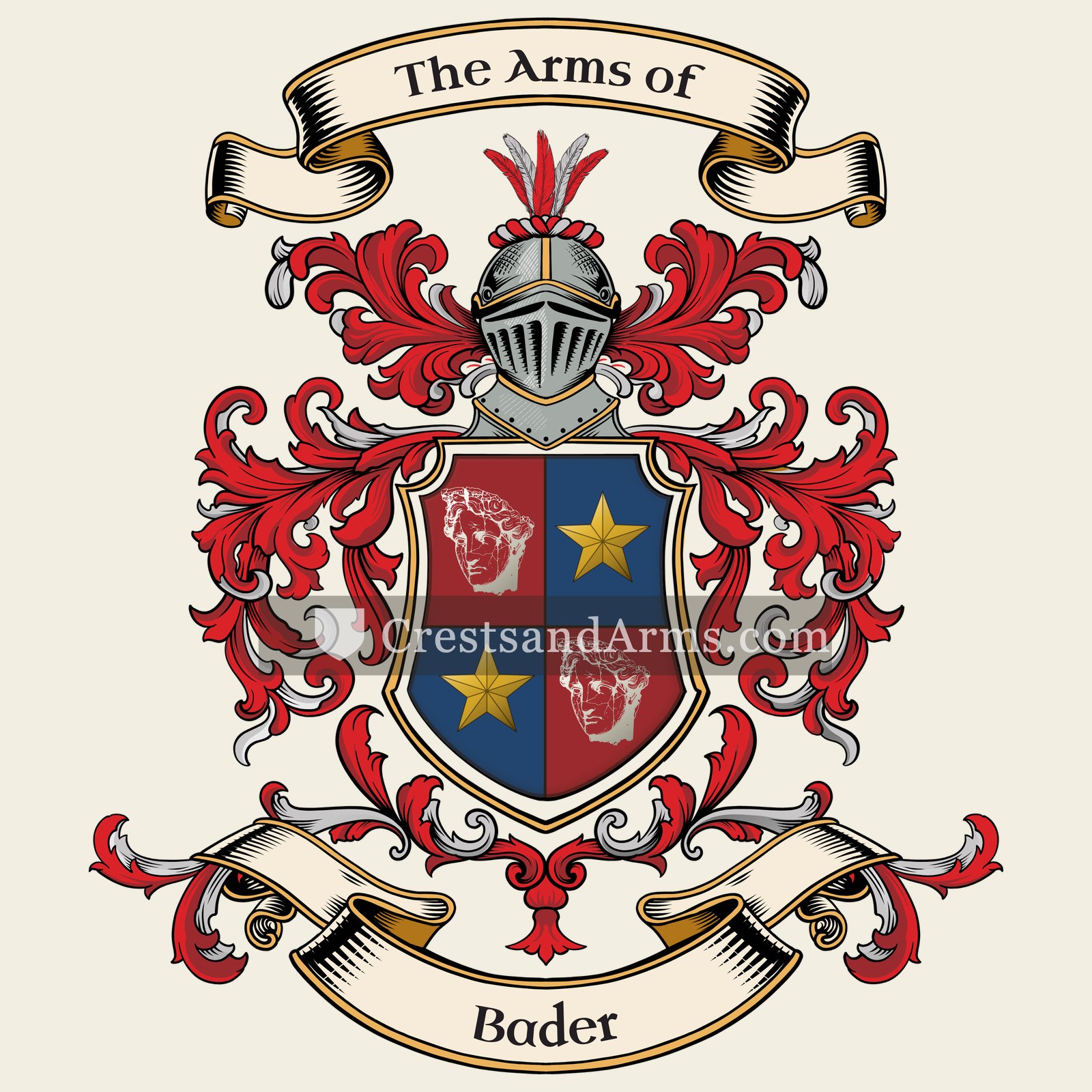
womanGrace, and the founding of a house
mulletThe third son, and a divine quality from above
Colours
Red (Gules)Means: Military strength
Blue (Azure)Means: Loyalty and truth
Gold (Or)Means: Generosity
Historical info
Source
J. B. Rietstap, Armorial Général, Gouda: G. B. van Goor Zonen, 1884–87
Blazon (the actual original written record)
“Ec.: aux 1 et 4 de gu. à une femme iss. de carn., les cheveux épars, les bras étendus, coiffée d'un chapeau d'homme d'or; aux 2 et 3 d'azur à une étoile (5) d'or. Cq. cour. C.: la femme iss., entre un vol coupé, à dextre d'arg. sur gu., à sen. d'or sur azur. L. conformes aux émaux du vol.”
SwitzerlandBâle, c. 1745
Digital archive packCoat of arms PNG, gold border print PDF, vector SVG and the certificate of authenticity. Sent to your email in minutes.
Map of Switzerland showing where the Bader arms are recorded
The Bader arms were recorded in Bâle, c. 1745.
This is where the arms were entered in the register. Families often moved to other parts of the country, so the same name can turn up in more than one region.
The body that granted and recorded arms in Switzerland in this period.
How Arms Worked in Switzerland
In Switzerland, coats of arms were not restricted to the nobility and were often adopted by common citizens and families. These symbols were passed down through generations to show family identity. When branches of a family grew, they often changed small details of the design to distinguish their own line from the original group.
Granting authority
Cantonal and civic authorities managed the use of coats of arms within their specific regions and local jurisdictions.
How they got arms
Families typically assumed their own coats of arms based on local custom rather than receiving them from a central monarch.
Where arms were recorded
Arms were recorded in various cantonal and civic registers starting from the fourteenth century throughout the Swiss region.
The family's standing
Recorded among the armigerous families of Switzerland.
Origin & History of the Bader Family in Switzerland
The family name Bader is deeply connected to the social and professional history of Switzerland, particularly within the region of Basel. Historically, the name functioned as an occupational surname derived from the German word for a bathhouse keeper. In medieval and early modern Swiss society, the bathhouse was a central hub for hygiene, social interaction, and even basic medical care, making the Bader a respected and essential figure in town life. By the time records confirm the family’s presence in Basel in 1745, the name had transitioned from a specific job title into a hereditary surname passed down through generations. These early family members were part of a growing urban middle class that helped shape the economic and civic identity of the city. As they settled into the region, the Bader family became woven into the fabric of Swiss communal life, reflecting the broader patterns of migration and professional stability that defined the era.
Bader Meaning & Related Branches
Root word
Bad
Old Germanic term referring to a bath or a bathing place.
This name
BaderAn occupational surname for someone who worked at or operated a public bathhouse.
also spelled
Baeder
Baddar
Baderre
Related arms
Baadervariant spelling
Enthoferrecorded with Bader, same area
Helsterrecorded with Bader, same area
Petterrecorded with Bader, same area
Documented Sources
J. B. Rietstap, Armorial Général, Gouda: G. B. van Goor Zonen, 1884–87
Statens Arkiver (Danish National Archives), Kirkebøger for Sjællands Stift (Parish Registers for the Diocese of Sjælland), 1722
Statens Arkiver (Danish National Archives), Folketællinger og lægdsruller (Census records and military levy rolls)
Kroman, Erik, Danske middelalderlige slægtsnavne (Danish Medieval Family Names), 1968
Digital archive packCoat of arms PNG, gold border print PDF, vector SVG and the certificate of authenticity. Sent to your email in minutes.


 bullValour and generosity
 bullValour and generosity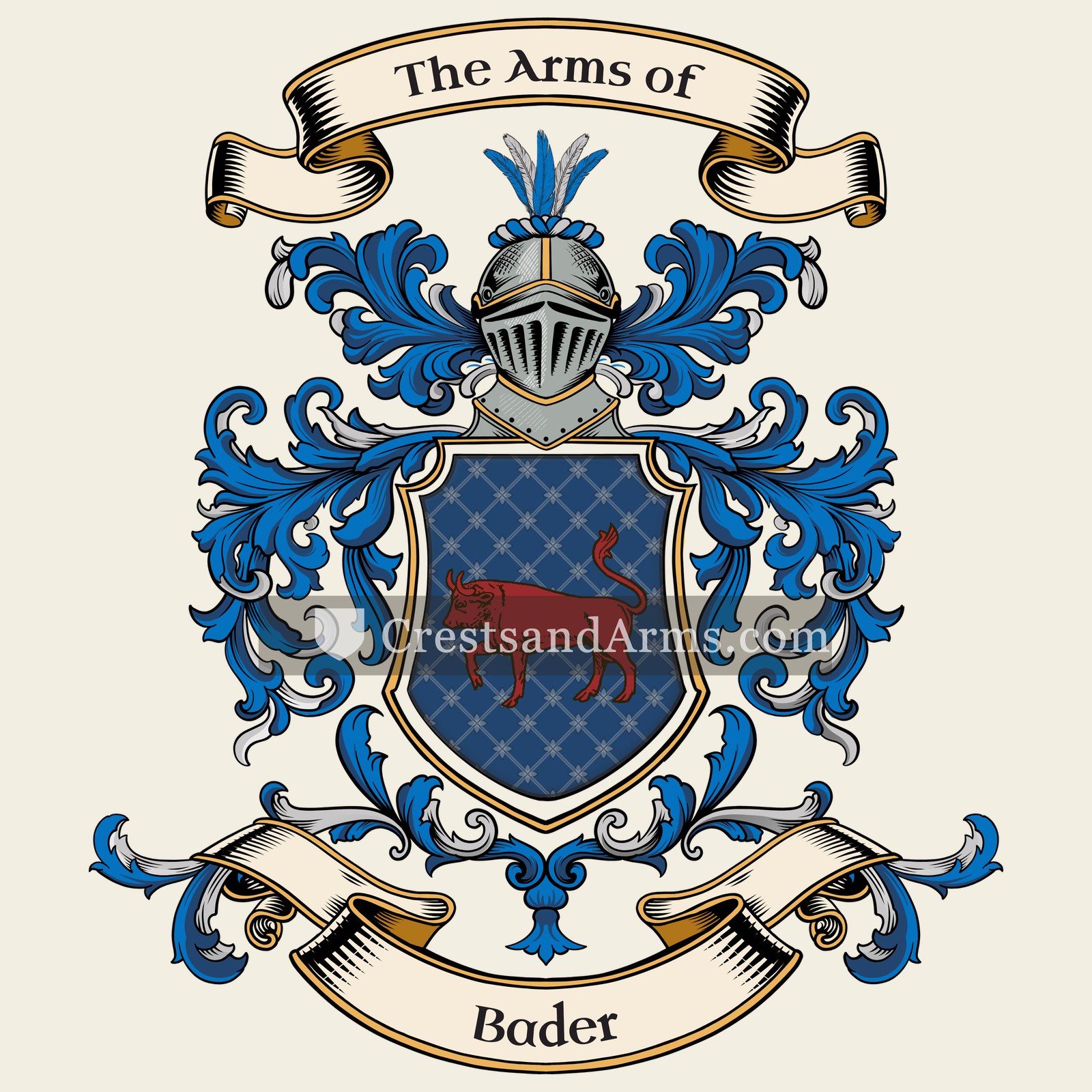


 palm treeVictory, and righteousness that flourishes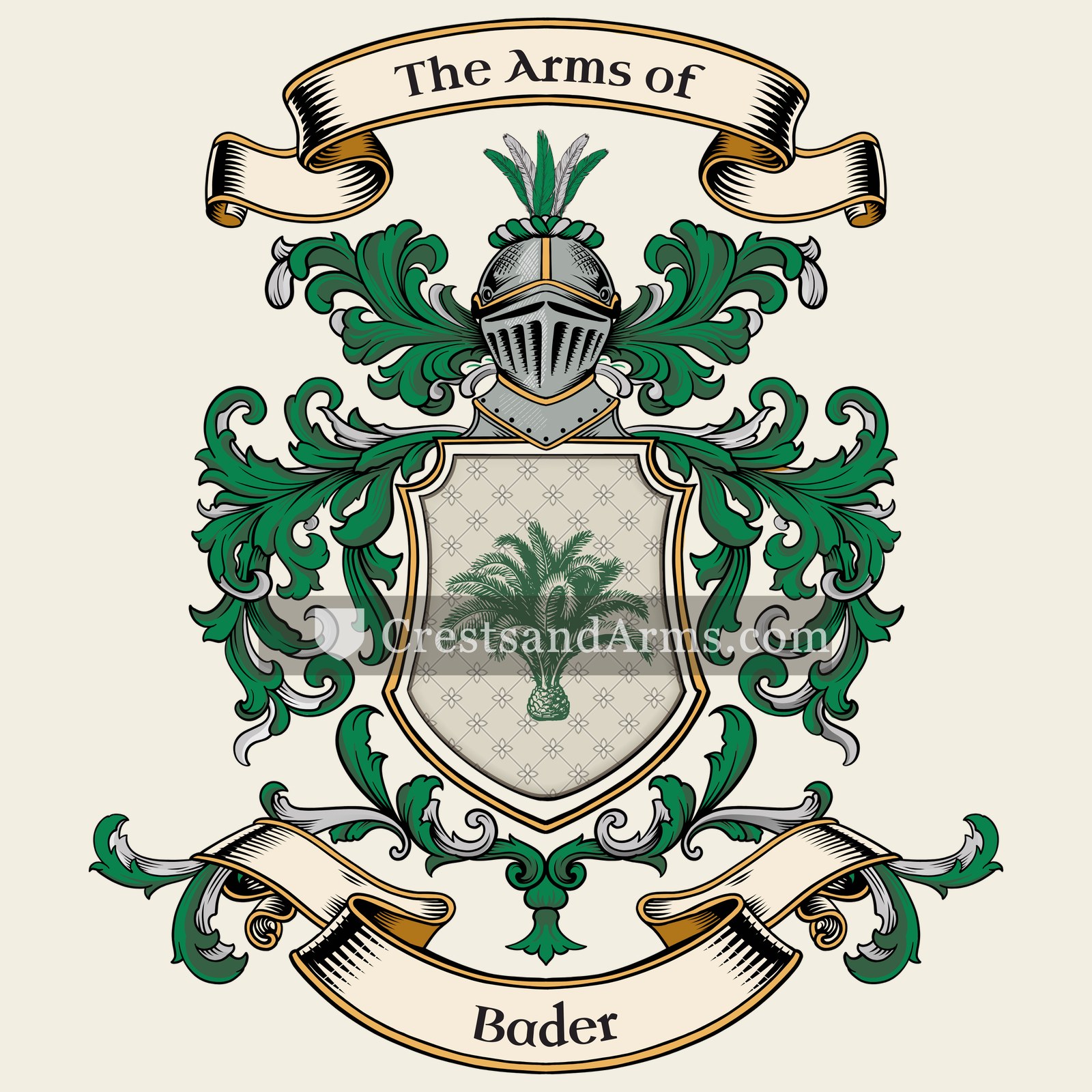


 womanGrace, and the founding of a house
 mulletThe third son, and a divine quality from above