Map of Netherlands showing where the Baer arms are recorded
The Baer arms were recorded in Guelders, c. 1815.
Guelders was river country in the east of the Netherlands, held by families whose estates sat along the water. Land there stayed in the same hands for generations, and long tenure is what fills a register of arms.
This is where the arms were entered in the register. Families often moved to other parts of the country, so the same name can turn up in more than one region.
Region
Guelders
First recorded
1815
Granting Authority for the Baer Arms
Hoge Raad van Adel
Photograph made by me · CC BY-SA 3.0
The body that granted and recorded arms in Netherlands in this period.
William I of the Netherlands
Sovereign of the period
William I of the Netherlands
1815–1840
Reigning in Netherlands when the Baer arms are first recorded.
How Arms Worked in Netherlands
In the Netherlands, coats of arms were often used by noble families and those who held specific public offices. These arms were passed down through the generations to legitimate descendants. Younger branches of a family usually kept the original design without needing to add special marks. This system ensured that the family identity remained clear and consistent over many years.
Granting authority
The Hoge Raad van Adel is the official body that regulates and manages noble titles and coats of arms in the Netherlands.
How they got arms
Families typically obtained their coats of arms through official royal grants or by proving their long-standing historical use of the symbols.
Where arms were recorded
Coats of arms are officially recorded in the registers held by the Hoge Raad van Adel, which began its work in 1814.
The family's standing
Recorded among the armigerous families of Guelders.
Origin & History of the Baer Family in Netherlands
The surname Baer is deeply rooted in the history of the Low Countries and the German-speaking regions of Europe. The name is derived from the Middle High German word for bear, which was often used as a nickname for a person who displayed great strength or a courageous spirit. By the time the family was documented in the region of Guelders in 1815, the name had already been established for generations as a common identifier in rural and urban communities alike. During this era, the area of Guelders was undergoing significant political shifts as it transitioned from Napoleonic rule into the newly formed United Kingdom of the Netherlands. Families like the Baers often held roles as local landowners or tradespeople, contributing to the social fabric of the province as it modernized. The name reflects a long tradition of naming practices that linked personal characteristics to family identity, allowing the lineage to be traced through the administrative and civil records that began to standardize during the early nineteenth century.
Related Branches & Arms
Root word
bero
A Germanic term referring to a brown-colored animal.
This name
BaerA topographic or habitational name for someone living near a bear or a house marked with a bear sign.
also spelled
Baere
Baer
van Bar
Documented Sources
J. B. Rietstap, Armorial Général, Gouda: G. B. van Goor Zonen, 1884–87
Grietje, Berendina. De geschiedenis van Gelderland. 1998
Hofstee, E. W. Nederlandse bevolkingsstatistiek. 1978
Gelders Archief, Burgerlijke Stand Gelderland, 1811-1950
Digital archive packCoat of arms PNG, gold border print PDF, vector SVG and the certificate of authenticity. Sent to your email in minutes.


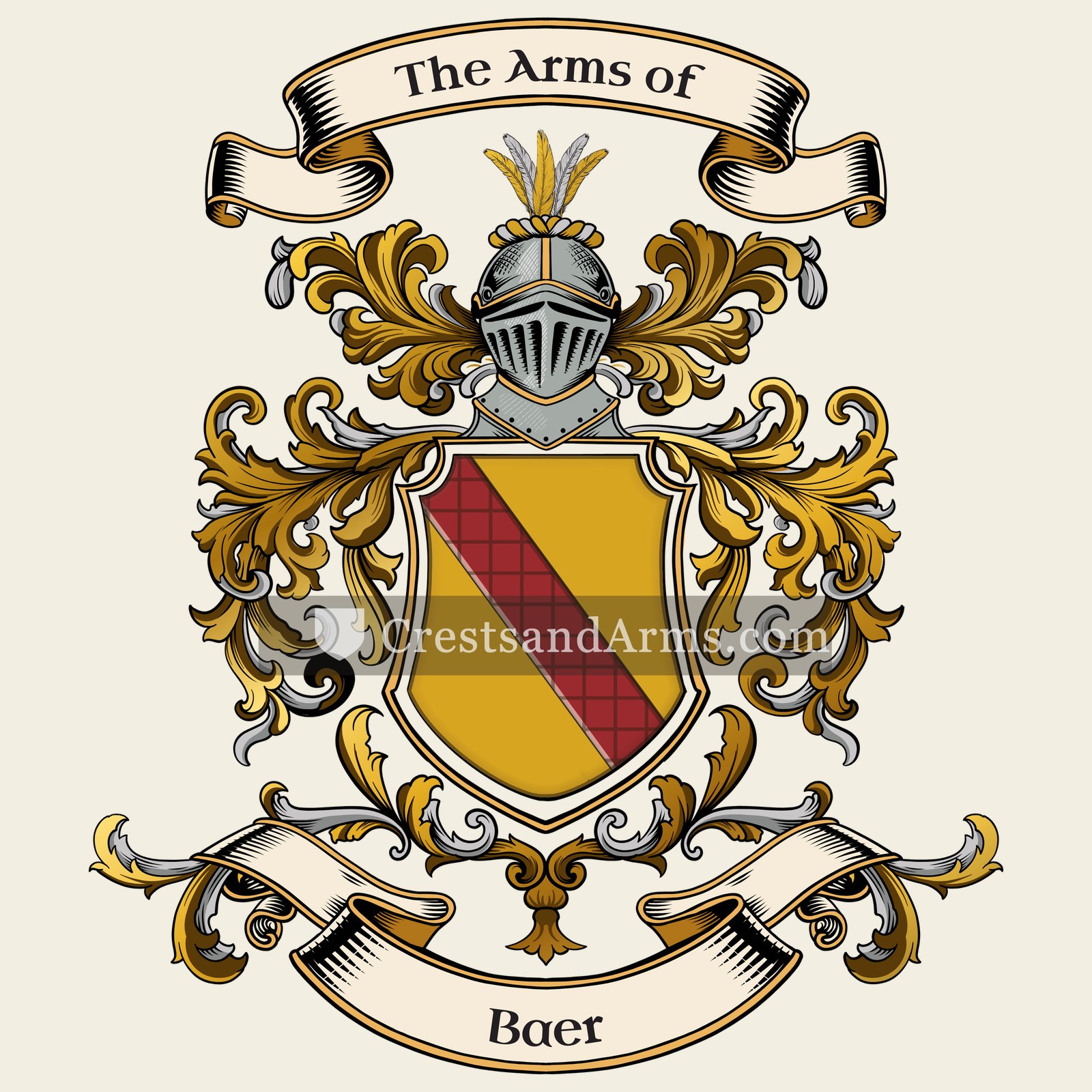
 bendDefence, and the scarf of a commander
 bendDefence, and the scarf of a commander