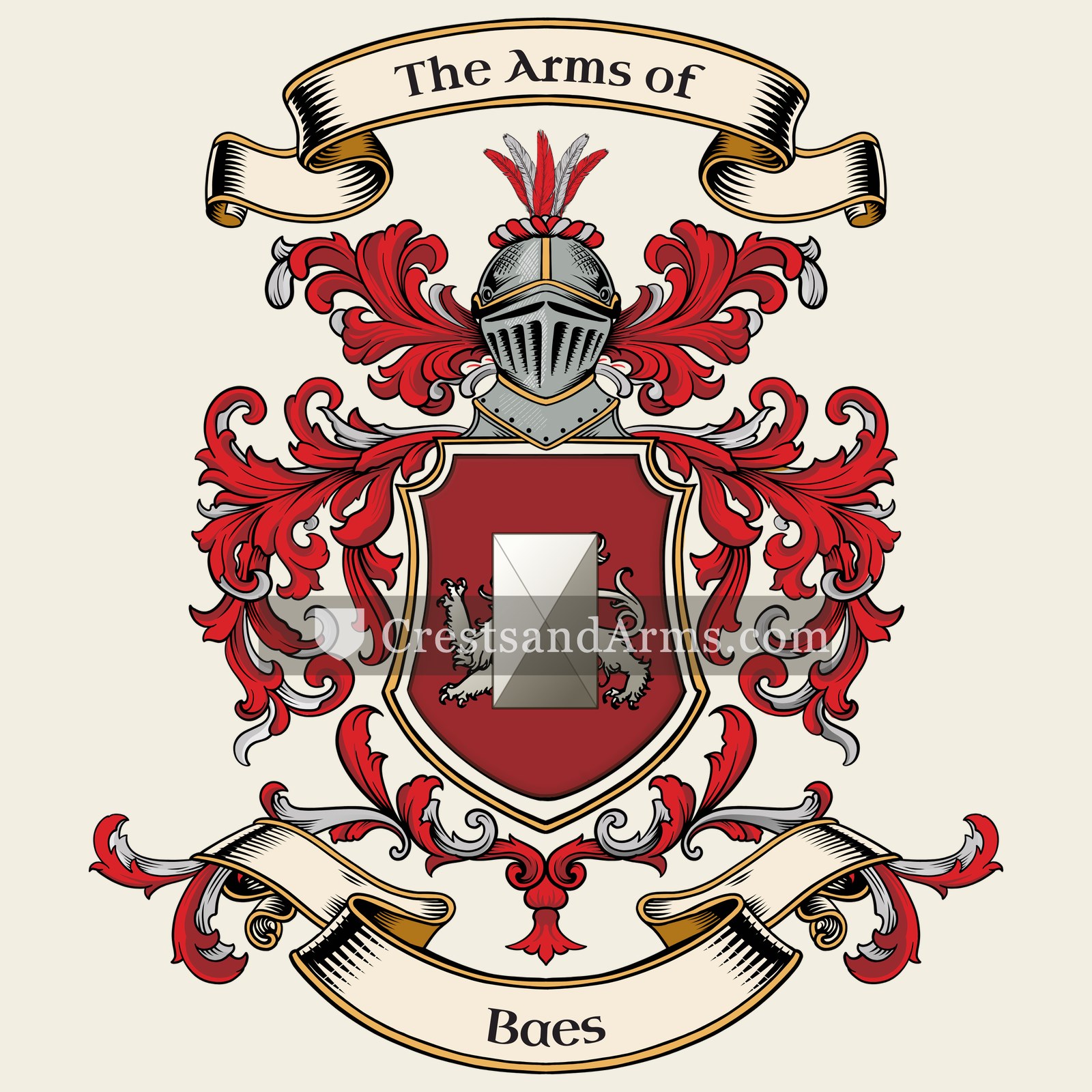
Map of France showing where the Baes arms are recorded
The Baes arms were recorded in Flandre, c. 1663.
Flandre grew rich on cloth, and its towns were among the busiest in Europe. Merchant families bought land with their profits and took arms to go with it, so trade put as many names in the registers here as land did.
This is where the arms were entered in the register. Families often moved to other parts of the country, so the same name can turn up in more than one region.
The body that granted and recorded arms in France in this period.
Louis XIV of France
Sovereign of the period
Louis XIV of France
1643–1715
Reigning in France when the Baes arms are first recorded.
How Arms Worked in France
In France, a coat of arms was a mark of honor that passed down through the male line to all legitimate descendants. Families often used the same shield without changes to show their shared heritage. If a branch wanted to stand out, they could add a small mark to their shield to show their specific place in the family tree.
Granting authority
The Juge d'armes de France acted as the official authority that regulated and verified coats of arms across the country.
How they got arms
Families typically inherited their arms from ancestors, though they could also receive them through royal grants or by proving their noble status.
Where arms were recorded
Coats of arms were officially recorded in the Armorial Général de France, which began its main collection in the year 1696.
The family's standing
Recorded among the armigerous families of Flandre.
Origin & History of the Baes Family in France
The family name Baes has deep roots in the historical region of Flanders, which straddled the border between modern-day France and Belgium during the seventeenth century. By 1663, records confirm that members of the Baes family were well-established in this area, living through a time of significant political transition as the French monarchy expanded its influence over the Flemish territories. The name itself likely originated as a descriptive term or a shortened form of a longer Germanic name, reflecting the common linguistic patterns of the Low Countries. As the French crown solidified its control over the region, families like the Baes were often caught between local Flemish traditions and the growing administrative reach of the French state. This period required families to adapt to new legal and social structures, which helped preserve their presence in the local records that historians study today. Through these early documents, we see a family that was deeply connected to the agricultural and social life of the Flemish countryside during a transformative era of European history.
Coat of Arms & Family Crest Details
Colours
Gold (Or)Means: Generosity
Historical info
Source
J. B. Rietstap, Armorial Général, Gouda: G. B. van Goor Zonen, 1884–87
Blazon (the actual original written record)
“D'or à trois fers de moulin de sa. C.: un fer de moulin de sa.”
NetherlandsHarlem, c. 1815
Digital archive packCoat of arms PNG, gold border print PDF, vector SVG and the certificate of authenticity. Sent to your email in minutes.
Map of Netherlands showing where the Baes arms are recorded
The Baes arms were recorded in Harlem, c. 1815.
This is where the arms were entered in the register. Families often moved to other parts of the country, so the same name can turn up in more than one region.
Region
Harlem
Town
Harlem
First recorded
1815
Granting Authority for the Baes Arms
Hoge Raad van Adel
Photograph made by me · CC BY-SA 3.0
The body that granted and recorded arms in Netherlands in this period.
William I of the Netherlands
Sovereign of the period
William I of the Netherlands
1815–1840
Reigning in France when the Baes arms are first recorded.
How Arms Worked in Netherlands
In the Netherlands, coats of arms were often used by noble families and those who held specific public offices. These arms were passed down through the generations to legitimate descendants. Younger branches of a family usually kept the original design without needing to add special marks. This system ensured that the family identity remained clear and consistent over many years.
Granting authority
The Hoge Raad van Adel is the official body that regulates and manages noble titles and coats of arms in the Netherlands.
How they got arms
Families typically obtained their coats of arms through official royal grants or by proving their long-standing historical use of the symbols.
Where arms were recorded
Coats of arms are officially recorded in the registers held by the Hoge Raad van Adel, which began its work in 1814.
The family's standing
Recorded among the armigerous families of Netherlands.
Origin & History of the Baes Family in Netherlands
The family name Baes has deep roots in the Low Countries, where it likely originated as a descriptive nickname derived from the Middle Dutch word "baes," meaning a master, a head of a household, or an employer. By the early 19th century, records confirm the presence of the Baes family in the city of Haarlem. During this period, Haarlem was a bustling center of trade and craftsmanship, providing a stable environment for families to establish their livelihoods. The name suggests that early ancestors may have held positions of authority or managed local workshops, reflecting the social structure of Dutch urban life at the time. As the family settled into the fabric of Haarlem, they became part of the long tradition of Dutch citizens who helped shape the city’s identity through their daily work and community involvement.
Baes Meaning & Related Branches
Root word
Bas
Derived from the Latin word bassus meaning low or short.
This name
BaesA descriptive nickname for a person of short stature or low social standing.
also spelled
Baesse
Baess
Bas
Base
Related arms
Oordtsame arms
van Oordtsimilar arms
van Oortsimilar arms
Documented Sources
J. B. Rietstap, Armorial Général, Gouda: G. B. van Goor Zonen, 1884–87
De Smet, J., De bevolking van de kasselrij Veurne in de 17e eeuw, 1962
Archives départementales du Nord, Série B, Registres des États de Flandre
Vandenbosch, M., Sociale geschiedenis van de Westhoek, 1975
Digital archive packCoat of arms PNG, gold border print PDF, vector SVG and the certificate of authenticity. Sent to your email in minutes.


 lionCourage, strength and royalty
 billetThe sealed letter, and a message delivered
 lionCourage, strength and royalty
 billetThe sealed letter, and a message delivered