Map of Ireland showing where the Bagan arms are recorded
The Bagan arms were recorded in Antrim, c. 1659.
Antrim was north-eastern Irish country settled from Scotland in the seventeenth century. The new landowners took formal grants and had them recorded, so their arms are unusually well documented.
This is where the arms were entered in the register. Families often moved to other parts of the country, so the same name can turn up in more than one region.
The body that granted and recorded arms in Ireland in this period.
How Arms Worked in Ireland
The Ulster King of Arms granted coats of arms to individuals who proved their social standing and good character. These symbols were typically inherited by all legitimate descendants of the original holder. If a family branch wanted a unique look, they could apply for a specific change to their design through the office to ensure their identity remained distinct.
Granting authority
The Ulster King of Arms acted as the official body that regulated and issued all coats of arms throughout Ireland.
How they got arms
Families obtained their arms through formal grants issued by the office after proving their eligibility and paying the required fees.
Where arms were recorded
All official grants were recorded in the registers held by the Ulster King of Arms starting from the year 1552.
The family's standing
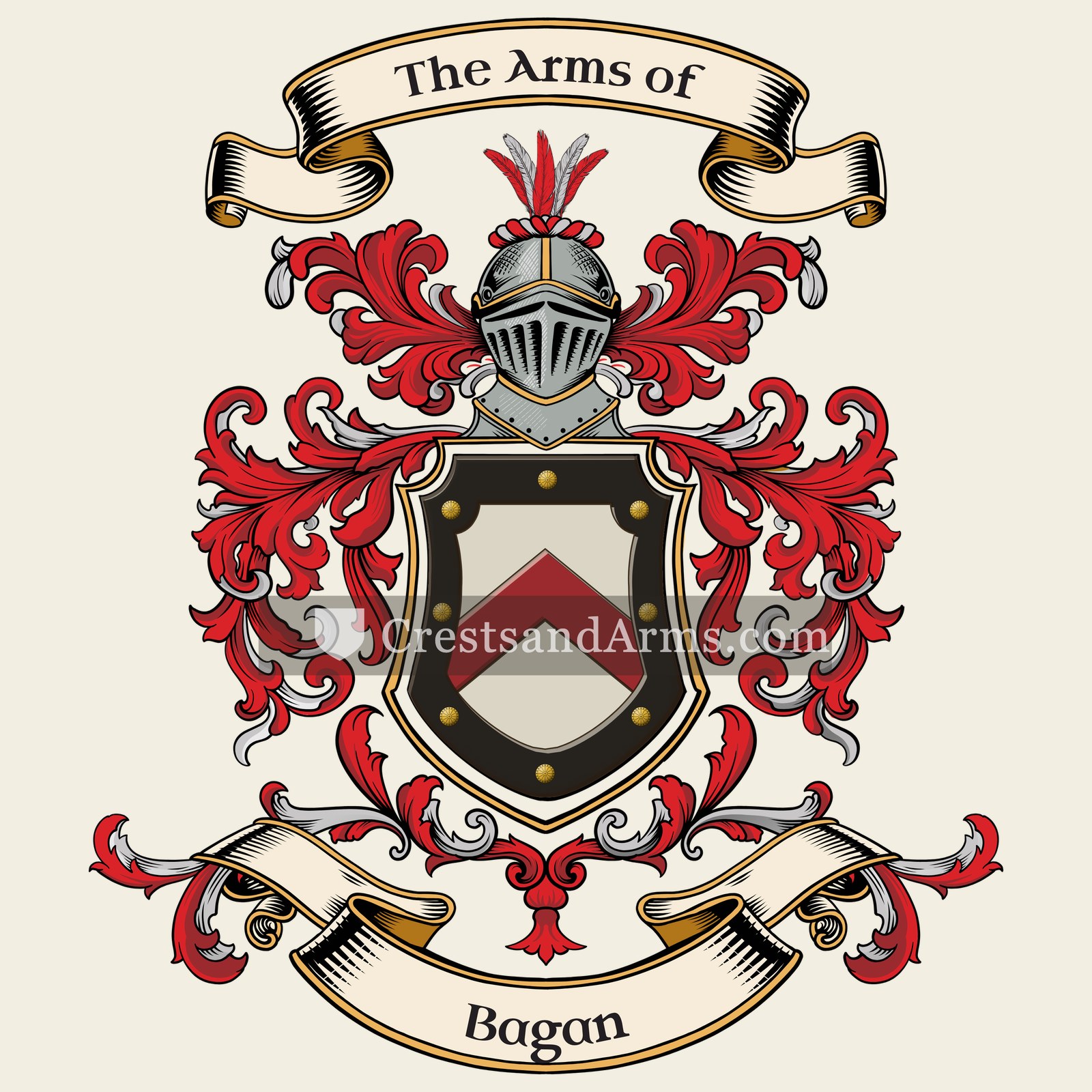
Recorded among the armigerous families of Antrim.
Origin & History of the Bagan Family in Ireland
The family name Bagan has deep roots in the northern regions of Ireland, with historical records confirming their presence in County Antrim as early as 1659. During this period, the name appeared in the Hearth Money Rolls, which were official tax documents used to track households across the country. Historians believe the name likely evolved from Gaelic origins, potentially linked to descriptive nicknames or local place names common in the Ulster province. As the family established themselves in Antrim, they became part of the complex social fabric of the seventeenth century, a time marked by significant migration and land settlement. Over the following generations, the family name persisted in the region, reflecting the resilience and continuity of those who lived through the shifting political landscapes of early modern Ireland.
Related Branches & Arms
Root word
Beag
An Irish Gaelic term meaning small or little.
This name
BaganDerived from a nickname for a person of small stature or a diminutive individual.
also spelled
Beahan
Beaghanne
Documented Sources
Sir Bernard Burke, The General Armory of England, Scotland, Ireland and Wales, London: Harrison & Sons, 1884
Pender, Séamus, A Census of Ireland, circa 1659: with supplementary material from the poll money ordinances (1660-1661), 1939
The National Archives of Ireland, Hearth Money Rolls (Antrim), 1669
Digital archive packCoat of arms PNG, gold border print PDF, vector SVG and the certificate of authenticity. Sent to your email in minutes.


 chevronProtection, and faithful service completed
 bordureA difference between branches of one family
 roundelA coin, and one who has been to the crusades
 chevronProtection, and faithful service completed
 bordureA difference between branches of one family
 roundelA coin, and one who has been to the crusades