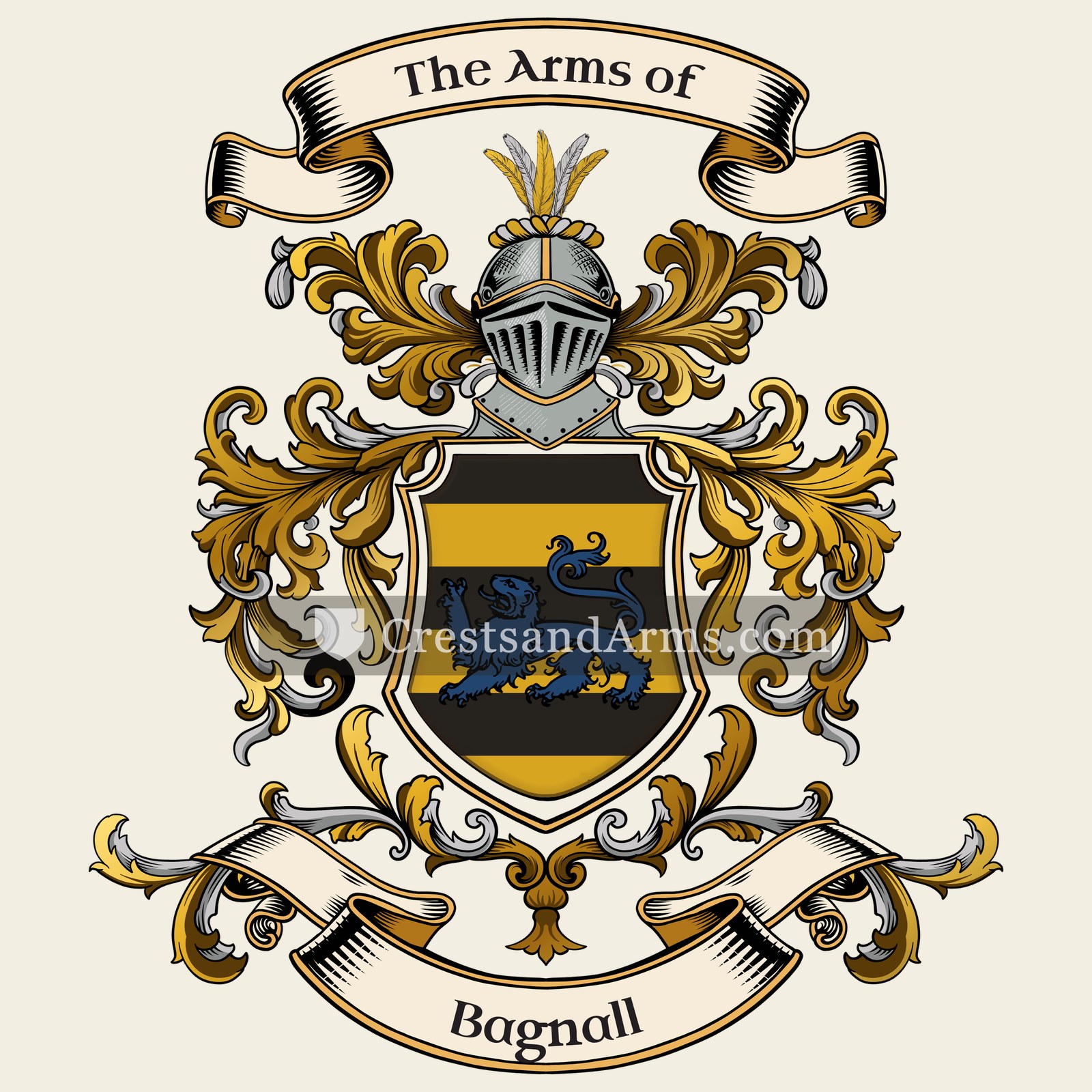
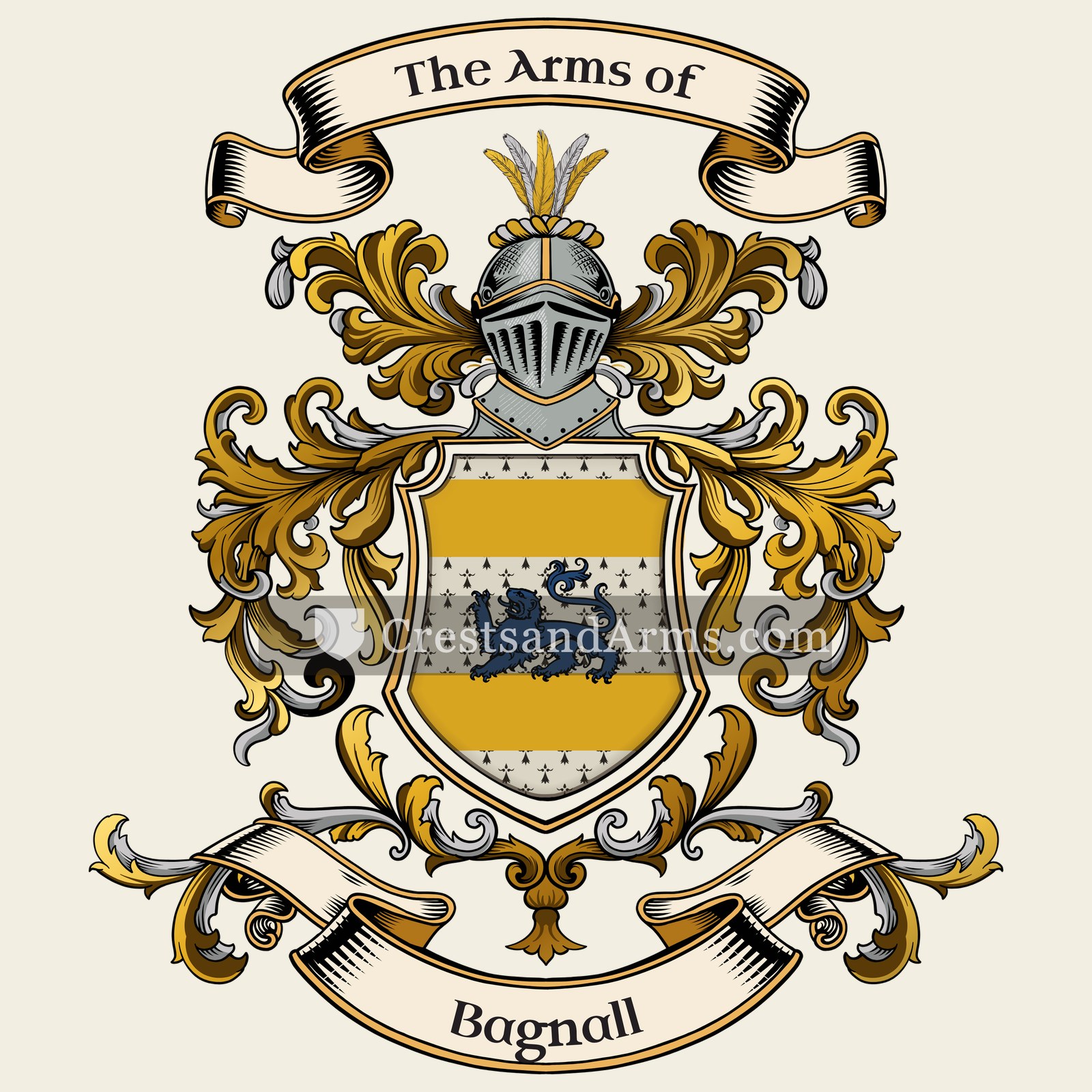
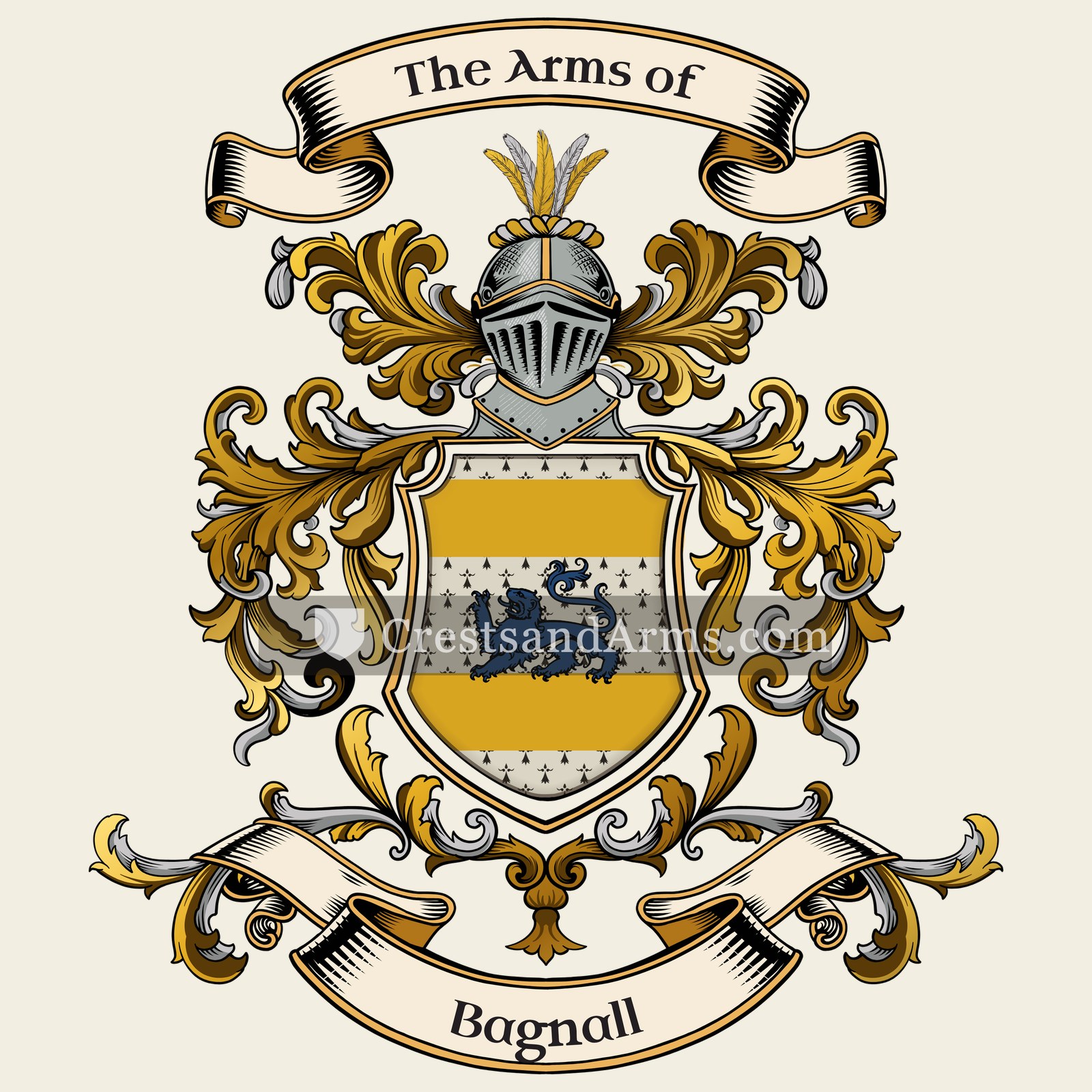
A record of documented arms, meaning and origin, researched for the Bagnall family lines. Documented in 3 countries.
Reg. 2394 · English, A–C
Coat of Arms & Family Crest Details
Symbols on this shield
lionCourage, strength and royalty
Colours
Gold (Or)Means: Generosity
Blue (Azure)Means: Loyalty and truth
Black (Sable)Means: Constancy
Historical info
Source
Sir Bernard Burke, The General Armory of England, Scotland, Ireland and Wales, London: Harrison & Sons, 1884
Blazon (the actual original written record)
“Barry of six or (another, erm.) and sa. over all a lion ramp. az”
KentKent, c. 1620
Where the Bagnall Arms Were Recorded
Kent
Map of England showing where the Bagnall arms are recorded
The Bagnall arms were recorded in Kent, c. 1620.
Kent sits between London and the short crossing to Europe, and the trade passing through made it wealthy. Merchant families bought land with that money, and it was landowners who took coats of arms.
This is where the arms were entered in the register. Families often moved to other parts of the country, so the same name can turn up in more than one region.
The body that granted and recorded arms in England in this period.
James VI and I
Sovereign of the period
James VI and I
1603–1625
Reigning in England when the Bagnall arms are first recorded.
How Arms Worked in England
English heraldry allowed arms to be shared by all legitimate descendants of the original owner. These symbols were treated as personal property that moved through the generations to all children. While the eldest son kept the original design, other family members could use the same shield without needing to change it or register their own unique versions.
Granting authority
The College of Arms in London has regulated the use of coats of arms throughout England and Wales since 1484.
How they got arms
Families typically obtained their coats of arms through a formal grant from the Crown or by proving their ancient right to them.
Where arms were recorded
All official coats of arms are recorded in the registers kept at the College of Arms, which date back to the fifteenth century.
The family's standing
Recorded among the armigerous families of Kent.
Origin & History of the Bagnall Family in England
The surname Bagnall is rooted in the landscape of medieval England, originating as a locational name derived from a specific place in Staffordshire. While the family name is tied to this northern origin, by the early 17th century, branches of the family had established themselves in the southern county of Kent. Records confirm that members of the family were living in Kent by 1620, a period defined by significant social movement and the expansion of families across the English countryside. During this era, individuals with the name were often involved in local agriculture or trade, contributing to the development of their communities as they settled into new regions. The transition of the name from its northern roots to the southern coast reflects the broader patterns of migration and family growth that shaped the English population during the early modern period.
Coat of Arms & Family Crest Details
Symbols on this shield
lionCourage, strength and royalty
Colours
ErmineMeans: Dignity
Gold (Or)Means: Generosity
Blue (Azure)Means: Loyalty and truth
Historical info
Source
Sir Bernard Burke, The General Armory of England, Scotland, Ireland and Wales, London: Harrison & Sons, 1884
Blazon (the actual original written record)
“Erm. two bars or, over all a lion ramp. az”
StaffordshireStaffordshire, c. 1647
Where the Bagnall Arms Were Recorded
Map of Wales showing where the Bagnall arms are recorded
The Bagnall arms were recorded in Staffordshire, c. 1647.
This is where the arms were entered in the register. Families often moved to other parts of the country, so the same name can turn up in more than one region.
The body that granted and recorded arms in Wales in this period.
Charles I of England
Sovereign of the period
Charles I of England
1625–1649
Reigning in England when the Bagnall arms are first recorded.
How Arms Worked in Wales
English heraldry allowed arms to be shared by all legitimate descendants of the original owner. These symbols were treated as personal property that moved through the generations to all children. While the eldest son kept the original design, other family members could use the same shield without needing to change it or register their own unique versions.
Granting authority
The College of Arms in London has regulated the use of coats of arms throughout England and Wales since 1484.
How they got arms
Families typically obtained their coats of arms through a formal grant from the Crown or by proving their ancient right to them.
Where arms were recorded
All official coats of arms are recorded in the registers kept at the College of Arms, which date back to the fifteenth century.
The family's standing
Recorded among the armigerous families of Staffordshire.
Origin & History of the Bagnall Family in Wales
The surname Bagnall originates from a specific place name in Staffordshire, England, but its history is deeply intertwined with the movement of people across the border into Wales. While the family was firmly established in Staffordshire by 1647, the name likely emerged from the Old English words for a nook or a valley belonging to a person named Bacga. As families moved westward during the medieval and early modern periods, the name traveled into the Welsh Marches and deeper into Wales. This migration was often driven by the search for land, employment in the growing iron and coal industries, or administrative roles within the border regions. Over time, the name became integrated into local Welsh communities, reflecting the fluid movement of families between the English Midlands and the rugged landscapes of Wales. This history highlights how a family name can bridge the gap between two distinct cultures through centuries of travel and settlement.
Coat of Arms & Family Crest Details
Symbols on this shield
lionCourage, strength and royalty
Colours
ErmineMeans: Dignity
Gold (Or)Means: Generosity
Blue (Azure)Means: Loyalty and truth
Historical info
Source
Sir Bernard Burke, The General Armory of England, Scotland, Ireland and Wales, London: Harrison & Sons, 1884
Blazon (the actual original written record)
“Erm. two bars or, over all a lion ramp. az”
DownDown, c. 1579
Where the Bagnall Arms Were Recorded
Down
Map of Ireland showing where the Bagnall arms are recorded
The Bagnall arms were recorded in Down, c. 1579.
Down was north-eastern Irish country settled from Scotland in the seventeenth century. The new landowners took grants and had them recorded, which is why so many Down families carry documented shields.
This is where the arms were entered in the register. Families often moved to other parts of the country, so the same name can turn up in more than one region.
The body that granted and recorded arms in Ireland in this period.
Elizabeth I of England
Sovereign of the period
Elizabeth I of England
1558–1603
Reigning in England when the Bagnall arms are first recorded.
How Arms Worked in Ireland
The Ulster King of Arms granted coats of arms to individuals who proved their social standing and good character. These symbols were typically inherited by all legitimate descendants of the original holder. If a family branch wanted a unique look, they could apply for a specific change to their design through the office to ensure their identity remained distinct.
Granting authority
The Ulster King of Arms acted as the official body that regulated and issued all coats of arms throughout Ireland.
How they got arms
Families obtained their arms through formal grants issued by the office after proving their eligibility and paying the required fees.
Where arms were recorded
All official grants were recorded in the registers held by the Ulster King of Arms starting from the year 1552.
The family's standing
Recorded among the armigerous families of Down.
Origin & History of the Bagnall Family in Ireland
The Bagnall family established a significant presence in Ireland during the late sixteenth century, primarily through their involvement in the military and administrative efforts of the English Crown. The family first rose to prominence in County Down around 1579, when Sir Nicholas Bagnall served as the Marshal of the Army in Ireland. His son, Sir Henry Bagnall, later expanded the family’s influence by securing large land grants and playing a central role in the political conflicts of the era, most notably during the Nine Years' War. Because of their high-ranking positions, the Bagnalls were deeply embedded in the colonial administration of the time. They were responsible for maintaining order and overseeing the development of estates in the northern regions of the country. Their history during this period reflects the broader pattern of English officials who settled in Ireland to manage territory and enforce royal authority during a time of intense regional instability.
Related Branches & Arms
Root word
Bagge-halh
A personal name combined with an Old English word for a nook.
This name
BagnallRefers to a person who lived in a secluded valley or corner of land.
also spelled
Bagenal
Bagnell
Bagnold
Related arms
Bagenalvariant spelling
Documented Sources
Sir Bernard Burke, The General Armory of England, Scotland, Ireland and Wales, London: Harrison & Sons, 1884
Bardsley, Charles Wareing, A Dictionary of English and Welsh Surnames, 1901
Reaney, P.H., A Dictionary of British Surnames, 1958
The National Archives, Prerogative Court of Canterbury and Related Probate Jurisdictions: Will Registers, 1620
Kent History and Library Centre, Parish Registers of Kent, 1620
Digital archive packCoat of arms PNG, gold border print PDF, vector SVG and the certificate of authenticity. Sent to your email in minutes.


 lionCourage, strength and royalty
 lionCourage, strength and royalty