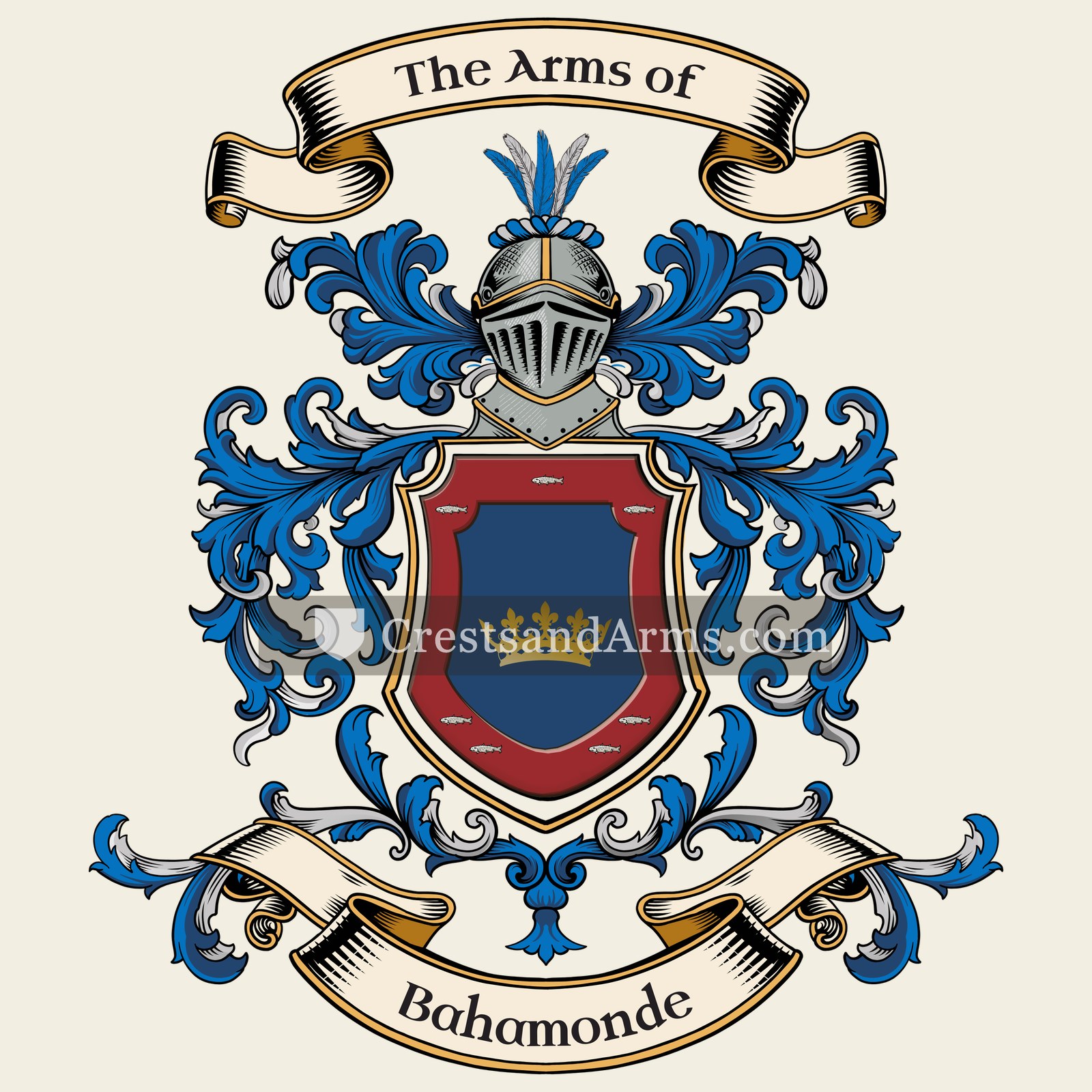
A record of documented arms, meaning and origin, researched for the Bahamonde family of Spain.
Reg. 5967 · Spanish, A–C
Coat of Arms & Family Crest Details
Symbols on this shield
crownSovereignty, authority and just reward
fishA true and generous mind, and Christian faith
Colours
Blue (Azure)Means: Loyalty and truth
Red (Gules)Means: Military strength
Gold (Or)Means: Generosity
Silver (Argent)Means: Peace and sincerity
Historical info
Source
J. B. Rietstap, Armorial Général, Gouda: G. B. van Goor Zonen, 1884–87
Blazon (the actual original written record)
“D'azur à un M d'or, surm. d'une couronne du même; à la bord. de gu., ch. de sept poissons nageants d'arg., 2 dans les cantons du chef, 2 aux flancs et 3 en p.”
Spainc. 1722
Digital archive packCoat of arms PNG, gold border print PDF, vector SVG and the certificate of authenticity. Sent to your email in minutes.
Map of Spain showing where the Bahamonde arms are recorded
The Bahamonde arms were recorded in Spain, c. 1722.
Arms such as these were typically recorded in Castile.
Castile was the heart of Spain and the source of most of its noble families. Land won in the long wars against the Moors was granted out to fighting men, and a man granted land was granted arms along with it.
This is where the arms were entered in the register. Families often moved to other parts of the country, so the same name can turn up in more than one region.
The body that granted and recorded arms in Spain in this period.
Philip V of Spain
Sovereign of the period
Philip V of Spain
1714–1724
Reigning in Spain when the Bahamonde arms are first recorded.
How Arms Worked in Spain
In Spain, a coat of arms was considered a form of property that belonged to the entire family line. These arms were passed down from a father to all his children equally. Younger branches of the family usually kept the original design without needing to add any special marks to distinguish their specific line.
Granting authority
The Cronista Rey de Armas was the official body that regulated and granted coats of arms throughout Spain.
How they got arms
Families often obtained their arms through royal grants or by proving their noble status to the official heraldic authority.
Where arms were recorded
Coats of arms were officially recorded in the registers of the Cronista Rey de Armas starting in 1496.
The family's standing
Recorded among the armigerous families of Spain.
Origin & History of the Bahamonde Family in Spain
The Bahamonde surname originated in the northwestern region of Galicia, Spain, where it was historically linked to the local nobility and landowning families. The name is derived from a combination of words in the Galician language that describe a specific type of landscape, likely referring to a broad or expansive valley. As the family grew, members began to migrate away from their ancestral roots in the north to seek new opportunities in the central Spanish heartland. By the year 1722, records confirm that the family had established a firm presence in Castile, where they integrated into the local social and administrative structures of the region. This transition from the rugged terrain of Galicia to the central plains of Castile highlights the family’s role in the broader movement of people across the Iberian Peninsula during the eighteenth century.
Bahamonde Meaning & Related Branches
Root word
Baja monte
Derived from the Spanish words for low and mountain.
This name
BahamondeRefers to a person who lived or originated from the base of a mountain.
also spelled
Bahamonda
Bahamondes
Bahamonday
Documented Sources
J. B. Rietstap, Armorial Général, Gouda: G. B. van Goor Zonen, 1884–87
Mogrobejo, Endika de. Diccionario hispano de apellidos y blasones. 1995
Digital archive packCoat of arms PNG, gold border print PDF, vector SVG and the certificate of authenticity. Sent to your email in minutes.


 crownSovereignty, authority and just reward
 fishA true and generous mind, and Christian faith
 crownSovereignty, authority and just reward
 fishA true and generous mind, and Christian faith