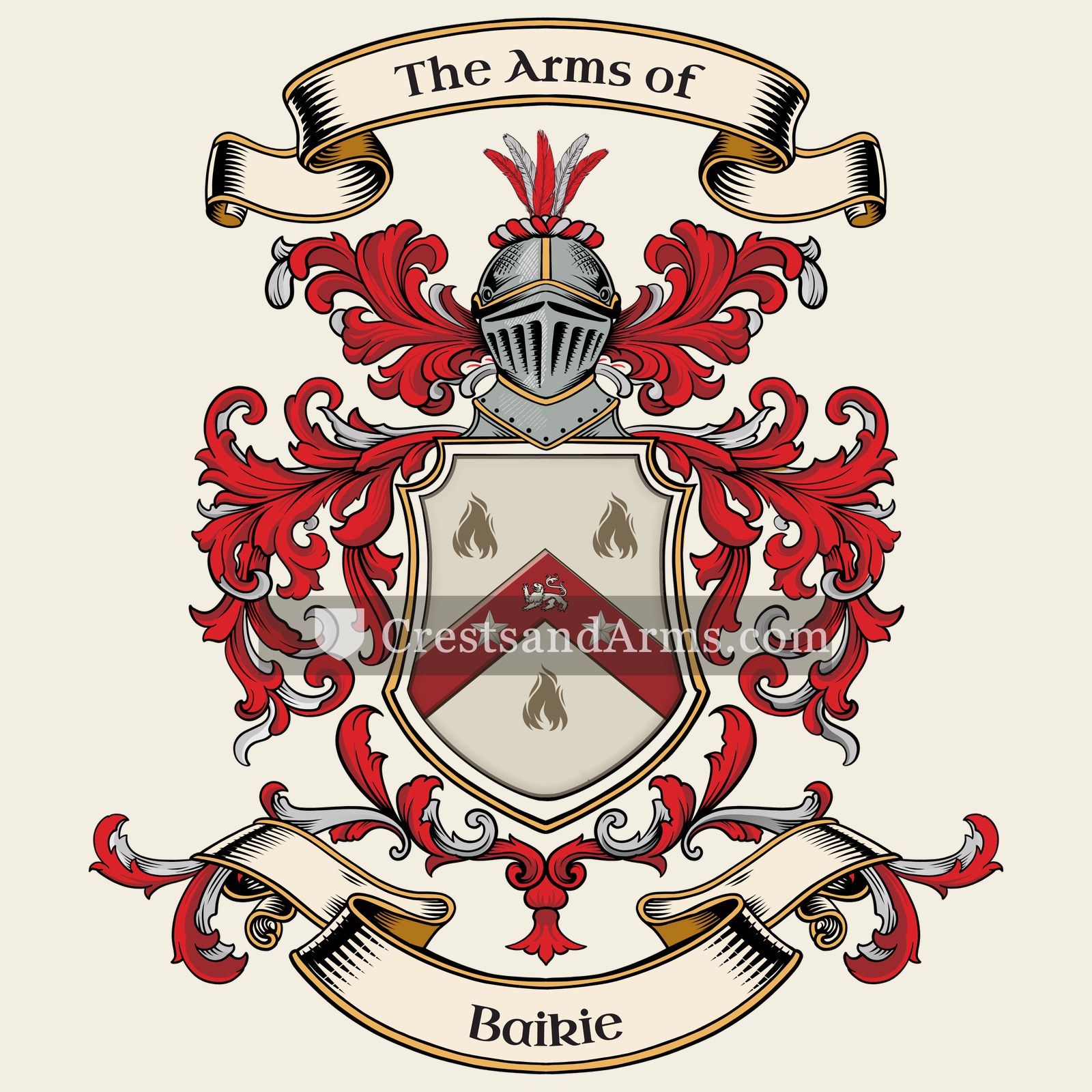
A record of documented arms, meaning and origin, researched for the Baikie family of Scotland.
Reg. 8508 · Scottish, A–C
Coat of Arms & Family Crest Details
Symbols on this shield
chevronProtection, and faithful service completed
lionCourage, strength and royalty
fireZeal and purification
mulletThe third son, and a divine quality from above
Colours
Silver (Argent)Means: Peace and sincerity
Red (Gules)Means: Military strength
Historical info
Source
Sir Bernard Burke, The General Armory of England, Scotland, Ireland and Wales, London: Harrison & Sons, 1884
Blazon (the actual original written record)
“Ar. on a chev. gu. betw. three flames of fire ppr. a lion ramp. betw. two stars of the field”
OrkneyTankerness · Orkney, c. 1748
Where the Baikie Arms Were Recorded
Orkney
Map of Scotland showing where the Baikie arms are recorded
The Baikie arms were recorded in Orkney, c. 1748.
Orkney was Norse country until it came to Scotland in 1468, and its landholders kept Norse customs after. Families held their own ground outright, and outright holding brought arms.
This is where the arms were entered in the register. Families often moved to other parts of the country, so the same name can turn up in more than one region.
The body that granted and recorded arms in Scotland in this period.
George II of Great Britain
Sovereign of the period
George II of Great Britain
1727–1760
Reigning in Scotland when the Baikie arms are first recorded.
How Arms Worked in Scotland
Scottish heraldry is unique because it treats a coat of arms as a piece of personal property protected by law. Only one person can own a specific design at any given time. When a family grows, the head keeps the original shield while other relatives must apply for their own distinct version with slight changes to prove their specific identity.
Granting authority
The Court of the Lord Lyon acts as the official body that regulates and controls all heraldic matters throughout Scotland.
How they got arms
Individuals obtain a legal right to their arms through a formal petition process that confirms their identity and family connection.
Where arms were recorded
All valid coats of arms are officially entered into the Public Register of All Arms and Bearings starting from 1672.
The family's standing
Recorded among the armigerous families of Orkney.
Origin & History of the Baikie Family in Scotland
The Baikie family name has deep roots in the rugged landscape of Orkney, where the family established a significant presence by the mid-eighteenth century. Historical records confirm that members of the Baikie family were well-integrated into the local society of the Orkney Islands by 1748, often serving as prominent landowners and active participants in the regional economy. The name itself is thought to be of Old Norse origin, which reflects the long history of Scandinavian influence throughout the northern islands of Scotland. Early family members were frequently involved in the trade and governance of the islands, helping to shape the unique cultural identity of the region. Over many generations, the family became closely tied to the history of Kirkwall, where they played a vital role in the development of the town and its surrounding agricultural lands.
Related Branches & Arms
Root word
Bakk
Old Norse term for a bank, ridge, or slope of land.
This name
BaikieDerived from a topographic feature referring to someone who lived near a riverbank or ridge.
also spelled
Baike
Documented Sources
Sir Bernard Burke, The General Armory of England, Scotland, Ireland and Wales, London: Harrison & Sons, 1884
Clouston, J. Storer, A History of Orkney, 1932
Firth, John, Reminiscences of an Orkney Parish, 1920
National Records of Scotland, Orkney Sasines, 1748
Digital archive packCoat of arms PNG, gold border print PDF, vector SVG and the certificate of authenticity. Sent to your email in minutes.


 chevronProtection, and faithful service completed
 lionCourage, strength and royalty
 fireZeal and purification
 mulletThe third son, and a divine quality from above
 chevronProtection, and faithful service completed
 lionCourage, strength and royalty
 fireZeal and purification
 mulletThe third son, and a divine quality from above