Map of England showing where the Bailey arms are recorded
The Bailey arms were recorded in Kent, c. 1620.
Kent sits between London and the short crossing to Europe, and the trade passing through made it wealthy. Merchant families bought land with that money, and it was landowners who took coats of arms.
This is where the arms were entered in the register. Families often moved to other parts of the country, so the same name can turn up in more than one region.
The body that granted and recorded arms in England in this period.
James VI and I
Sovereign of the period
James VI and I
1603–1625
Reigning in England when the Bailey arms are first recorded.
How Arms Worked in England
English heraldry allowed arms to be shared by all legitimate descendants of the original owner. These symbols were treated as personal property that moved through the generations to all children. While the eldest son kept the original design, other family members could use the same shield without needing to change it or register their own unique versions.
Granting authority
The College of Arms in London has regulated the use of coats of arms throughout England and Wales since 1484.
How they got arms
Families typically obtained their coats of arms through a formal grant from the Crown or by proving their ancient right to them.
Where arms were recorded
All official coats of arms are recorded in the registers kept at the College of Arms, which date back to the fifteenth century.
The family's standing
Recorded among the armigerous families of Kent.
Origin & History of the Bailey Family in England
The surname Bailey originated in England as an occupational name derived from the Middle English word "baili," which referred to a person who acted as a steward or an official in charge of a manor or a legal district. Because these individuals held positions of local authority, the name became common among those who managed lands for the nobility or served as court officers. By the early 17th century, families bearing this name were well-established across various English counties, including Kent. Records confirm that members of the Bailey family were present in Kent by 1620, a time when many English families were beginning to document their lineages more formally. These early ancestors were often integrated into the local community through farming, trade, or administrative work, reflecting the transition of the name from a specific job title to a hereditary family surname passed down through generations.
Meaning of the Bailey family crest colors & symbols
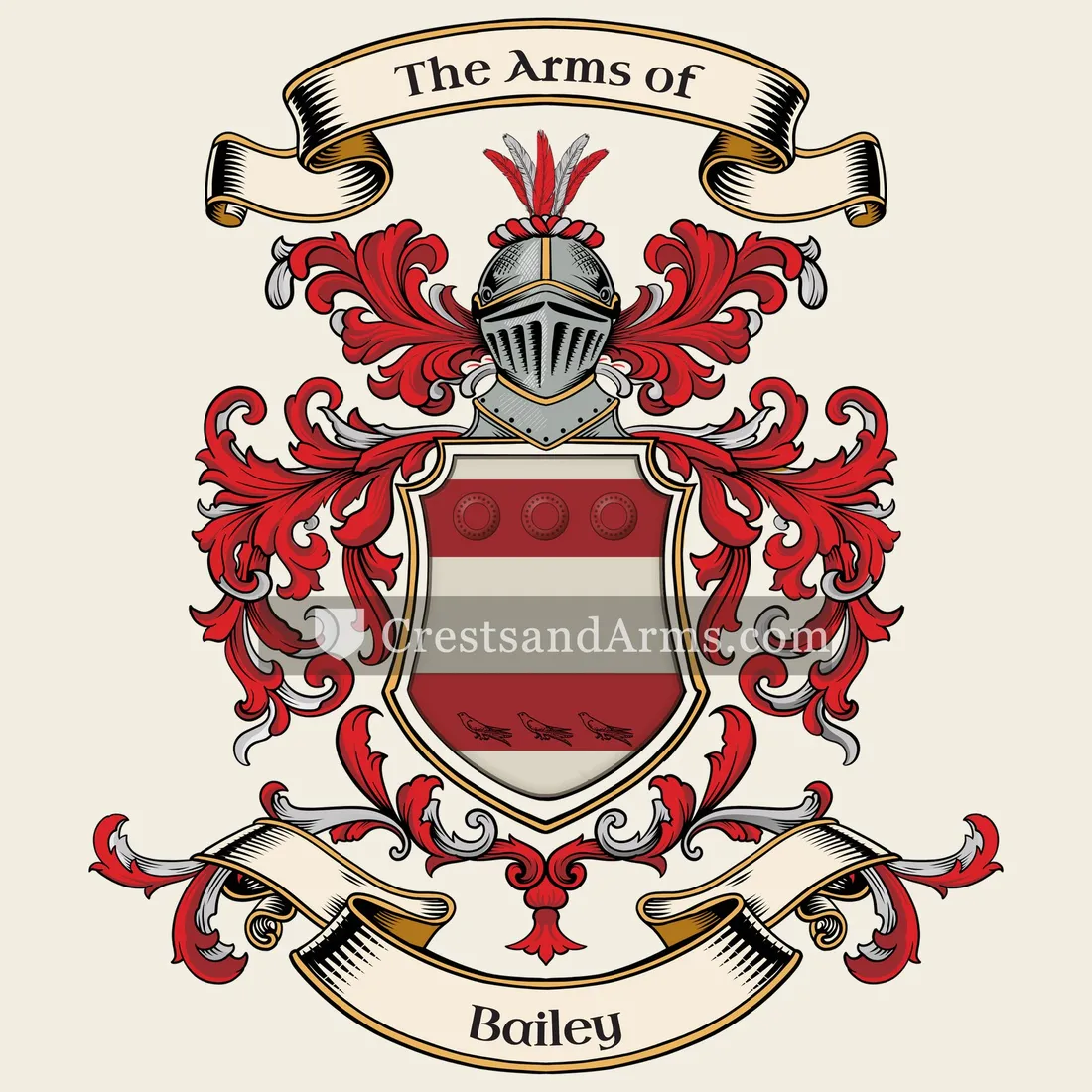
Symbols on this shield
ringFidelity, and a promise kept
martletA younger son, who must win his own land
Colours
Silver (Argent)Means: Peace and sincerity
Red (Gules)Means: Military strength
Historical info
Source
Sir Bernard Burke, The General Armory of England, Scotland, Ireland and Wales, London: Harrison & Sons, 1884
Blazon (the actual original written record)
“Ar. betw. two bars, three annulets in fesse gu. all betw. as many martlets of the last”
BreconGlanusk Park · Brecon, c. 1647
Digital archive packCoat of arms PNG, gold border print PDF, vector SVG and the certificate of authenticity. Sent to your email in minutes.
Map of Wales showing where the Bailey arms are recorded
The Bailey arms were recorded in Brecon, c. 1647.
Brecon was mid-Welsh hill country, held in small estates by families who stayed for generations. Land was worth less than in the lowlands, but holding it still brought arms.
This is where the arms were entered in the register. Families often moved to other parts of the country, so the same name can turn up in more than one region.
The body that granted and recorded arms in Wales in this period.
Charles I of England
Sovereign of the period
Charles I of England
1625–1649
Reigning in England when the Bailey arms are first recorded.
How Arms Worked in Wales
English heraldry allowed arms to be shared by all legitimate descendants of the original owner. These symbols were treated as personal property that moved through the generations to all children. While the eldest son kept the original design, other family members could use the same shield without needing to change it or register their own unique versions.
Granting authority
The College of Arms in London has regulated the use of coats of arms throughout England and Wales since 1484.
How they got arms
Families typically obtained their coats of arms through a formal grant from the Crown or by proving their ancient right to them.
Where arms were recorded
All official coats of arms are recorded in the registers kept at the College of Arms, which date back to the fifteenth century.
The family's standing
Recorded among the armigerous families of Brecon.
Origin & History of the Bailey Family in Wales
The surname Bailey originated as an occupational title derived from the Middle English word "baili," which referred to a bailiff or a person in charge of a manor or estate. While the name is often associated with England, it established a firm presence in Wales by the mid-seventeenth century. Records confirm that members of the Bailey family were living in the town of Brecon by 1647. During this period, Brecon was a significant administrative and market hub, making it a logical place for individuals with administrative or legal backgrounds to settle. As these families integrated into the local Welsh community, they transitioned from being known by their professional roles to using Bailey as a permanent hereditary surname. This shift reflects the broader trend of families adopting fixed names as they became more deeply rooted in the social and economic life of the Welsh borderlands.
Bailey Meaning & Related Branches
Root word
bailiff
An official or officer of the law.
This name
BaileyAn occupational surname for a steward, official, or person in charge of a manor.
also spelled
Baily
Baillie
Bayley
Related arms
Baillievariant spelling
Bailyvariant spelling
Baleyvariant spelling
Bayleyvariant spelling
Documented Sources
Sir Bernard Burke, The General Armory of England, Scotland, Ireland and Wales, London: Harrison & Sons, 1884
Reaney, P.H., A Dictionary of English Surnames, 1958
Bardsley, Charles Wareing, A Dictionary of English and Welsh Surnames, 1901
The National Archives, Prerogative Court of Canterbury and related Probate Jurisdictions: Will Registers, 1620
Kent History and Library Centre, Parish Registers of Kent, 1620
Digital archive packCoat of arms PNG, gold border print PDF, vector SVG and the certificate of authenticity. Sent to your email in minutes.


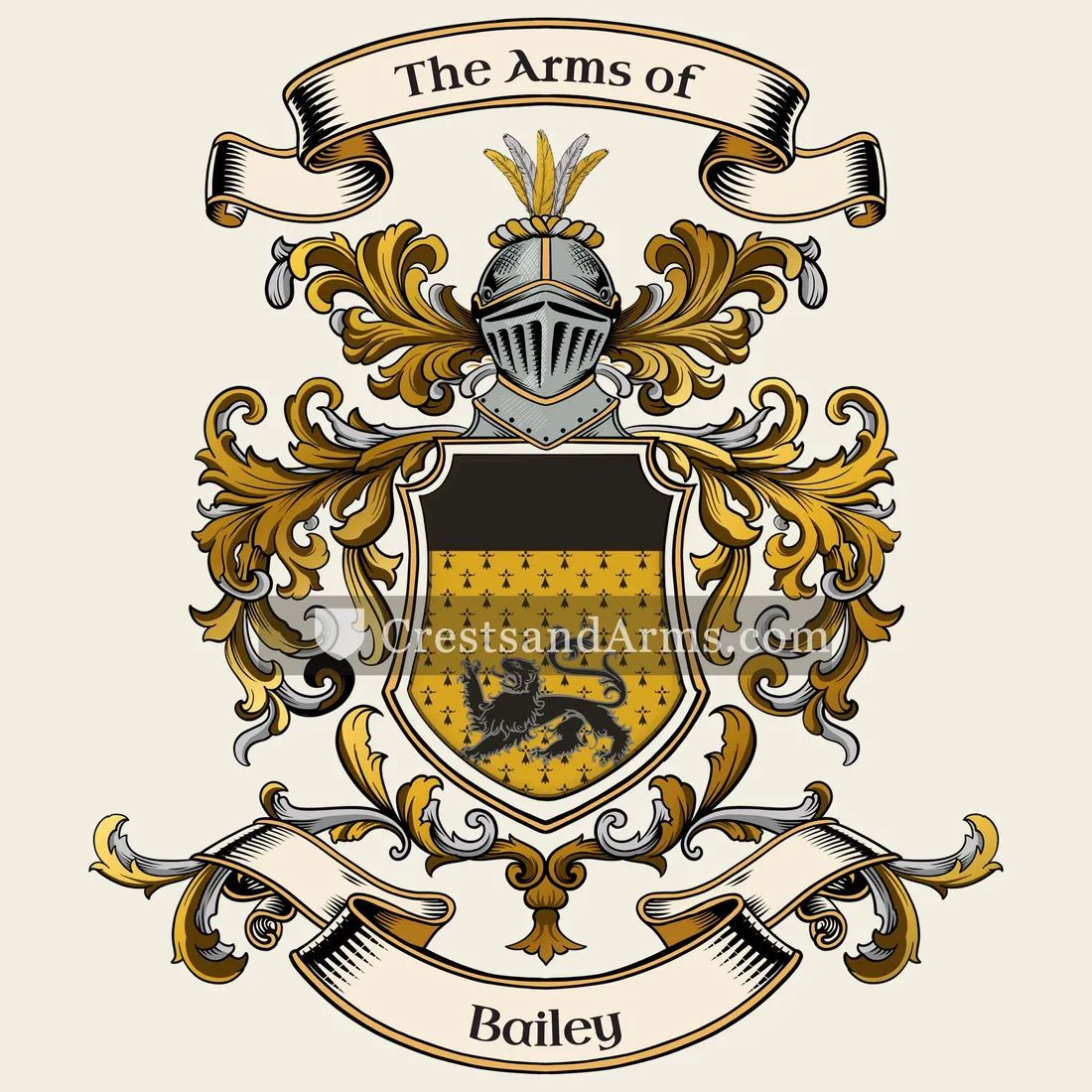
 chiefAuthority, wisdom and dominion
 lionCourage, strength and royalty
 chiefAuthority, wisdom and dominion
 lionCourage, strength and royalty


 ringFidelity, and a promise kept
 martletA younger son, who must win his own land